
Let's address the elephant in the room, once and for all
Ousmane Dembele lifted the Ballon d’Or this year and for once, few argued against the verdict.
The PSG winger produced a season of rare brilliance – 32 goals, 28 assists, dominance in Ligue 1 and decisive performances in Europe.
Even Barcelona supporters who had hoped for a fairytale win by their teenage star, Lamine Yamal, admitted Dembele’s victory was deserved.
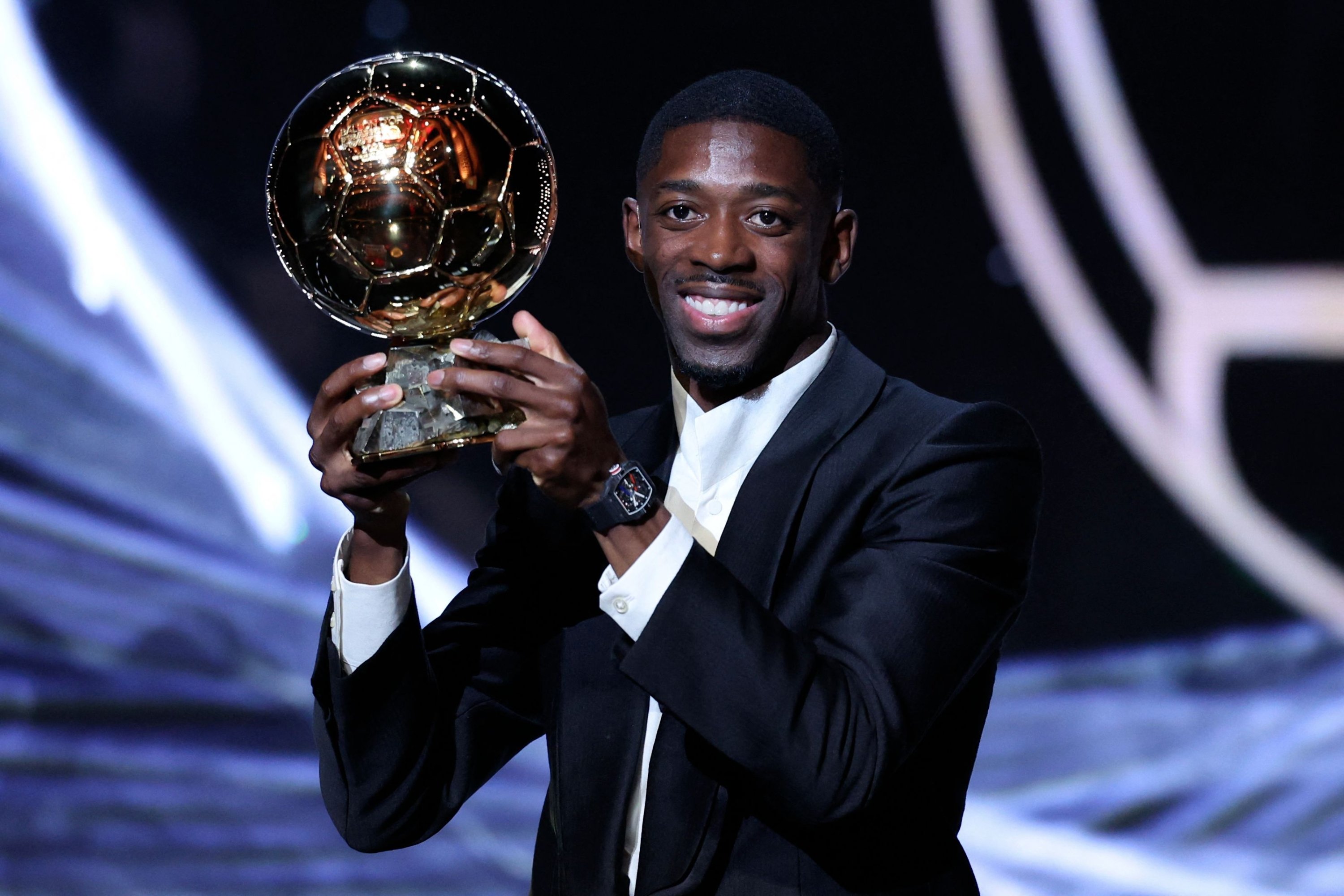
Calling it a monster season sums up the general mood.
Yet while the player himself seemed beyond debate, the award never is.
Raphinha’s surprisingly fifth-place finish, Pedri languishing down at No. 11 and Vitinha leapfrogging Mohamed Salah stirred questions about how the world’s most prestigious individual honor is decided.
Raphinha at fifth and Pedri at 11th? Is that a joke?
Every year, the same debate resurfaces: What does this golden ball really mean?
The Ballon d’Or began in 1956 with a simple purpose.
France Football magazine wanted to honor Europe’s best footballer and Stanley Matthews – elegant and enduring at Blackpool – became the inaugural winner.
At the time, only European players were eligible and voting was restricted to European journalists.
The award was low-key, a niche recognition in a game that still prided collective success over individual acclaim.
But as football grew global, the prize expanded with it.
By 1995, non-Europeans playing in Europe became eligible.
George Weah, the Liberian striker starring at AC Milan, made history as the first African to claim the honor.
It should be noted that he was not the first Black man to bag the prestigious award.
Twelve years later, the gates opened fully, welcoming all players worldwide.
From then on, the Ballon d’Or was no longer a magazine feature.
It was a cultural event, a televised gala where football’s greatest dressed in tuxedos, sponsors lined the carpets and global broadcasters cut live to living rooms across continents.
No period defined the Ballon d’Or quite like the Messi-Ronaldo decade.
From 2008 to 2017, the two icons carved up the trophy between them – Messi winning five, Ronaldo four. Each triumph wasn’t just a football award; it was ammunition in the GOAT debate.
The duopoly magnified everything: voting controversies, lobbying tactics, fan wars online.
Barcelona pointed to Messi’s artistry and records; Madrid campaigned relentlessly for Ronaldo.
In 2013, the Bernabeu was turned into a political billboard, with 45,000 Ronaldo masks handed out just as FIFA extended the voting window – a window that allowed Ronaldo’s Sweden hat trick to swing momentum away from Franck Ribery’s treble-winning season.
Ribery later admitted he felt “robbed.”
During these years, the Ballon d’Or became less about footballing purity and more about theater – the Oscars of the sport, where the narrative mattered as much as the numbers.
The mechanics of the award have never stood still.
In 2010, FIFA and France Football merged their awards, creating the FIFA Ballon d’Or.
Captains, coaches and journalists voted.
On paper, it was inclusive; in practice, it blurred the lines.
Stars voted for teammates.
In 2014, Messi put Di Maria, Mascherano and Iniesta on his ballot.
Ronaldo chose Ramos, Bale and Benzema.
Coaches followed suit, making the process feel like a popularity contest rather than a meritocracy.
By 2016, FIFA and France Football split, restoring voting rights solely to journalists, one per country.
But that presented its own problems.
A single ballot from Sri Lanka or Albania carried as much weight as one from Spain, Brazil, or England.
In 2024, when Vinicius Jr. lost out, Real Madrid president Florentino Perez, who is a "crybaby" when things don't go his way, openly questioned the credibility of votes from “countries we do not know.”
The backlash was swift. Namibia’s representative responded: “If I were from a major football nation and disagreed with him, would my vote suddenly count?”
It highlighted the paradox: inclusivity widens perspective, but it also fuels accusations of imbalance.
Every few years, the list of submitted ballots sparks ridicule.
A Sri Lankan journalist once voted Leonardo Bonucci as the best player in the world.
Roy Hodgson, while England coach, put Javier Mascherano at the top of his ballot.
In 2019, Italy’s representative ranked Frenkie de Jong as second-best on the planet.
Such anomalies might be dismissed as personal opinion – but when they help decide the sport’s most significant individual award, they become fuel for critics who see the Ballon d’Or as broken.
By 2024, UEFA stepped in as co-organizer, introducing a points-based system meant to add transparency.
Each vote now translates into fixed points, tallied into a final ranking.
On paper, it was progress. In reality, controversy remained – because no matter the math, the definition of “best” has never been fixed.
Sometimes it means World Cup dominance: Zidane in 1998, Ronaldo Nazario in 2002, Cannavaro in 2006, Messi in 2022.
Other times, it rewards Champions League brilliance, like Ronaldo’s 2014 season or Benzema’s 2022.
And sometimes, it feels like sheer narrative – Modric in 2018, when Croatia’s run to the final trumped both World Cup winners and Champions League kings.
The lesson? There is no permanent standard, only shifting criteria that bend to the mood of the moment.
One thing is certain: attackers dominate.
Lev Yashin, in 1963, remains the only goalkeeper to win.
Defenders rarely come close.
Even Oliver Kahn, after saving three penalties to win Bayern the 2001 Champions League, was passed over for Michael Owen.
Manuel Neuer, despite finishing third in the voting for the award behind Cristiano Ronaldo and Lionel Messi in 2014, in actuality never stood a chance.
Fabio Cannavaro’s win in 2006 remains a rare exception – a defender lifted by the narrative of Italy’s World Cup triumph.
The bias toward attacking flair is so entrenched that players like Sergio Busquets, Philipp Lahm, or Neuer – pillars of their teams – never got a serious look-in.
As Michael Owen once put it: “It’s easier to attack than defend. If you give me weeks, I can knock down a house. Building one? That takes forever.”
What was once a symbolic award has become a commercial commodity.
Clubs lobby hard. Sponsors crave winners.
Agents often slip Ballon d’Or clauses into contracts, where a podium finish can unlock six-figure bonuses.
Barcelona fans remember well when Dembele’s agent pushed for a pay rise, touting him as a “future Ballon d’Or winner.”
The irony? He’s lifted the prize before Kylian Mbappe. Well, good for him.
For brands like Adidas and Nike, a Ballon d’Or win is worth more than the trophy itself.
Clubs have mastered the campaign.
In 2021, PSG allegedly lobbied for Messi with France Football insiders, amid reports of perks and tickets.
Real Madrid, upon Vinicius Jr.’s loss, boycotted the ceremony entirely, using absence as a political message.
Bayern Munich, in contrast, have historically downplayed individual accolades, which may explain why no Bayern player has won since Karl-Heinz Rummenigge in 1981, despite decades of dominance.
And then there’s the question of geography.
Sadio Mane once called it “sad” that no African has won since Weah.
Mohamed Salah’s numbers in recent years rival Ballon d’Or winners – but his nationality, club and lack of institutional campaigning have left him overlooked.
For all the scandals, campaigns and contradictions, the Ballon d’Or remains football’s most cherished prize.
Players dream of lifting it from boyhood. Fans measure greatness by it.
Clubs parade it like silverware.
And yet, the truth persists: the Ballon d’Or crowns not just the “best,” but the narratives that surround them.
Politics, perception and power.



