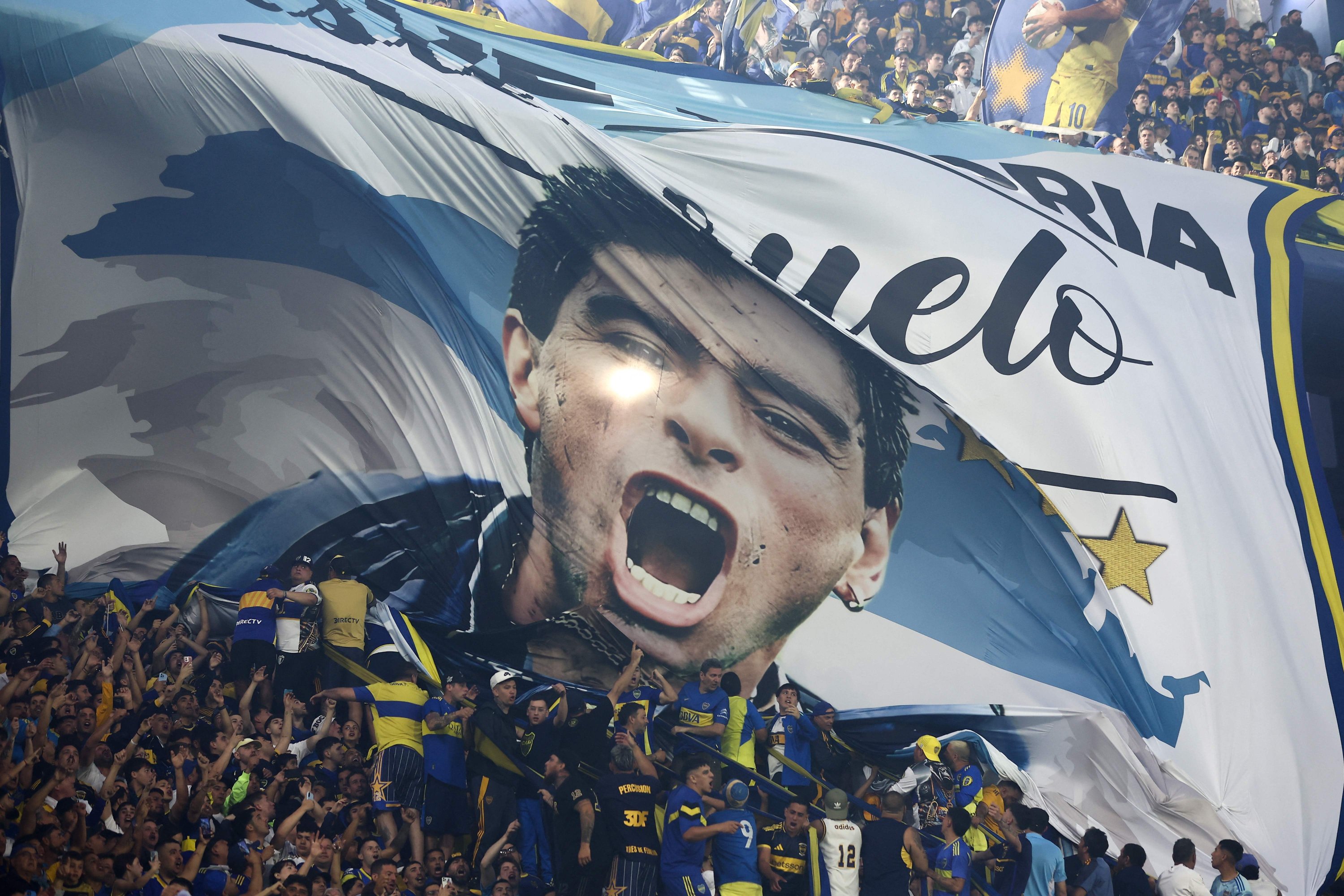
Diego Armando Maradona, the Argentine genius whose brilliance reshaped football’s language and lore, is remembered on the fifth anniversary of his death – a legacy still pulsing through stadiums, streets and stories around the world.
Maradona’s rise was as improbable as it was electrifying.
Born on Oct. 30, 1960, into a modest Buenos Aires household, his talent was discovered at age 8 and quickly outgrew every neighbourhood boundary.
Estrella Roja led to Argentinos Juniors, where he signed professionally before turning 16.
Boca Juniors soon came calling, and by 1981 he had his first major title – a launchpad to Europe.
Barcelona unveiled him in 1982 with the expectations reserved for prodigies.
In two seasons he scored 38 goals in 58 matches, winning the Copa del Rey and Spanish Super Cup.
But his legend would be forged in southern Italy.
When Maradona arrived in Naples in 1984, the city embraced him as both savior and symbol.
Across 258 matches, he scored 115 goals, but his real value lived in the transformation he inspired: a once-overlooked club suddenly standing toe to toe with Italy’s giants.
Two Serie A titles, a UEFA Cup, an Italian Cup and a Super Cup followed – the brightest era in Napoli’s history.
After spells with Sevilla, Newell’s Old Boys and a final return to Boca Juniors, he retired in 1997, leaving behind moments no statistic could fully measure.
Maradona ascended to near-mythic status during the 1986 World Cup in Mexico.
His quarterfinal masterpiece against England became football scripture: first, “the Hand of God,” provoking debate that still ripples; then, a slalom through five defenders over 60 mesmeric meters – voted the “Goal of the Century” by FIFA in 2002.
Argentina went on to beat West Germany 3-2 in the final, with Maradona orchestrating the triumph. He finished his international career with 91 appearances and 34 goals.
His brilliance was matched by turbulence.
In 1991 he served a 15-month ban for drug use and was expelled from the 1994 World Cup for a positive test.
Addiction led to grave health crises in 2004 and 2007.
Long-standing tax debts with Italian authorities – more than 37 million euros ($43 million) dating back to his Napoli days – followed him for years.
Maradona stepped into coaching but never reached the peaks he once dominated with a ball at his feet.
After early posts at Textil Mandiyu and Racing, he took charge of Argentina in 2008, only to be dismissed after a heavy 4-0 loss to Germany in the 2010 World Cup quarterfinals.
His temper remained as famous as his touch.
Following a World Cup qualifying win over Uruguay, his outburst at reporters earned him a two-month FIFA ban.
He later coached Al-Wasl, Fujairah, Dorados de Sinaloa and Gimnasia de La Plata, each spell fleeting, none capable of matching the grandeur of his playing days.
Maradona died of a heart attack on Nov. 25, 2020, sending the football world into collective mourning.
Two years later, in the first World Cup staged without him, Argentina – with Lionel Messi carrying the nation’s hopes – lifted the 2022 trophy after a dramatic final against France.
In many ways, it felt like a tribute written in the language Maradona loved most.