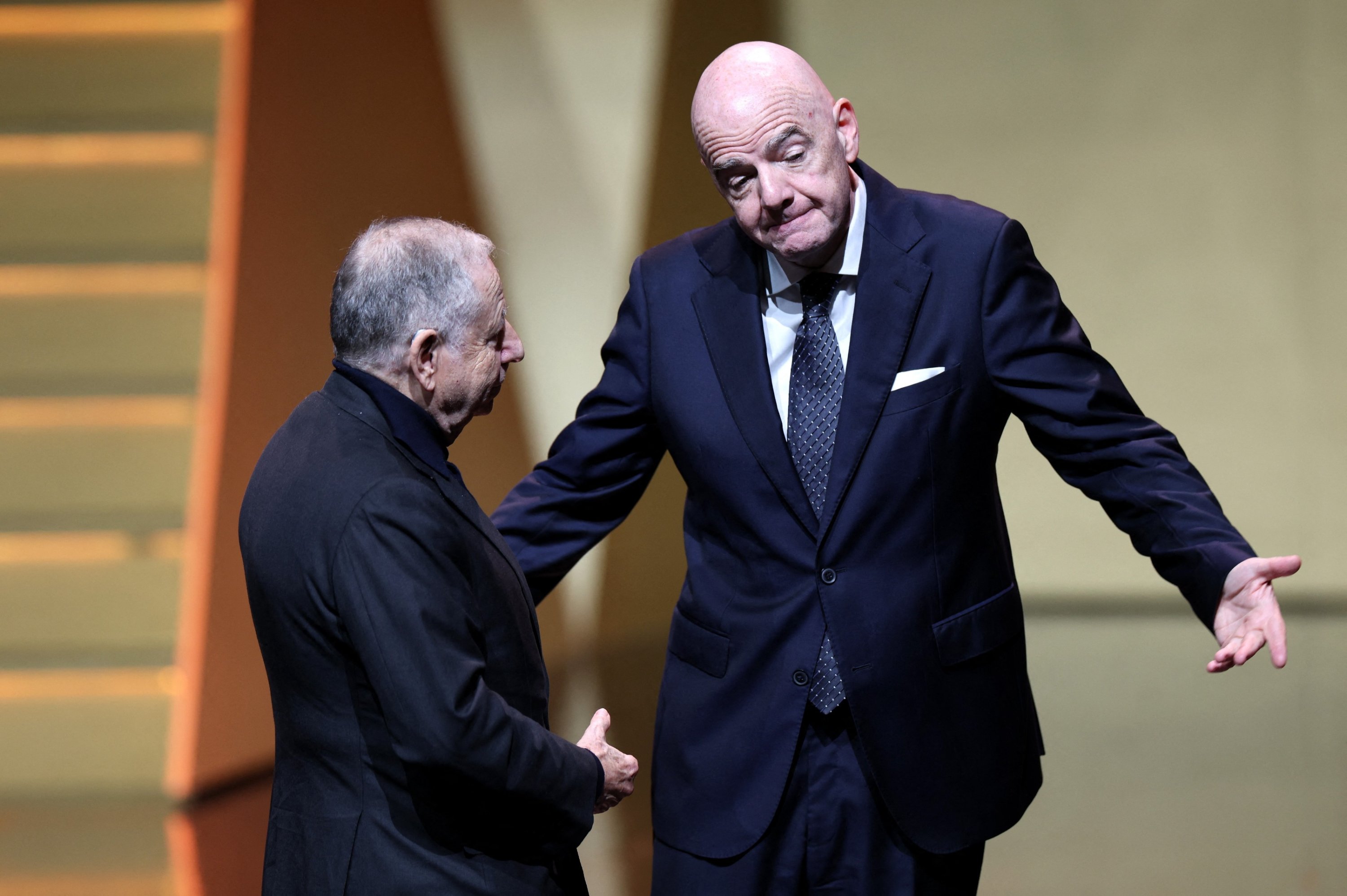
Gianni Infantino will face his first contested election since becoming FIFA president in 2016, with French Football Federation chief Philippe Diallo and Japan's Kohzo Tashima challenging his bid for a fourth term.
FIFA confirmed Thursday that it had received three nominations for the March 18, 2027, election, which will take place at the governing body's 77th Congress in Rabat, Morocco. All 211 member associations are entitled to vote.
Infantino, who succeeded Sepp Blatter following a corruption scandal that rocked FIFA, is seeking to remain in office until 2031. He was re-elected unopposed in 2019 and 2023.
The three nominations have been forwarded to FIFA's electoral committee for eligibility and integrity checks. The approved candidates will be announced no later than Feb. 18, 2027.
Diallo, 63, has led the French Football Federation since 2023. He previously held several positions in French football administration and FIFA's dispute-resolution structures.
His candidacy has received backing from European national associations represented on UEFA's Executive Committee and the FIFA Council.
UEFA described European support for the Frenchman as unanimous, while the French federation's Executive Committee also unanimously approved his nomination.
Diallo has called for greater accountability and a different approach to FIFA's governance.
"It was important that another voice can carry another vision, more respectful toward what we love in football," he said.
Tashima, 68, is the honorary president of the Japan Football Association (JFA), which he led from 2016 to 2024. A former Japanese international and coach, he also served as president of the East Asian Football Federation.
He joined FIFA's executive committee in 2015, before it was replaced by the FIFA Council a year later. His candidacy makes him the first Japanese contender for the presidency.
Tashima has made transparency and institutional reform central to his campaign, arguing that FIFA needs to rebuild trust.
"Drawing on this experience, I intend to strengthen governance and promote highly transparent management at FIFA," he said in a statement.
Speaking Friday, he indicated that he would be willing to work with Diallo to challenge Infantino, although the two had not yet held direct discussions.
"We do share some moral or ethical positions, so he's a great person to team up with," Tashima said. "I'm not looking at Diallo as opposition. I just want to change FIFA."
He added that he was not considering withdrawing from the race.
Former Switzerland captain Ramon Vega, who had also expressed interest in running, was not among the three nominees confirmed by FIFA.
Candidates must secure written backing from at least five member associations and demonstrate active involvement in football for at least two of the previous five years.
FIFA's presidential election is conducted by secret ballot, with each of its 211 member associations receiving one vote, regardless of its size or financial influence.
With three candidates, a two-thirds majority of associations present and eligible to vote is required in the first round. If all 211 participate, the winner would need at least 141 votes.
If nobody reaches that threshold, the candidate with the fewest votes is eliminated in subsequent rounds until two remain. A simple majority then determines the winner.
In a two-candidate contest, more than 50% of valid votes is sufficient. If all associations cast valid ballots, 106 votes would secure victory.
An unofficial tally by The Associated Press, based on public endorsements before the nomination deadline, puts Infantino's support at 105 associations. However, public backing does not guarantee votes because the final decision is made by secret ballot.
Despite criticism of his leadership, Infantino continues to enjoy considerable backing, particularly in Africa and Asia.
During his presidency, he has overseen the expansion of the men's World Cup from 32 to 48 teams and the introduction of a 32-team Club World Cup.
However, his leadership has faced mounting scrutiny over governance and transparency, particularly following his abandoned FIFA Forward Enterprise (FFE) proposal.
Unveiled in July 2026, the plan sought to transfer FIFA's commercial and tournament operations to a new subsidiary controlled by the governing body, allowing private investors to acquire minority stakes in the business.
The proposal faced opposition from UEFA, the Asian Football Confederation (AFC) and CONCACAF over transparency, governance and a lack of consultation.
Infantino withdrew it on July 31 and later apologized for mistakes in how it had been handled, confirming in October that it had been permanently abandoned.
Tashima has criticized the proposal, arguing that FIFA's commercial revenue belongs to the organization rather than its president.
Meanwhile, Infantino has secured important endorsements. Confederation of African Football President Patrice Motsepe said all 54 African member associations supported his re-election.
AFC President Sheikh Salman bin Ibrahim Al-Khalifa also endorsed him in October.
The Union of Arab Football Associations, representing 22 national associations across Africa and Asia, announced its support Thursday, citing Infantino's contribution to the development of football.
Africa and Asia collectively account for 100 of FIFA's 211 votes, giving their support considerable weight. UEFA, meanwhile, has backed Diallo.
Although the endorsements suggest an advantage for the incumbent, the secret ballot leaves room for individual associations to change their positions.