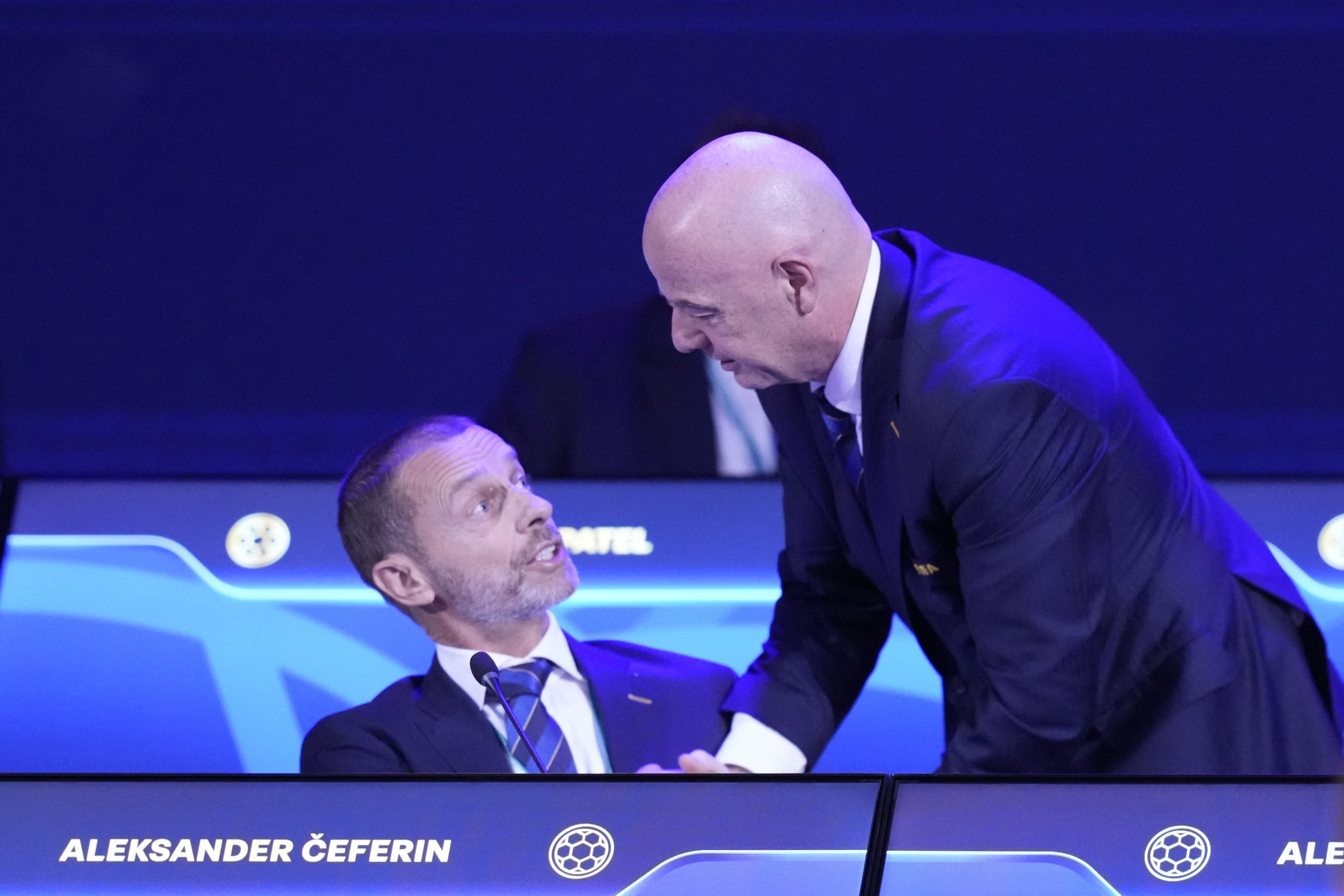
UEFA has asked FIFA to answer 42 questions about President Gianni Infantino’s leadership, including the abandoned FIFA Forward Enterprise (FFE) project and the FIFA Peace Prize, by Nov. 2, according to British media reports Monday.
UEFA General Secretary Theodore Theodoridis sent the letter to his FIFA counterpart, Mattias Grafstrom, seeking responses on 12 topics, Sky Sports and other British outlets reported. Reuters has not seen a copy of the letter, and neither organization immediately responded to requests for comment.
“These questions require answers now,” Theodoridis wrote, according to the reports.
“They cannot be deferred until the next meeting of the FIFA Council, nor can future governance reforms substitute for scrutiny of decisions already taken and accountability for them.”
The move escalates pressure on Infantino after UEFA emerged as a leading critic of his proposed FFE initiative, which would have established a company to manage the commercial interests of FIFA competitions, including the World Cup, while allowing private investors to acquire a minority stake.
The plan, reportedly valued at $4.2 billion, was subsequently abandoned. Infantino apologized to FIFA’s 37-member governing council in Zurich last week for mistakes in putting it together and invited members to submit questions about his leadership in writing. He said he would respond at the council’s next meeting on Dec. 16 in Doha, Qatar.
UEFA’s demand for answers before Nov. 2 signals that European football officials are unwilling to wait until that meeting to scrutinize decisions made under Infantino’s leadership.
The controversy comes as the 56-year-old prepares to seek a fourth term as FIFA president in March 2027. The deadline for rival candidates to submit nominations is Nov. 18.
Infantino’s reelection campaign is expected to turn its attention to Asia this week, with a meeting scheduled for Wednesday in Tokyo with officials from the Asian Football Confederation (AFC).
The gathering will take place at a five-star hotel with limited media access, according to reports.
AFC President Sheikh Salman bin Ibrahim Al Khalifa initially opposed Infantino’s proposal to establish a subsidiary to manage World Cup commercial interests, but may have moved closer to the FIFA president, The Athletic has reported.
The Asian confederation joined criticism of the abandoned plan, although its member associations have shown differing positions on Infantino’s leadership. Qatar, which hosted the 2022 World Cup, has expressed support for him, while Jordan has declared its opposition.
Infantino has offered critics an independent review of FIFA’s decision-making processes as he seeks to contain the fallout from the controversy. However, the dispute has raised broader questions about transparency, accountability and the distribution of the governing body’s considerable financial resources.
An Associated Press (AP) tally indicates that Infantino is approaching the simple majority of FIFA’s 211 member associations needed to secure reelection.
The count shows 87 associations have indicated support for him, either through individual statements or endorsements issued by their regional confederations. Support from additional associations, including those in Asia, could prove decisive.
Europe represents the largest bloc of opposition, although Infantino’s critics remain divided across other regions.
No incumbent FIFA president has lost an election since 1974, a record that underscores the challenge facing anyone seeking to unseat Infantino.
Candidates must have played an active role in football for at least two of the five years preceding their nomination and secure declarations of support from at least five member associations.
The distribution of FIFA funding has also drawn scrutiny as the leadership dispute unfolds.
FIFA generates billions of dollars from the men’s World Cup and redistributes money to national football associations through development programs and other funding mechanisms. Critics argue that insufficient oversight of those funds can create incentives for member associations to remain loyal to the president.
“FIFA is a massive patronage network,” Jules Boykoff, a political scientist at Pacific University and a former professional soccer player, told The Associated Press.
“It brings in billions from the men’s World Cup and distributes it to football associations around the world in exchange for loyalty.”
Boykoff said FIFA’s development funding was intended to support football but lacked adequate oversight.
“To say FIFA is in need of structural overhaul is to make an enormous understatement,” he added.