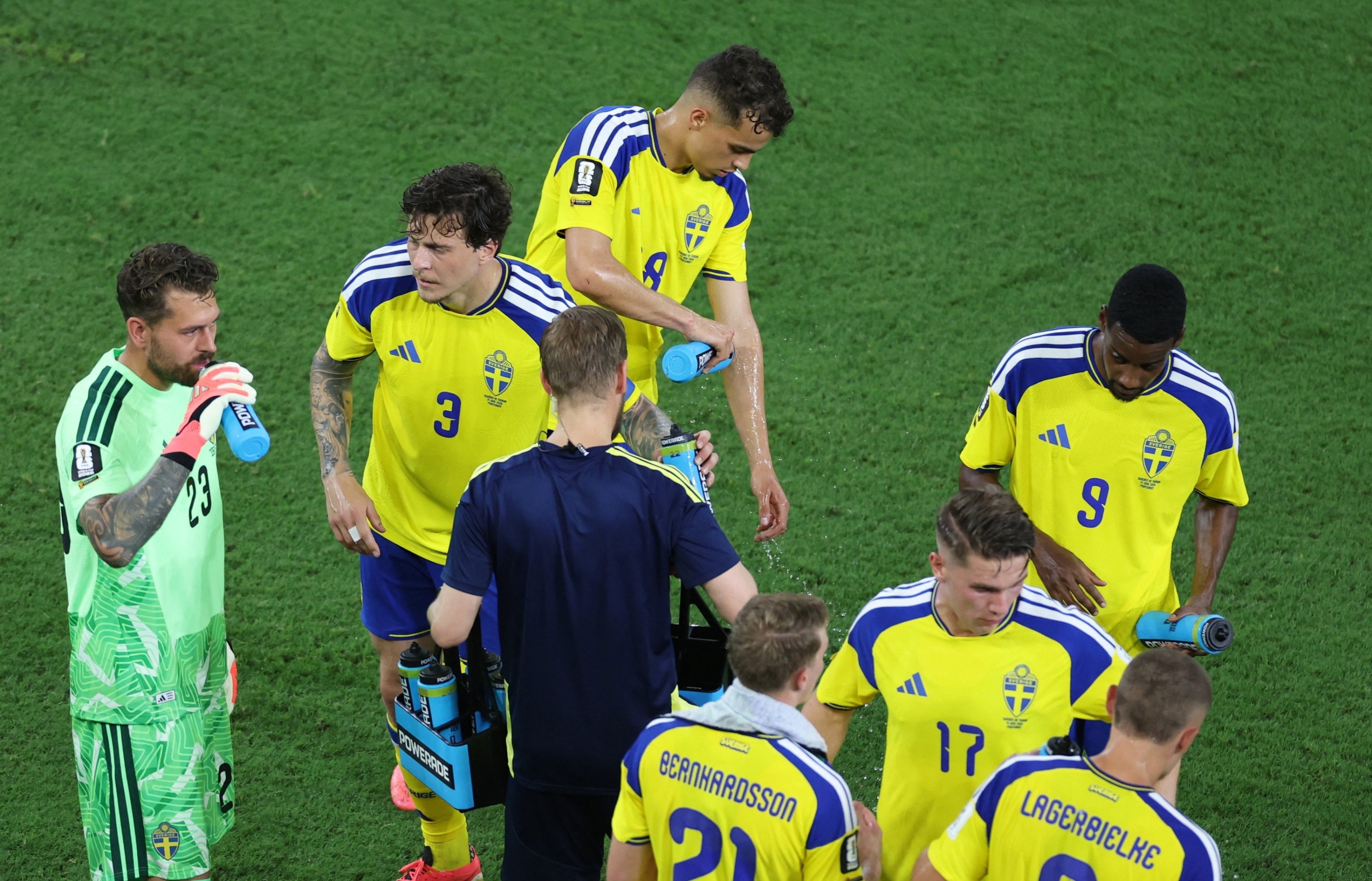
Mandatory three-minute hydration breaks, a standard feature seen at this year's FIFA World Cup matches, are proving as controversial as they are cooling, with players split over interruptions that some argue disrupt the flow of the game while coaches embrace them as tactical timeouts.
The breaks were introduced after the sweltering Club World Cup in the U.S. last year, when soaring temperatures and oppressive humidity fuelled concerns among players, coaches and fans.
Matches will have hydration breaks taken around the 22nd minute in each half and the rule essentially breaks the game down into four quarters.
"I think hydration breaks are a bit interesting because I was obviously watching almost all the games... Every time, going to commercial is a bit not really that I like it," Netherlands skipper Virgil van Dijk told reporters.
"I think for the neutral watchers on TV, it's also not great. So if it's really hot, obviously it will be good to put them in. But I think you have to look at it in every game separately, in my opinion."
Although not all fixtures are played during the day, hydration breaks have been mandated in each game at the World Cup in the interest of fairness and uniformity.
"As a player, it can work both ways," Belgium's Youri Tielemans said. "In some cities, it's not that hot and maybe we shouldn't do it.
"But at the end of the day, if you do it in some cities, you should do it for everyone."
Broadcasters are allowed to cut away to commercials 20 seconds after the referee signals a hydration break but must return to live action 30 seconds before the restart.
However, some broadcasters like Britain's ITV and Spanish-language broadcaster Telemundo opted not to show commercials to preserve the sanctity of the live game so fans can watch the players and coach interact.
Critics say hydration breaks can also have an adverse effect on teams, affecting their momentum.
World Cup debutants Curacao were in dreamland when Livano Comenencia equalised against Germany in their group opener in the 21st minute, only for the referee to signal a hydration break soon after, allowing Germany coach Julian Nagelsmann to rally his troops to a 7-1 victory.
"For me, it's a coaching break more than a cooling break, so to me it's very important," Belgium coach Rudi Garcia said.
"Maybe if we are in a good moment, in a good flow, maybe it can interrupt, so this also we will see. But during the two friendly games we played... it was interesting to give some information tactically to the team.
"For me, it's a very good thing. So, for example, the weather can be hot and maybe this hydration break will always be important."
France coach Didier Deschamps also said it was an opportunity to speak to his players and "adjust a couple of things" before the restart.
"It's four quarter times we've got, basically. The coaches adapt to this new reality," he added.
On the other hand, medical experts believe the hydration breaks are necessary and that they need to be much longer than three minutes.
"The hydration break in each half absolutely needs to be longer than three minutes. At least five minutes for each break and preferably six," said Douglas Casa, CEO of the Korey Stringer Institute that develops practical strategies to prevent sudden death in sport.
The call for extended breaks comes amid growing alarm over heat-related risks, according to Mike Tipton of the Extreme Environments Lab at the University of Portsmouth.
"As it stands and due in part to climate-change-driven increases in environmental thermal stress, some of the venues for the 2026 World Cup are likely to exceed the recommended heat-related 'high risk' threshold, especially during afternoon kickoffs," Tipton said.