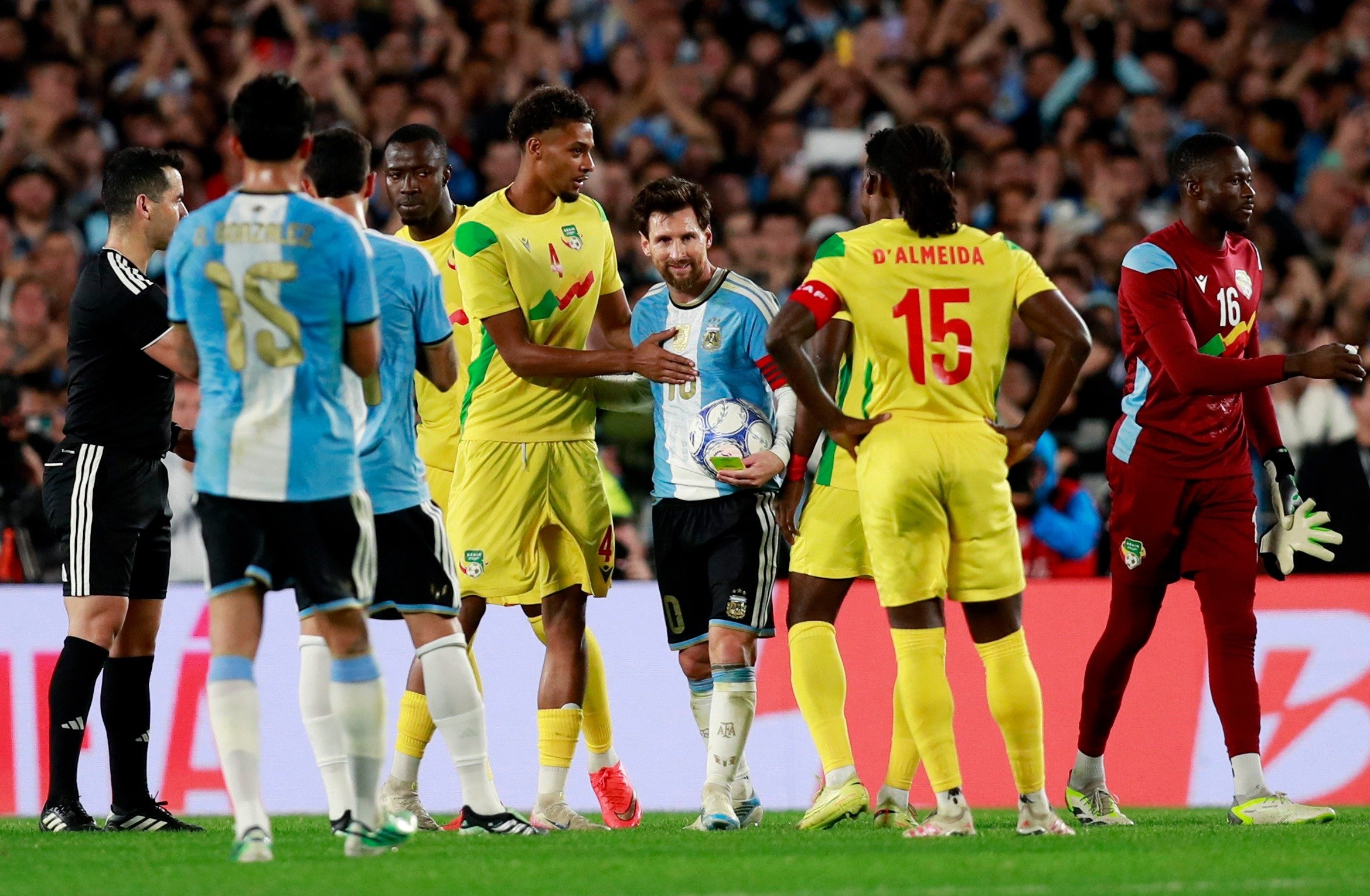
When Benin and Burkina Faso flew to Buenos Aires for friendlies against Argentina – including superstar Lionel Messi's swansong – it would have seemed like dreamland for players who rarely, if ever, rub shoulders with the aristocrats of the "Beautiful Game."
In reality, the organization was a shambles, according to a member of the Benin delegation.
The flight to Buenos Aires took not hours but days. There was no hot water in the hotel. Training facilities were "not up to scratch."
And the African football associations invited didn't receive any of the profits from the match, which potentially generated millions of dollars in revenue and TV rights, he told Agence France-Presse (AFP).
Before the match on Tuesday, the state-owned daily La Nation in Cotonou looked forward breathlessly to the team "showcasing Benin to the whole world," and the national football association revelled in the "privilege" of being selected to play.
"I'm going to tell Messi, 'You are a god,'" Benin defender Mohamed Tijani told the Argentine press of the country's legendary No. 10. "He's the best player in the world."
The Cheetahs lost 3-0.
Adding to the frustration, Benin head coach Gernot Rohr hit out at how his players were treated following the game, saying they were denied the chance to take photos with Messi.
"The Argentinians didn't give our players anything, not even a photo with Messi," Rohr told RMC Sport.
The German coach claimed some Benin players seeking to exchange shirts were prevented from entering Argentina players' area.
"My players tried everything, but nothing worked," he said.
"We wanted to exchange shirts, but we didn't get any. They wouldn't even allow us to enter their player corridor. Security was turning everyone away. Players were coming with their shirts hoping to swap them with Argentina players."
Rohr had an old Messi Argentina matchday-worn shirt, which he managed to give to his counterpart Lionel Scaloni for Messi to sign it before returning it to him.
"I waited half an hour, but it's not a big deal," he said.
Whilst there is no standard practice for organizing international professional friendlies, smaller African teams generally rely on agencies to manage their away fixtures and don't necessarily make any profit from the games.
"African football associations accept these deals because everything is taken care of. It saves them having to find opponents and organize friendlies," explained an expert on African football who asked not to be named.
"But it's true the travel and accommodation arrangements are substandard."
The Burkina friendly turned into a farce.
On the eve of kick-off, the Stallions were still stranded in Morocco after their connecting flight to Buenos Aires was canceled.
When organizers eventually found them a plane at the last minute, the senior squad was so annoyed it refused to board and Burkina ended up hastily despatching an under-23 team.
The young players arrived jet-lagged just a few hours before the match and were predictably thrashed 7-0 by this year's World Cup finalists.
Piqued, Burkina's military ruler Ibrahim Traore complained the country's football was "in a sorry state" and threatened "significant decisions" to "remedy it."
"The next international window in November is fast approaching," Burkinabe Football Federation official Ibrahim Dianda warned on Facebook.
"If the relationship between the stakeholders doesn't change, we risk a repeat of these difficulties and the consequences could be even more regrettable," he wrote.
Fans want to know who is to blame for the humiliation.
Could it be the African federations that accept these one-sided deals?
Or the Argentine Football Association (AFA), which is accused by some of capitalizing on its high profile and on appearances by Messi – the country's most famous living export – to maximize revenue?
Whatever the underlying motives, the AFA is in financial difficulty, faces a money laundering probe and has a president, Claudio Tapia, suspected of tax evasion.
In Argentina, some newspapers and social media channels pour scorn on what they sniffily refer to as "chatarra" (cheap, low-quality) fixtures.
Messi's side also played Mauritania (110th in the FIFA rankings) and Zambia (91st) in World Cup warmups this year, beating them 2-1 and 5-0, respectively.
His team also pocketed a hefty sum – several million dollars – for traveling to Luanda in November 2025 for a friendly marking Angola's 50th Independence Day celebrations.
An assist and a goal by the eight-time Ballon d'Or winner ensured a 2-0 victory over the African side.
In reaction to the uproar in Burkina over the national team's treatment, match organizer Eurodata Sport issued a terse statement shared online by the AFA that it had "honored its contractual commitments."