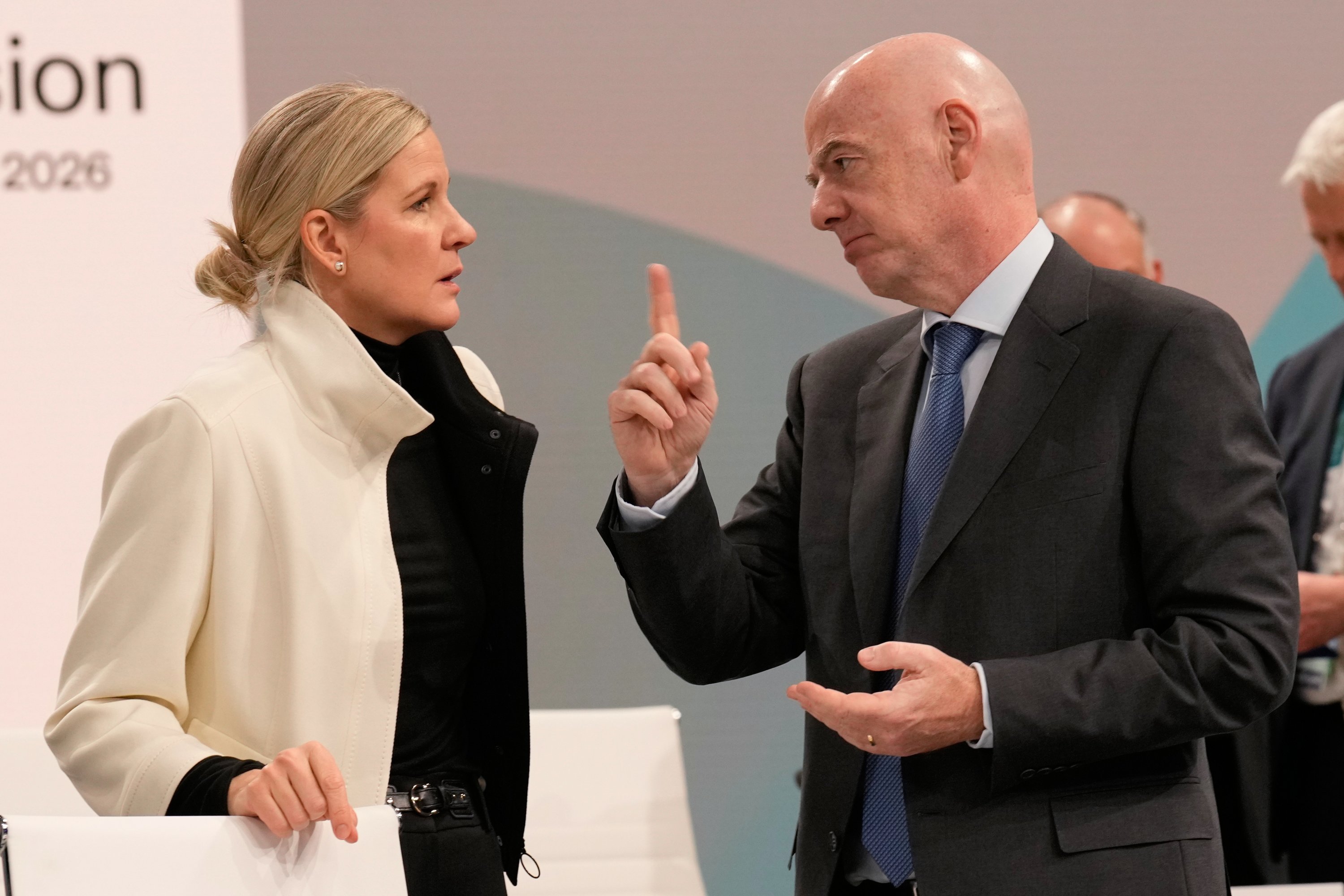
FIFA President Gianni Infantino's close relationship with President Donald Trump has helped smooth the path for a successful World Cup, and attention is now turning to IOC President Kirsty Coventry to see whether she will pursue a similar approach ahead of the 2028 Los Angeles Olympics.
So far, Casey Wasserman, chairman of the LA28 organizing committee, and his team have led dealings with the U.S. administration.
Coventry, the former Zimbabwean Olympic swimming champion who has been IOC president for just over a year, has yet to meet Trump.
"Wasserman's team's mandate is to deliver the Games, protect the revenue and 'make the trains run on time,'" Terrence Burns, a former IOC marketing executive, told Agence France-Presse (AFP).
"President Coventry's mandate is to protect universality and the integrity of sport.
"Those two things run in parallel right up to the moment they don't, and the moment they don't is when relationships, not only contracts, matter."
Chief among Coventry's priorities is ensuring safe entry for the thousands of athletes who will compete at the Games.
In terms of numbers, the World Cup is minuscule compared with the Olympics: 11,200 athletes, or 15,000 including the Paralympics, compared with about 1,200 at the World Cup. However, the U.S. refused entry to FIFA-accredited Somali referee Omar Artan and also blocked some members of the Iranian delegation.
"Managing the political dynamics counting down to LA28 is arguably President Coventry's biggest challenge," Michael Payne, a former IOC head of marketing who is well informed on Olympic matters, told AFP.
"It is totally naive to think that you can have the whole world turn up without strong engagement with the political authorities," he added.
"Failure by the IOC leadership to properly engage with the global political establishment is a recipe for disaster."
It is one thing to deal with the political establishment and quite another to deal with the maverick that is Trump.
Asked last year how she intended to deal with Trump, Coventry said: "I have been dealing with, let's say, difficult men in high positions since I was 20 years old."
Burns, however, said: "Nobody handles him. The question is whether the IOC has a strategy that does not depend on personal chemistry.
"This means a private channel with a respected relationship, and hopefully one where no public statement demands a public response."
Infantino has made much of his closeness to Trump, awarding him the much-ridiculed inaugural FIFA Peace Prize, but it has also created problems.
For example, Trump admitted he had intervened by calling Infantino to request that the red card shown to U.S. World Cup star Folarin Balogun be reviewed so he could play in the round of 16 against Belgium.
FIFA promptly rescinded the card, and Balogun was allowed to play, although the United States lost heavily and was eliminated.
Burns suggested that if a similar situation had involved a Cape Verde player, "a call from the president of Cape Verde would not have had a similar result."
"The real lesson for President Coventry regarding Trump is never to mistake proximity for influence," Burns said.
"Infantino just made that mistake in front of the entire world.
"But, and this is important, in the end, Infantino's No. 1 objective is a successful 2026 World Cup, and he is pragmatic enough to understand what it takes to do that.
"One may disagree with how he goes about it, but he's operating in a very narrow lane with a definitive timeline."
Payne said Coventry, a former sports minister in Zimbabwe's government, should look to Juan Antonio Samaranch rather than Irishman Michael Killanin as an example.
"In the late 1970s, IOC President Killanin did not really engage up front with the political authorities, and that led to a decade of boycotts that nearly destroyed the Olympic movement," Payne said.
"Samaranch had to spend much of his presidency engaging with political leaders to get them to understand that boycotts were a failed strategy and to support the Olympics."
Coventry could also take a leaf out of her predecessor Thomas Bach's book.
"Tokyo 2020 only took place in 2021 because it had been postponed due to the COVID-19 pandemic, and because Thomas Bach built a very close relationship with Prime Minister Abe," Payne said.
"Maybe Bach put too much emphasis on politics, but going in the opposite direction and ignoring the political establishment is not going to work."