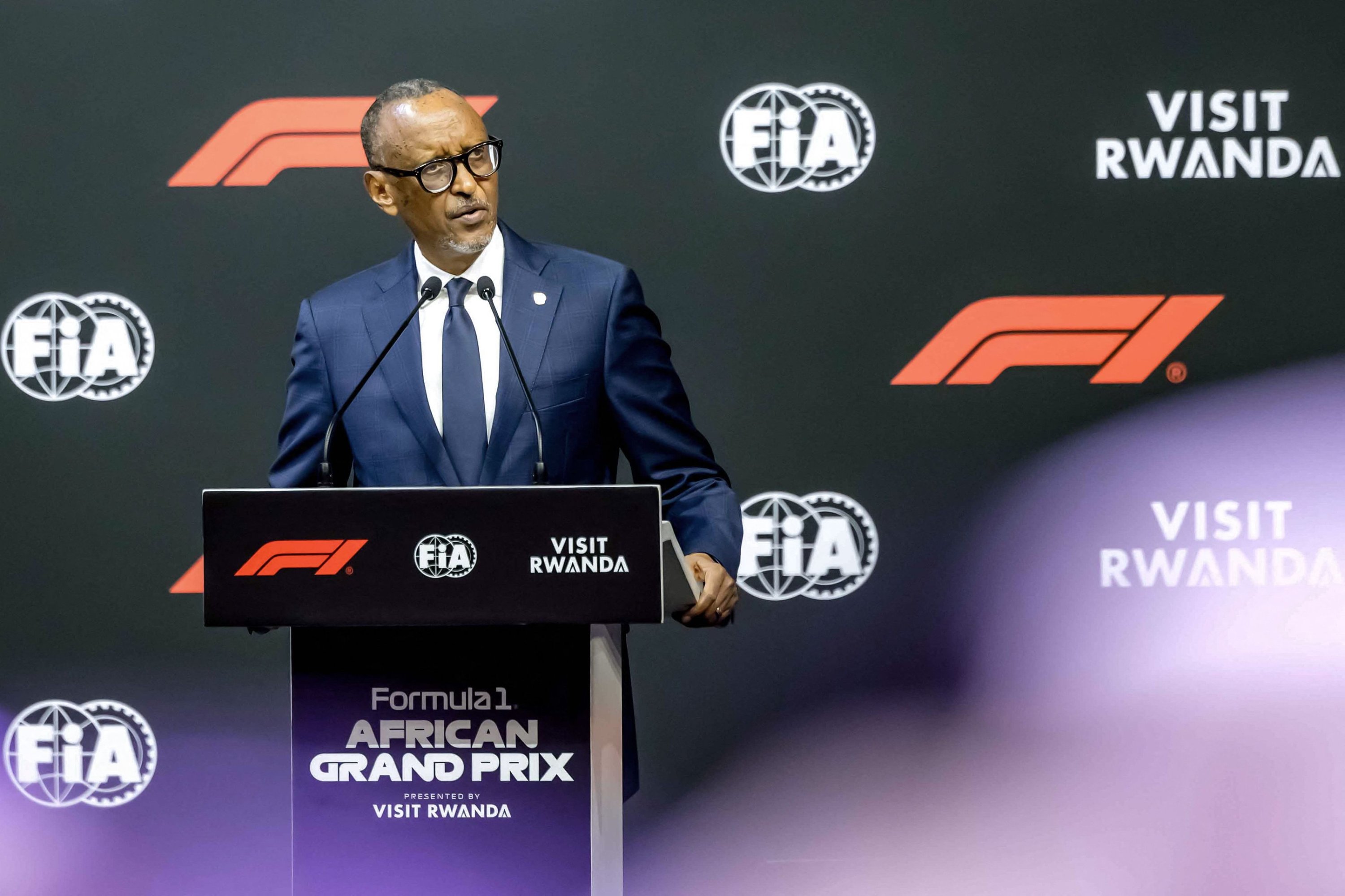
Rwanda’s agreement to host Formula One’s first African Grand Prix in more than three decades promises international exposure, tourism opportunities and investment, but undisclosed costs and human rights concerns raise questions about whether the project will deliver lasting benefits.
Formula One announced a 10-year agreement with Rwanda on Oct. 13, 2026, paving the way for the championship to return to Africa for the first time since 1993.
The inaugural race is planned for the early 2030s at a new circuit in Bugesera, south of Kigali, as President Paul Kagame’s government seeks to establish the country as a destination for international business, tourism and major sporting events.
The deal represents a significant expansion of Rwanda’s strategy to promote its international image through high-profile sports partnerships.
But with the financial terms undisclosed, the investment raises questions about its cost, the distribution of its economic benefits and whether the government’s ambitions justify the commitment.
Rwanda is not simply buying the right to stage a sporting competition. It is investing in a recurring international showcase that could associate the country with technology, luxury tourism, business and sporting excellence.
Formula One broadcasts will expose Rwanda to audiences worldwide, while the race could attract international journalists, corporate executives, sponsors and wealthy spectators. The government hopes that attention will translate into more tourists, private investment and commercial activity.
The strategy builds on Rwanda’s Visit Rwanda campaign, which has used partnerships with prominent football clubs, including Arsenal and Aston Villa, to promote the country.
Formula One would extend that approach into a sport with a global calendar and substantial commercial reach.
Unlike a conventional advertising campaign, however, hosting a Grand Prix requires a long-term commitment to infrastructure, operations and contractual obligations.
The agreement’s financial terms have not been publicly disclosed in the available reporting. The total hosting fees, construction costs and potential public liabilities therefore remain unclear.
Expenses could include circuit construction, safety installations, spectator facilities, security, medical services, transport and long-term maintenance.
Even if private investors finance parts of the project, public authorities could face costs associated with roads, utilities and other supporting infrastructure.
Without greater transparency, it is difficult to determine who carries the financial risks or whether the expected returns will justify the investment.
The government’s ambitions extend beyond race weekend. Rwanda wants to attract international tourism, conferences, major sporting events and foreign investment, and Formula One could help advance those goals.
Visitors could spend money on hotels, restaurants, transport and other local services. Corporate guests might also use the event to explore investment opportunities or establish business relationships.
The proposed circuit’s location in Bugesera, about 40 kilometers south of Kigali, is significant because it is near a new international airport under construction. The area could become part of a wider development zone combining transport, tourism and commercial facilities.
But international exposure does not automatically produce economic growth. The benefits will depend on visitor numbers, spending patterns and how much business reaches Rwandan companies rather than foreign contractors or international hotel groups.
The race could also create jobs in construction, hospitality, logistics, broadcasting and event management. Developing local expertise in motorsport operations could provide longer-term opportunities.
However, temporary construction work and race-weekend employment are not the same as permanent jobs. The project’s lasting value will depend on whether local workers acquire transferable skills and domestic businesses win contracts.
The Bugesera circuit must meet the standards required to host a Formula One world championship race. Former Formula One driver Alex Wurz is involved in its design, while the planned location offers potential logistical advantages because of its proximity to the new airport.
Yet the circuit will need a purpose beyond hosting an annual Grand Prix.
Purpose-built racing facilities require continuing maintenance and operating expenditure. If the venue attracts little activity between races, it could become an expensive asset with limited commercial value. Regional motorsport competitions, corporate events and other entertainment activities could help generate revenue, provided demand is sufficient.
Vietnam offers a cautionary example. A circuit was built in Hanoi for a Formula One race scheduled for 2020, but the event was canceled during the COVID-19 pandemic and never took place.
Rwanda’s project is different, and its outcome remains uncertain. Nevertheless, the comparison highlights the risks of investing heavily in infrastructure tied to a major sporting event before its long-term commercial viability is established.
The financial questions are accompanied by criticism of Rwanda’s human rights record.
Amnesty International criticized Formula One’s agreement, arguing that it could help the Rwandan government improve its international image despite allegations of arbitrary detention, torture and restrictions on freedom of expression. Formula One has emphasized the sport’s potential to inspire people and reach new audiences in Africa.
The controversy reflects a broader debate over sportswashing, the use of sporting events and partnerships to improve the reputation of governments or institutions facing criticism.
Kagame’s government has pursued economic development and international investment since the 1994 genocide. At the same time, human rights organizations have raised concerns about restrictions on political opposition, civil society and freedom of expression.
The Grand Prix will not resolve those concerns. Critics argue that international sporting partnerships can give governments prestigious platforms without requiring meaningful improvements in their human rights records. Supporters of such partnerships maintain that international events can promote tourism, create jobs and encourage investment.
Rwanda’s regional role adds another dimension. The country has faced allegations of supporting the M23 rebel movement in neighboring Democratic Republic of Congo, where the conflict has caused widespread suffering. Rwanda has disputed accusations concerning its involvement.
The agreement therefore places Formula One within a wider debate about the responsibilities of international sporting organizations when selecting host countries.
The deal also advances Formula One’s commercial ambitions. Returning to Africa would restore the championship’s presence on a continent it has not visited for a world championship race since 1993 and expand its reach into a potentially important market.
Formula One has cited an estimated 100 million fans across Africa, highlighting the audience it hopes to reach. Seven-time world champion Lewis Hamilton has also advocated for the sport to return to the continent.
South Africa had pursued a return to the calendar through the historic Kyalami circuit, which last hosted a championship race in 1993. Rwanda’s agreement secures an opportunity to bring the sport back to Africa, although it does not rule out another African race in the future.
For Formula One, Rwanda offers a government willing to commit to a long-term project. For Kagame, the championship provides international exposure that conventional advertising would struggle to replicate.
The project’s ultimate test will be whether its economic benefits extend beyond government prestige and international publicity.
If public resources support the circuit or its associated infrastructure, citizens have a legitimate interest in knowing whether the money could generate greater returns through health care, education, housing or transport.