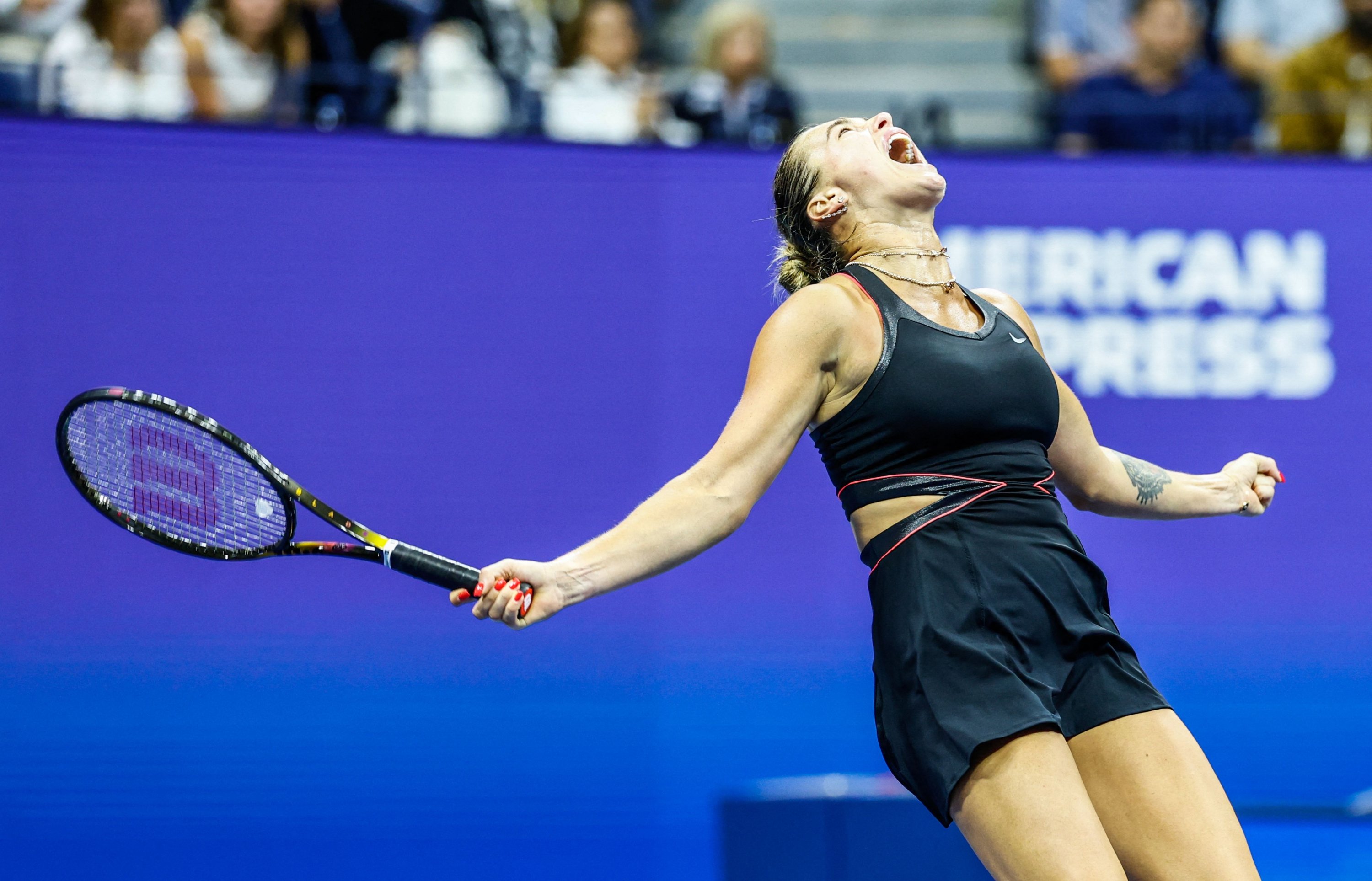
On her first opportunity to close out the U.S. Open semifinal against Jessica Pegula and secure a chance to defend her Flushing Meadows crown, Aryna Sabalenka mishit an easy overhead into the net, her gaze dropping to the court in frustration.
On her second chance, a clumsy volley went astray – a mistake she later admitted stemmed from venturing forward too often, having converted just 15 of 27 net approaches. Tension mounting, Sabalenka steadied herself when it mattered most, finally sealing victory on her third match point Thursday night with a 4-6, 6-3, 6-4 win over Pegula in a rematch of last year’s final.
“I was super emotional. I was just like, ‘Oh my gosh, no way it’s happening. Please, just close this match,’” Sabalenka said afterward. “The whole match, I just kept telling myself: (Onto) the next one, just one step at a time, don’t worry about the past. Just try better in the next point.”
When it was over, Sabalenka rocked back on her heels, spread her arms, and screamed.
On Saturday, when she faces No. 8 Amanda Anisimova in the final, the No. 1-seeded Sabalenka will try to become the first woman to claim consecutive championships at Flushing Meadows since Serena Williams won three in a row from 2012 to 2014.
Anisimova eliminated No. 23 Naomi Osaka 6-7 (4), 7-6 (3), 6-3 in a match that ended just before 1 a.m. to reach her second straight major final. At Wimbledon in July, Anisimova was the runner-up to Iga Swiatek, who beat her 6-0, 6-0 in the title match.
But Anisimova recovered quickly enough to get past Swiatek in two sets in the U.S. Open quarterfinals.
Now, the 24-year-old New Jersey-born, Florida-raised Anisimova gets another shot at winning her first Grand Slam trophy. She is the first opponent to beat Osaka this late in a Grand Slam. Before this loss, Osaka had been 13-0 in major quarterfinals, semifinals, and finals.
Like Osaka vs. Anisimova, Thursday’s first semifinal was tight – closer than Sabalenka’s straight-set triumph over Pegula 12 months ago that gave the 27-year-old from Belarus her third Grand Slam title, all on hard courts.
Since then, Sabalenka was runner-up to Madison Keys at the Australian Open in January and to Coco Gauff at the French Open in June, then was eliminated in the Wimbledon semifinals by Anisimova in July.
Arthur Ashe Stadium’s retractable roof was shut before the semifinals began, preventing disruption from gusts of wind up to 30 mph and the rain that arrived during play.
In the controlled indoor conditions, No. 4 Pegula played cleanly in the first and third sets, making just three unforced errors in each. But in the second set, she made nine. By the end, Sabalenka had accumulated more than twice as many winners as Pegula, 43-21.
“We were pushing each other,” Pegula said, “every single game.”
All evening, Pegula went after her returns, taking big cuts and not playing it safe. Sabalenka, however, saved all four break points she faced in the final set.
“It was really high level. I don’t really know what else to say,” Pegula said, wearing a white New York Yankees jacket and enjoying a root beer lollipop at her news conference. “I don’t know how I didn’t break back in the third.”
Asked how she managed those moments, Sabalenka laughed: “Just praying inside and hoping for the best.”
Neither player had lost a set in the tournament before Thursday, although Sabalenka only needed four matches, instead of five, to reach the semifinals because her quarterfinal opponent, Marketa Vondrousova, withdrew with a knee injury.
That meant Sabalenka hadn’t competed since Sunday. Might she be rusty? It didn’t look that way at the outset, as she used a nifty drop-shot-volley-winner combination to go up a break and grab a 4-2 lead.
But Pegula didn’t fold. In the next game, with thousands in the stands roaring for every point, Sabalenka netted off-balance groundstrokes on two points in a row and double-faulted to get broken right back.
Sabalenka shook her head and slammed her arms by her side, ending her streak of 32 consecutive holds, and draped a white towel over her head at the changeover. Pegula then broke again to cap a four-game run that wrapped up the set. Sabalenka quickly retrieved her bag and headed to the locker room.
When she returned, Sabalenka elevated her play – and steadied her mind when necessary.
“I will go out there on Saturday,” she said, “and I’ll fight for every point like it’s the last point of my life.”