Daily Sabah logo

Politics
Diplomacy Legislation War On Terror EU Affairs Elections News Analysis
TÜRKİYE
Istanbul Education Investigations Minorities Expat Corner Diaspora
World
Mid-East Europe Americas Asia Pacific Africa Syrian Crisis Islamophobia
Business
Automotive Economy Energy Finance Tourism Tech Defense Transportation News Analysis
Lifestyle
Health Environment Travel Food Fashion Science Religion History Feature Expat Corner
Arts
Cinema Music Events Portrait Reviews Performing Arts
Sports
Football Basketball Motorsports Tennis
Opinion
Columns Op-Ed Reader's Corner Editorial
PHOTO GALLERY
JOBS ABOUT US RSS PRIVACY CONTACT US
© Turkuvaz Haberleşme ve Yayıncılık 2025

Daily Sabah - Latest & Breaking News from Turkey | Istanbul

  • Politics
    • Diplomacy
    • Legislation
    • War On Terror
    • EU Affairs
    • Elections
    • News Analysis
  • TÜRKİYE
    • Istanbul
    • Education
    • Investigations
    • Minorities
    • Expat Corner
    • Diaspora
  • World
    • Mid-East
    • Europe
    • Americas
    • Asia Pacific
    • Africa
    • Syrian Crisis
    • Islamophobia
  • Business
    • Automotive
    • Economy
    • Energy
    • Finance
    • Tourism
    • Tech
    • Defense
    • Transportation
    • News Analysis
  • Lifestyle
    • Health
    • Environment
    • Travel
    • Food
    • Fashion
    • Science
    • Religion
    • History
    • Feature
    • Expat Corner
  • Arts
    • Cinema
    • Music
    • Events
    • Portrait
    • Reviews
    • Performing Arts
  • Sports
    • Football
    • Basketball
    • Motorsports
    • Tennis
  • Gallery
  • Opinion
    • Columns
    • Op-Ed
    • Reader's Corner
    • Editorial
  • TV

MIT lab turns X-ray vision into a reality for $300

by Associated Press

CAMBRIDGE, Mass. Dec 22, 2015 - 12:00 am GMT+3
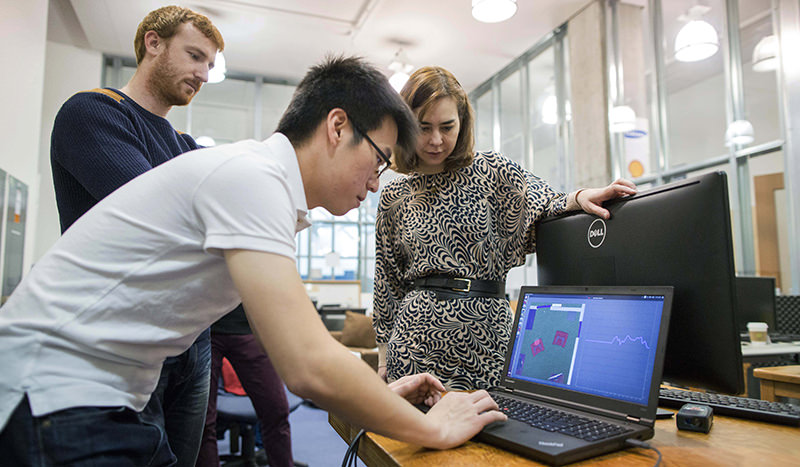
In this Nov. 19, 2015, photo, Massachusetts Institute of Technology researcher Chen-Yu Hsu works on a laptop as researcher Zach Kabelac, left, and professor Dina Katabi, right, watch in their lab at MIT (AP Photo)
by Associated Press Dec 22, 2015 12:00 am
X-ray vision, a comic book fantasy for decades, is becoming a reality in a lab at MIT.

A group of researchers led by Massachusetts Institute of Technology professor Dina Katabi has developed software that uses variations in radio signals to recognize human silhouettes through walls and track their movements.


Researchers say the technology will be able to help health care providers and families keep closer tabs on toddlers and the elderly, and it could be a new strategic tool for law enforcement and the military.

"Think of it just like cameras, except that it's not a camera," said Fadel Adib, a researcher on the MIT team developing the device.

"It's a sensor that can monitor people and allow you to control devices just by pointing at them," he said.

Work began in 2012 to determine how wireless signals could be used to "see" what's happening in another room, said Katabi, who directs the MIT Wireless Center.


"At first we were just interested ... can you at all use wireless signals to detect what's happening in occluded spaces, behind a wall, couch, something like that," Katabi said.

"It turned out that we were able to detect that. And when we figured out we could detect that, we started asking more advanced questions: Could we use it to detect exactly how people are moving in a space if they are behind a wall?"

The device displays the signal on a screen, where the person's movements can be tracked in real time. It depicts the target as a red dot moving around the room, occupying a chair and speeding up or slowing down.

The wireless signals used to track a person's motions also can measure the individual's breathing and heart rate and potentially identify the person based on the shape of his or her skeleton, said researcher Zach Kabelac.

"The person won't be wearing anything on them, and the person it's tracking doesn't even need to know the device is there," Kabelac said.

"If something unfortunate happens to them, like a fall, the device will contact the caregiver that they chose to alert" by generating a text message or an email, he added.

That makes health care applications especially interesting, Katabi said. But she also sees military and law enforcement possibilities particularly in hostage situations.

"You don't want to send the police inside without knowing where the people are standing or where the hostages are," she said. "If there is someone with a gun, where they are standing?"

A company set up to market the technology, now dubbed Emerald, will spin out of the MIT lab next year, with a goal of marketing the device early in 2017, and it's expected to sell for $250 to $300, Adib said. The team is working to make the device smaller and to develop an interface that will let users configure it through a smartphone app, Katabi added.

The technology raises questions about privacy rights and intrusion, and Adib said the team gave serious thought to those implications.

"The user interface will be friendly for setting it up and using it at home, but it will be very hard to use it to track someone just by pointing it at their wall," he said.
  • shortlink copied
  • Last Update: Dec 22, 2015 9:22 am
    KEYWORDS
    business
    The Daily Sabah Newsletter
    Keep up to date with what’s happening in Turkey, it’s region and the world.
    You can unsubscribe at any time. By signing up you are agreeing to our Terms of Use and Privacy Policy. This site is protected by reCAPTCHA and the Google Privacy Policy and Terms of Service apply.

    No Image
    In photos: Fall colors in Turkey's Tohma Canyon
    PHOTOGALLERY
    • POLITICS
    • Diplomacy
    • Legislation
    • War On Terror
    • EU Affairs
    • News Analysis
    • TÜRKİYE
    • Istanbul
    • Education
    • Investigations
    • Minorities
    • Diaspora
    • World
    • Mid-East
    • Europe
    • Americas
    • Asia Pacific
    • Africa
    • Syrian Crisis
    • İslamophobia
    • Business
    • Automotive
    • Economy
    • Energy
    • Finance
    • Tourism
    • Tech
    • Defense
    • Transportation
    • News Analysis
    • Lifestyle
    • Health
    • Environment
    • Travel
    • Food
    • Fashion
    • Science
    • Religion
    • History
    • Feature
    • Expat Corner
    • Arts
    • Cinema
    • Music
    • Events
    • Portrait
    • Performing Arts
    • Reviews
    • Sports
    • Football
    • Basketball
    • Motorsports
    • Tennis
    • Opinion
    • Columns
    • Op-Ed
    • Reader's Corner
    • Editorial
    • Photo gallery
    • DS TV
    • Jobs
    • privacy
    • about us
    • contact us
    • RSS
    © Turkuvaz Haberleşme ve Yayıncılık 2021