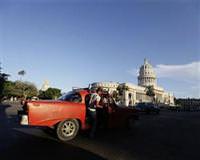
First Americans in Cuba under easier U.S. travel rules
by
Aug 17, 2011 - 12:00 am GMT+3
by Aug 17, 2011 12:00 am
The first group of Americans to tour Cuba under new, more liberal U.S. travel regulations have been greeted by hugs, handshakes and a welcoming Cuban government, according to a trip organizer.
The 30 travelers are pioneers in a new era of "people-to-people" exchanges the Obama administration approved in January to "enhance the free flow of information" to Cubans and over the objections of those who favor a hardline against the communist government.
About 30 to 35 travel groups are believed to have obtained licenses so far under the new regulations, which reinstate rules put in place by President Bill Clinton in 1999, but revoked by his successor, President George W. Bush in 2003.
The first group of travelers have been to orphanages, medical facilities, art museums, music performances and tobacco farms and have walked the streets of Old Havana in a first taste of the forbidden fruit that Cuba has been for five decades under the U.S. trade embargo against the country.
Their reactions, said Tom Popper of Insight Cuba, the travel agency bringing in the group, have varied widely.
"Some people are amazed by what they see and astonished by the people and the culture and everything around them," he told Reuters this week.
"And some people feel horrible that getting coffee is a struggle and food stuff is hard (to find) and that there's two economies and that a doctor has to drive a taxi to supplement his income," Popper said.
He described an emotional visit to a facility for the blind where 40 people awaited the group and applauded their arrival.
"They had a presentation, a couple of them played music, they danced together," Popper said. "People hugged. There were tears everywhere. It was just beautiful."
Such exchanges, he said, "make a difference in Americans and make a difference in Cubans. So I just hope maybe one day they can see the value in what we're doing."
OPPOSITION TO RAPPROCHEMENT
"They" are the U.S. politicians and others, mostly Cuban exiles, who oppose rapprochement with the government led by President Raul Castro and believe American travel to Cuba helps the communist system whose fall they have awaited for 50 years.
They have fought to preserve that part of the embargo which prevented almost all Americans from going to Cuba and out of which the new regulations take a big bite, according to John McAuliff, who as head of the Fund for Reconciliation and Development advocates for better U.S.-Cuba relations.
"In principle, the president's January announcement means virtually any American with a serious interest in Cuba can visit," he said.
Among other things, the new regulations permit Americans to go to Cuba through travel agencies such as Insight Cuba that obtain a U.S. license to conduct "purposeful travel," which means it must be educational and interactive with Cubans.
"No beaches," said Popper.
The tourists were spread out across Cuba this week, but upon arrival last Thursday, one participant extolled the virtues of the travel opening.
"It's marvelous that more people can come here because of the fact that it's people to people rather than government to government. I think people have a way of coming to terms with an awful lot of trouble that governments can't do," said the man who, in a possible bow to political sensitivities, identified himself as James Bond.
Popper said the Cuban government has helped set up events for the group, including sessions with officials who took "very strong questions" from the group.
Critics have charged they will get a sanitized view of Cuba, but Popper disagreed. "There's no sugarcoating," he said.
The cash-strapped Cuban government welcomes more Americans because tourism is a major money earner for the island, but also because it gets a chance to change perceptions.
"I think they believe that since their politicians are not able to work out anything diplomatic, each person who goes back to the United States has a new and different perspective," Popper said.
It appears to work, because he said most visitors leave saying "Cuban life isn't as bad as I thought."
McAuliff estimated that a maximum of 100,000 Americans will go to Cuba this year under the new rules.
Cuban-American members of the U.S. Congress already have proposed legislation to roll back the regulations, so it remains to be seen how long the freer travel will last.
"It will make a real difference in attitudes in both countries if fully implemented, which is what terrifies the Cuban-American hardliners," McAuliff said.
Keep up to date with what’s happening in Turkey,
it’s region and the world.
You can unsubscribe at any time. By signing up you are agreeing to our Terms of Use and Privacy Policy.
This site is protected by reCAPTCHA and the Google Privacy Policy and Terms of Service apply.