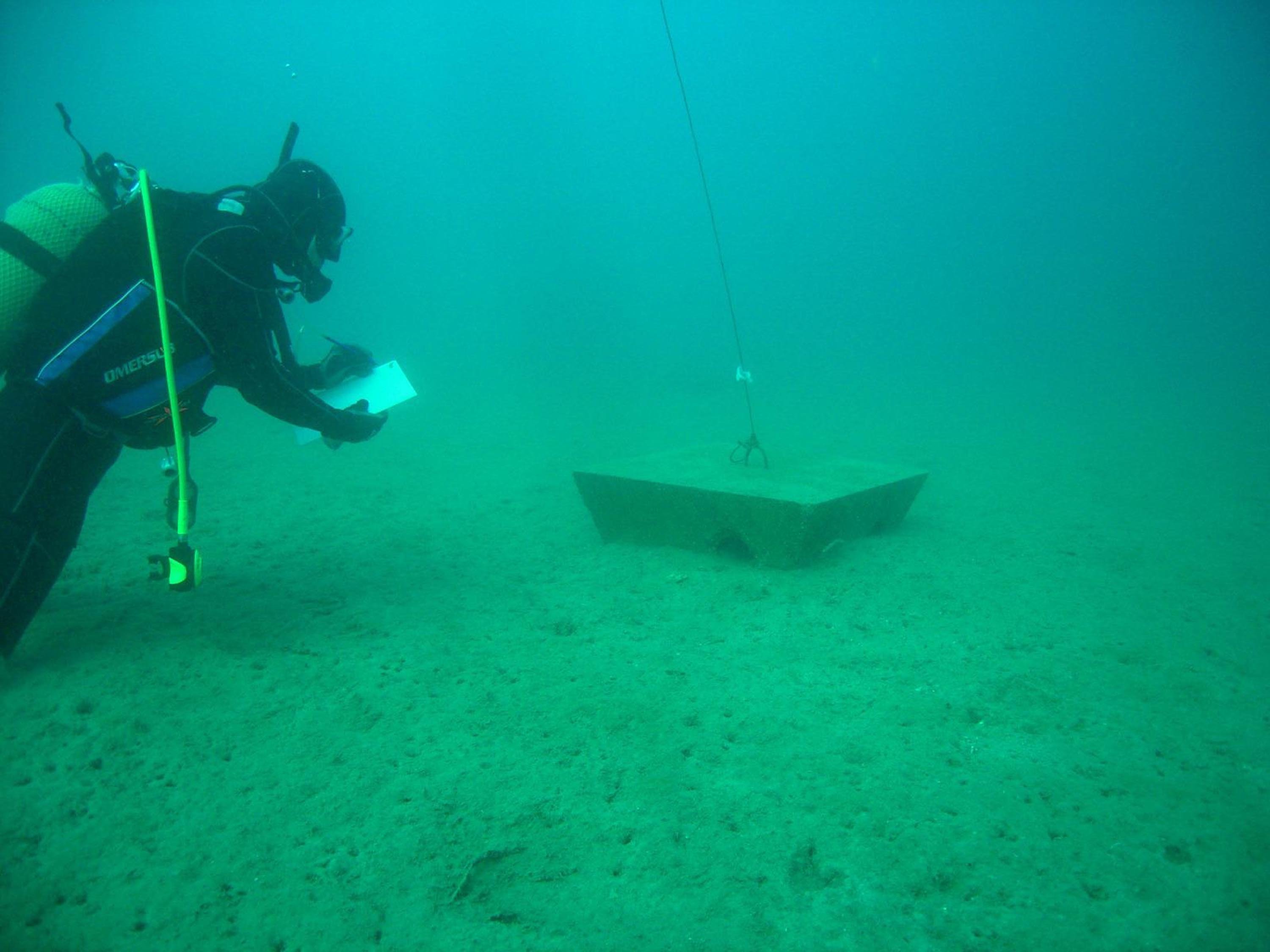
Octopus populations in Izmir Bay, located along Türkiye’s western coast, once a common sight in local waters, have been steadily decreasing due to factors such as overfishing, global warming and the disappearance of important food sources. To counter this decline, researchers from Ege University have launched a project to protect octopuses and increase their numbers by installing artificial reefs designed to serve as breeding and sheltering grounds.
The project is led by professor Ali Ulaş from Ege University’s Faculty of Fisheries, Department of Fishing and Processing Technology, who explained that the reefs create safe spaces for octopuses to live and reproduce. “In this way, while creating a new breeding ground, we also increase the number of shelters in the region, which helps boost the octopus population,” he said.
Artificial reefs are not new in the world of marine conservation. Globally, they have been used since the 1950s to protect marine life and enhance biodiversity. In Türkiye, Ege University pioneered artificial reef studies in the 1980s, and the current initiative builds upon that expertise. The newly placed reefs in Izmir Bay are specifically designed for octopuses, which have been identified as one of the species most affected by environmental pressures.
Ulaş emphasized that octopuses are highly intelligent creatures but also “habitat-dependent,” meaning they require safe dens and hiding places in order to survive in a given area. “If an octopus cannot find a shelter, it feels threatened and leaves the area. Therefore, the number of octopuses in a region is directly related to the number of available shelters. Based on this understanding, we developed a special shelter module for octopuses to support natural dens in the bay,” he explained.
The artificial shelters were constructed from concrete and designed to resemble the natural rocky habitats where octopuses typically reside. To reduce the risk of chemical interactions from the concrete, clay pots were placed inside each shelter. The deployment process involved careful coordination between divers and crane vessels, which placed the reef blocks in selected areas of Izmir Bay.
These reefs are already being used by octopuses, offering them new breeding grounds and safe habitats. According to Ulaş, octopuses migrate toward the shores of Izmir Bay in September and October, spend the winter months in shallow coastal waters, and then move back to deeper waters between March and April. The artificial reefs are expected to strengthen this natural migration cycle by providing additional dens during their stay in shallow waters.
The project not only benefits marine life but also has economic implications for the local community. By helping to increase octopus numbers, it creates new opportunities for fishermen, who have been struggling with declining catches in recent years. “This way, we support biodiversity while also ensuring that fishermen can rely on sustainable resources,” Ulaş said.
The Ministry of Agriculture and Forestry has also taken notice of the issue and is preparing a broader Octopus Artificial Reef Project in response to the decline in octopus production. The planned initiative will cover Izmir Bay and extend across Foça, Karaburun, and Urla, all of which are important fishing and marine biodiversity areas along the Aegean coast.
Through this joint effort, researchers and authorities hope to restore balance to Izmir Bay’s marine ecosystem, ensuring that octopuses remain a vital part of both biodiversity and local livelihoods in the years to come.