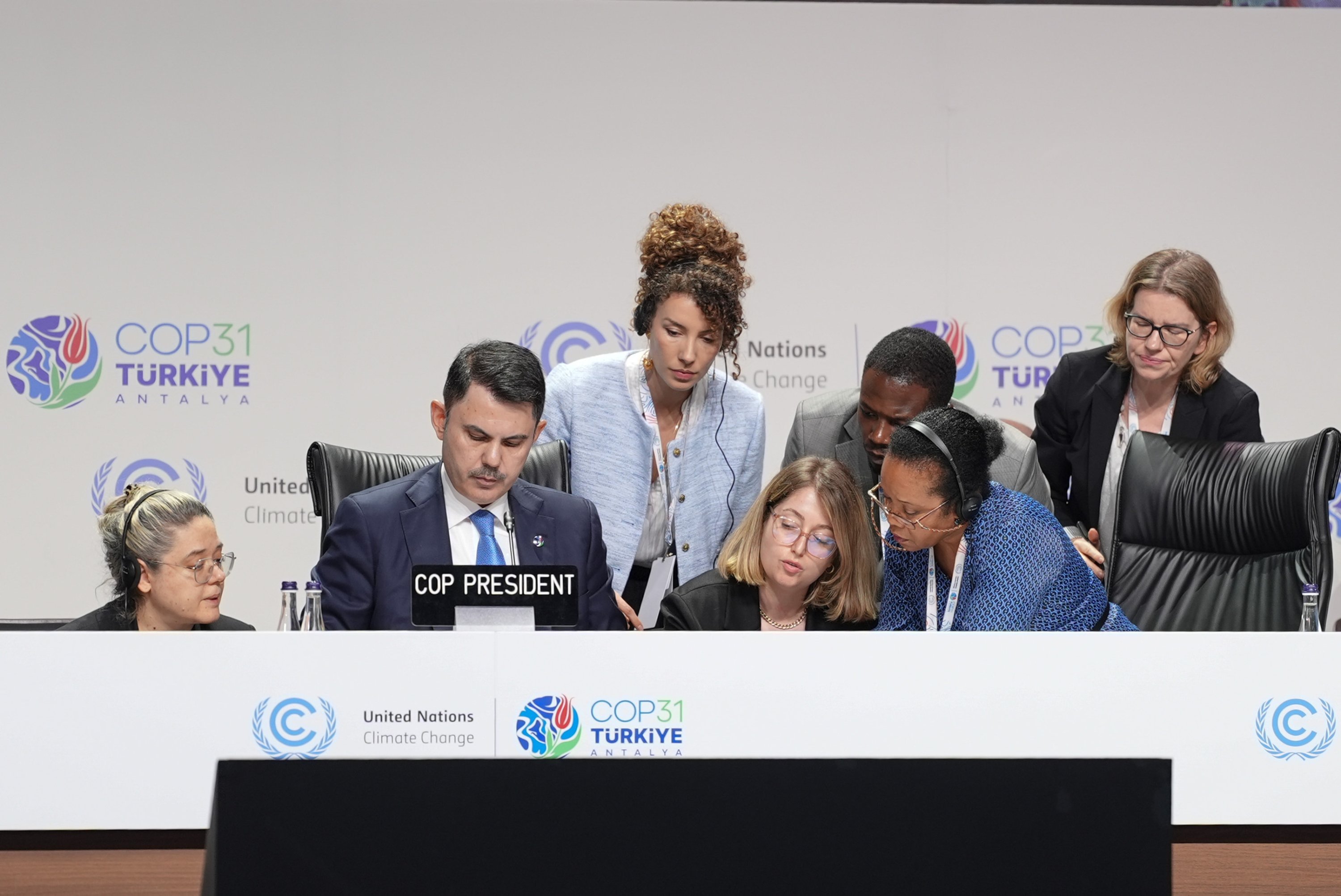
Türkiye's efforts to bridge differences among countries at the United Nations Climate Change Conference (COP31) continued until the final hours of the summit, but disagreements over fossil fuels and climate finance prevented delegates from reaching consensus on a proposed agreement Sunday.
The conference, which was scheduled to conclude on Nov. 20, extended more than 44 hours beyond its deadline as negotiators sought common ground on how to advance global climate action while accommodating countries' differing energy priorities and development needs.
COP31 President-designate and Environment, Urbanization and Climate Change Minister Murat Kurum acknowledged the lack of consensus at the closing plenary, saying the presidency had worked to bring countries together without imposing a settlement.
“We did everything we could. The decision rests with 196 countries. Therefore, we will respect their decision,” Kurum said, stressing that the presidency could not impose an agreement that the parties did not accept.
The proposed “Antalya Pact,” prepared by the COP31 presidency following intensive consultations with delegations, sought to advance practical climate measures while building on commitments reached at previous United Nations climate summits.
However, the latest draft failed to satisfy countries seeking stronger language on fossil fuels and more concrete commitments on climate finance.
A central point of disagreement was whether the proposed agreement should explicitly call for a transition away from fossil fuels.
The latest draft did not directly mention fossil fuels, coal, oil or natural gas. Instead, it referred to the commitments adopted at the 2023 COP28 in Dubai, where countries agreed to transition away from fossil fuels in energy systems.
Kurum defended the presidency's approach, arguing that countries should focus on implementing decisions already reached rather than reopening previously agreed commitments.
During a joint press conference with Australian Climate Change and Energy Minister Chris Bowen and U.N. climate chief Simon Stiell, Kurum said the proposed electrification target offered a practical route toward reducing dependence on fossil fuels.
The proposed “35 by 35” target called for electricity's share of global final energy consumption to increase to 35% by 2035, from around 21% currently.
The presidency argued that concentrating on implementation and concrete measures could help countries advance climate action while taking account of national circumstances, development needs and energy security.
The draft also recognized that global warming is on course to exceed the 1.5-degree Celsius (2.7-degree Fahrenheit) threshold and called for the development of carbon-removal technologies to help reverse the overshoot.
Kurum said the presidency had put forward measures covering renewable energy, the Paris Agreement's 1.5-degree Celsius goal, carbon capture, utilization and storage technologies, and increased adaptation finance. He emphasized that the presidency and Australia had worked to bring delegations together from the beginning of the summit.
“Some countries fixated on a word or a phrase and, frankly, brought other issues unrelated to climate change into these discussions, unfortunately preventing the process from moving forward,” Kurum said. “We did everything we could. The decision rests with 196 countries. Therefore, we will respect their decision."
The European Union, Panama, Norway, the Marshall Islands and some other countries objected to the proposed agreement, arguing that it failed to provide sufficiently strong language on moving away from fossil fuels.
Ireland's Climate and Energy Minister Darragh O'Brien, speaking on behalf of the EU, said the bloc would not endorse an agreement that did not explicitly mention fossil fuels.
Panama also rejected the proposal, while climate-vulnerable countries stressed the importance of stronger commitments to limit global warming and protect communities facing rising temperatures and climate-related disasters.
On the other side of the dispute, Russia supported the omission of explicit fossil fuel language, while Saudi Arabia and other oil-producing countries resisted calls for a specific transition commitment.
The disagreements underscored the difficulty of establishing a common approach among countries with different energy systems, economic structures and priorities for the transition to cleaner energy.
Türkiye and Australia sought to reconcile these positions through successive draft texts and consultations, but the final proposal failed to secure the consensus required for adoption.
Kurum said the presidency had sought to ensure that all participating countries could express their views freely and safely, emphasizing that its responsibility was to encourage parties to reach an agreement.
“If we are to speak of sincerity and fairness, we must make an effort together. If we fail to make that effort, the world will get worse,” Kurum said, warning that continued deadlock in the negotiation rooms would leave the world facing increasingly severe climate impacts.
Financing for developing countries also emerged as a major obstacle.
An earlier version of the draft included a proposal to increase adaptation finance to $120 billion by 2035. The figure was subsequently removed, prompting concern among developing countries seeking more predictable financial support to address climate impacts.
African countries and other vulnerable nations have repeatedly called for greater assistance from wealthier countries, arguing that insufficient funding could undermine their ability to prepare for extreme weather, rising temperatures and other climate-related challenges.
The absence of a concrete numerical commitment in the final proposal left a significant demand unresolved alongside the dispute over fossil fuels.
Kurum said Türkiye would not prepare another version of the proposed cover decision after countries failed to reach consensus.
“There will be no new text from now on. Since consensus has not been achieved, we will not work on a new text. We will implement the existing decisions and continue with the decisions taken within the framework of the Paris Agreement,” he said.
He added that the presidency had fulfilled its responsibility by facilitating negotiations and seeking common ground, but the final decision rested with the participating countries.