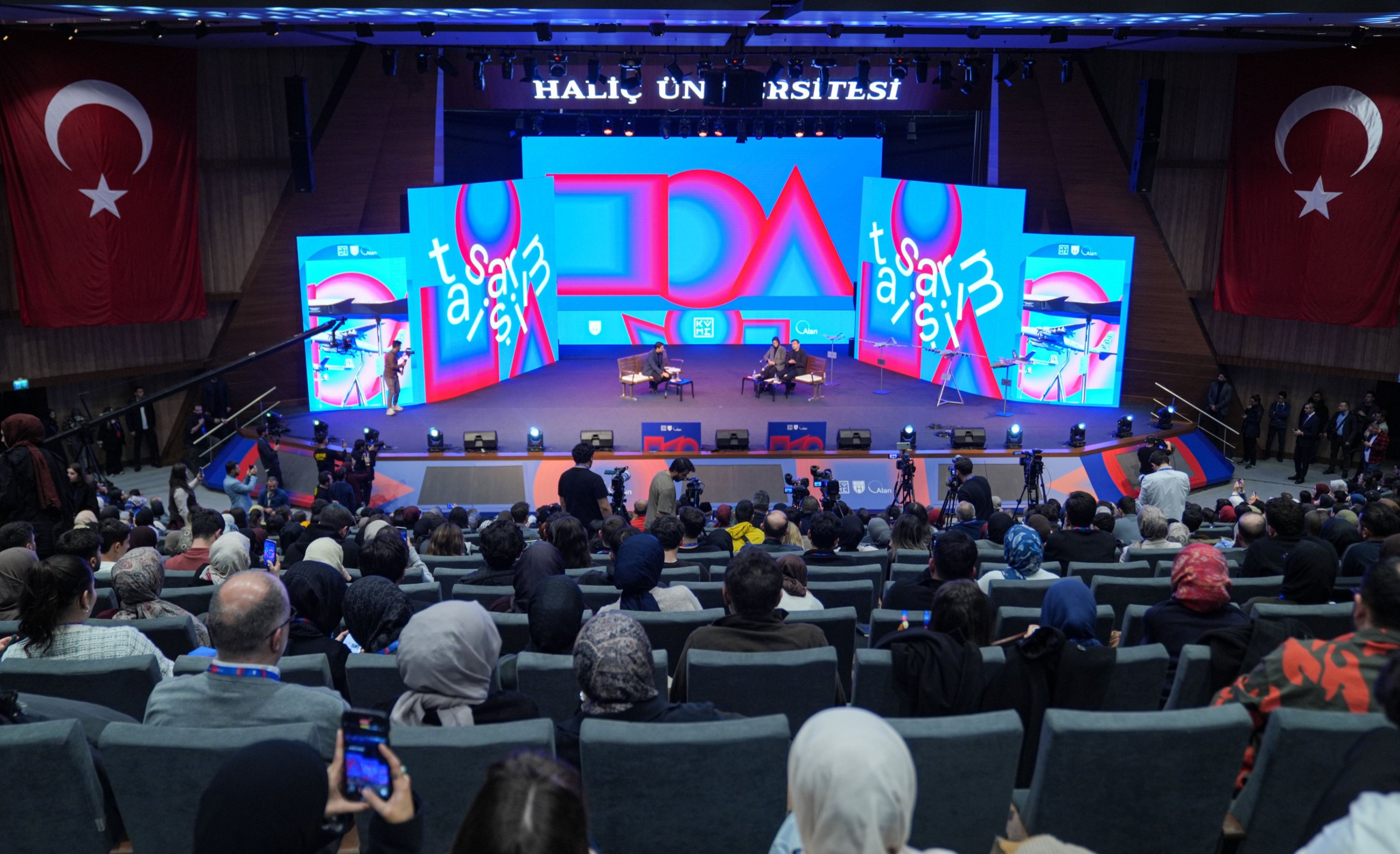
The second gathering of Alan, the design ecosystem established by the Culture and Civilization Foundation (KÜME), brought together students, academics and leading figures from Türkiye’s cultural, intellectual and industrial landscape on Saturday at Haliç University in Istanbul, underscoring design as a strategic tool shaping society, economy and identity rather than a purely aesthetic discipline.
Held under the theme “Design as Work” and guided by the motto “Everything Is Design,” the event marked the continuation of a process first introduced at Teknofest Istanbul with the slogan “Alan is KÜME’s ecosystem.” The program positioned design as a multidimensional field intersecting with ethics, production, technology and civilization, while emphasizing the need for originality rooted in local values amid global pressures.
The event featured keynote speeches and panel discussions that explored how design influences human behavior, economic systems and cultural continuity, with speakers questioning dominant global paradigms and calling for a more human-centered and values-driven approach.
Sümeyye Erdoğan Bayraktar, a member of KÜME’s board of trustees, focused on the relationship between design, culture and social responsibility, particularly in the context of women’s issues and identity.
Bayraktar underlined that design often reflects the worldview and values of its creators, noting that many solutions adopted today are shaped by external mental frameworks. She questioned why societies should remain passive while global trends dictate lifestyles, values and even perceptions of comfort and success.
Highlighting the importance of producing original solutions rooted in local cultural and intellectual resources, Bayraktar said that design could serve as a powerful instrument to protect identity while responding to global challenges. She pointed to the work of civil society organizations in women’s studies, noting that many follow Western narratives without sufficiently questioning their relevance to local realities.
Bayraktar also cited the Declaration of Principles on Women’s Rights, developed through extensive academic collaboration, noting that it was the first such document to recognize the rights of homemakers explicitly. She added that the declaration also addressed modern gender-based social engineering as a threat to women’s rights and social cohesion, marking a departure from existing international frameworks.
The event also featured remarks by Selçuk Bayraktar, chairman of the board of trustees of KÜME, who linked design directly to originality, production and leadership, drawing on his experience in Türkiye’s defense and technology sectors.
Bayraktar said that while Türkiye is a strong production country, it often struggles with ownership of ideas and design, limiting its ability to lead rather than follow. He stressed that true leadership requires original thinking and confidence in one’s own roots, rather than imitation.
Using a nature metaphor, Bayraktar explained that strong roots are essential to reaching greater heights, noting that civilizations, like trees, can only grow upward if their foundations are solid. He emphasized that reconnecting with historical, scientific and cultural heritage was critical for future innovation.
Bayraktar highlighted Baykar’s approach to design as an example of this philosophy, noting that while many aircraft designs mimic birds, Baykar’s platforms draw inspiration from fish, reflecting a deliberate choice to break from convention. He said this originality was not about being contrarian, but about trusting one’s own perspective and experience.
Addressing the challenges of the digital age, Bayraktar also touched on misinformation and the growing reliance on artificial intelligence and anonymous digital platforms. He warned that confidently presented but inaccurate information poses serious risks, emphasizing the need for accountable and verifiable knowledge sources. In this context, he introduced the KÜRE Encyclopedia as a platform that provides reliable, transparent and up-to-date information.
Throughout the day, the discussions reinforced the idea that design extends far beyond form and function, shaping social norms, economic behavior and future trajectories. Speakers repeatedly stressed that originality, ethical responsibility and cultural awareness must guide design processes if societies are to remain resilient and self-directed in an increasingly homogenized world.