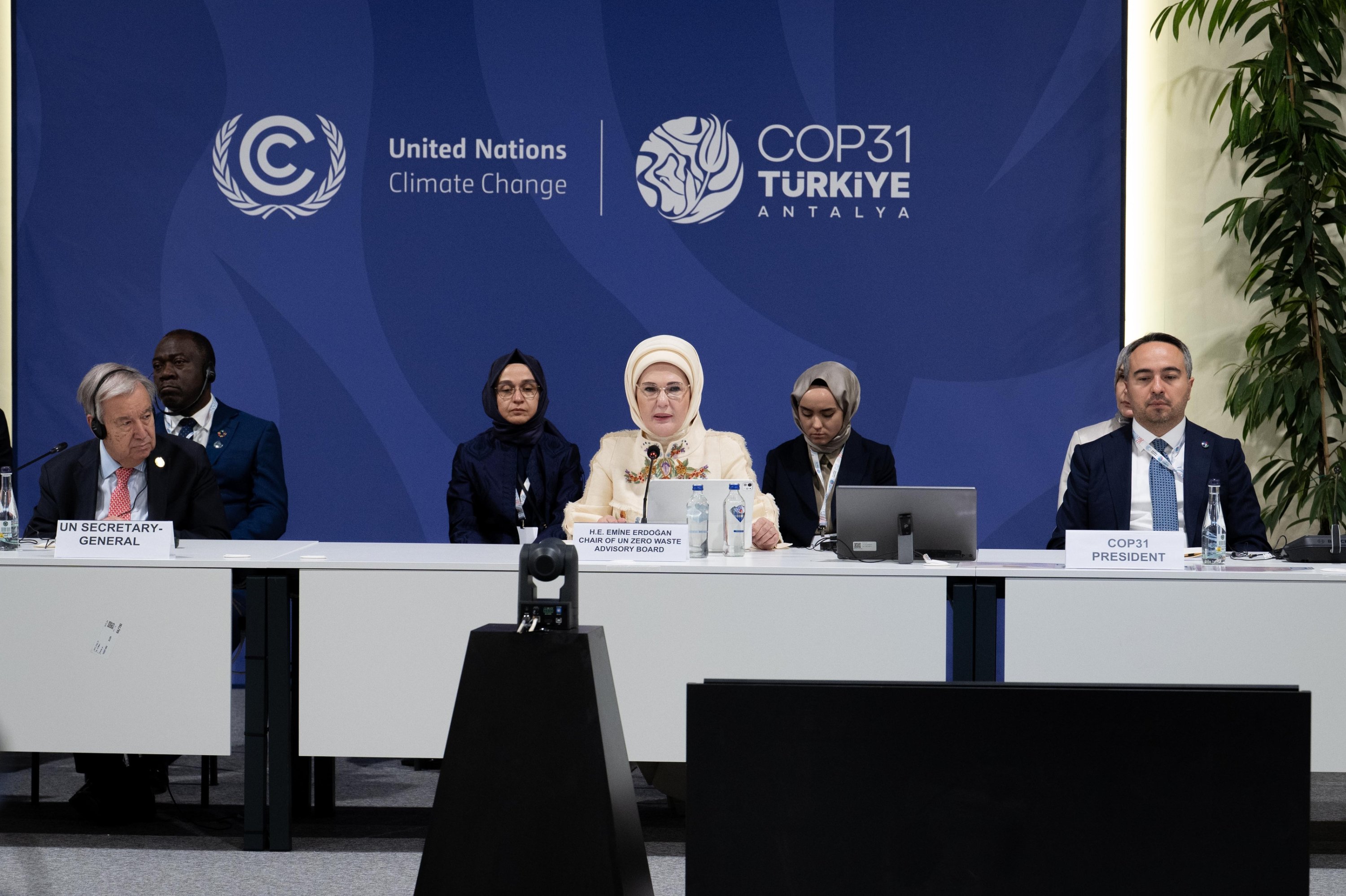
First lady Emine Erdoğan on Wednesday called for a fundamental shift in global consumption and waste management practices, urging governments to embrace circular economy principles and traditional environmental knowledge to curb rising waste generation and methane emissions.
Speaking at a high-level roundtable during the leaders’ summit of the 31st United Nations Climate Change Conference (COP31) in Antalya, Erdoğan said the world must reduce the projected increase in global annual municipal solid waste by at least 50% by 2035.
“Humanity has drawn all its inspiration from nature throughout history. What we need to do now is learn lessons from the school of nature once again,” she said, stressing that achieving the waste reduction target would require a fundamental reconsideration of how societies produce, consume and manage resources.
Erdoğan, who chairs the United Nations Zero Waste Advisory Board of Eminent Persons, said the growing global waste burden should not be viewed solely as an environmental problem but also as a crisis of mindset, culture and civilization.
The roundtable, titled “Zero Waste, Circularity and Methane – Leaders’ Roundtable,” was organized by the COP31 presidency, the International Energy Agency (IEA) and the U.N. Zero Waste Advisory Board of Eminent Persons.
Recalling how disposable products were promoted as symbols of modernity and convenience in the early 1950s, Erdoğan said the single-use lifestyle had once been presented as a sign of prosperity and progress.
She noted that magazines of the period celebrated disposable plates, cups, forks and knives as innovations that saved time and made everyday life easier.
However, the consequences of that consumption model have become increasingly evident. Erdoğan said single-use plastics account for 40% of global waste, while the world has experienced an unprecedented increase in waste generation over the past half-century.
Municipal solid waste is projected to double by 2050, reaching approximately 4 billion metric tons, she said.
“If we consider this almost unmanageable waste burden solely as an environmental crisis, we will be addressing the issue incompletely,” Erdoğan said. “This is, in fact, a crisis of mindset. At the same time, it is a crisis of culture and civilization.”
She argued that societies cannot move toward the future without accounting for the consequences of what they leave behind, adding that climate action must begin with a reassessment of the values and assumptions that shape consumption.
Erdoğan said the relationship between consumption and prosperity should be reconsidered, particularly as food waste continues to exacerbate environmental and social challenges.
Nearly 30% of the world's food production is wasted, she said, adding that the amount of food discarded globally could feed nearly 700 million people experiencing hunger if only one-quarter of the wasted food were recovered and used for consumption.
Food waste also accounts for 10% of global greenhouse gas emissions, Erdoğan said, highlighting methane as one of the most significant emissions associated with discarded food.
She added that methane emissions have been responsible for nearly one-third of global warming to date, with around 60% of these emissions originating from human activities.
Erdoğan stressed that individual consumption habits, when repeated on a global scale, can have significant environmental consequences.
From crops rejected in the fields for cosmetic reasons to fruit forgotten in refrigerators, seemingly insignificant decisions contribute to a much wider waste problem, she said.
The consequences are ultimately borne by vulnerable populations, including children who go hungry, people forced to leave villages rendered uninhabitable by climate change and species that disappear permanently, she added.
“If we want to untangle this knot, we must first free this issue from being confined to technical language,” Erdoğan said, calling for value-based systems that people can understand, embrace and incorporate into their daily lives.
She described the Zero Waste Movement as essential to this transformation, arguing that environmental protection requires more than awareness of greenhouse gas emissions and waste statistics.
Preventing people from throwing away bread, for example, also requires restoring a sense of appreciation for food and the resources used to produce it, she said.
Similarly, avoiding littering and reducing plastic waste are linked to a broader understanding of nature as a shared responsibility and a trust to be protected, Erdoğan added.
She also highlighted the relevance of traditional knowledge and practices, saying concepts such as the circular economy, renewable energy and resource management were not entirely new ideas but had long been embedded in local traditions across the world.
Referring to Anatolia as an example, Erdoğan recalled the traditional saying, “Without the old, there can be no new,” describing it as a concise expression of the circular economy.
Preserving seasonal produce, using leftovers, repairing broken objects and extending the life of clothing were once natural parts of everyday life, she said.
Erdoğan said such practices reflected respect for food, labor and nature, adding that local knowledge could help societies combat resource waste, methane emissions, pollution and the growing impacts of climate change.
She urged governments to ensure that this knowledge does not become a forgotten heritage but instead serves as an effective component of global climate action.
Erdoğan also pointed to nature's ability to reuse resources, noting that fallen blossoms and other organic material that might be considered waste under conventional production systems can instead become nutrients for the soil.
“Nature does not create waste. It uses its resources in the most efficient way,” she said, calling on humanity to draw lessons from natural systems.
She proposed expanding composting practices to return organic household waste to the soil and scaling up the recovery of organic waste generated by workplaces, shopping centers, hotels and airports.
Such waste could be converted into compost for landscaping or used as a raw material for animal feed production, she said.
Erdoğan linked these measures to the COP31 presidency's waste and circularity objectives, including reducing the projected increase in global municipal solid waste by at least 50% by 2035.
She also called for increasing the circular material use rate to at least 15% by treating discarded materials as potential sources of new raw materials rather than as waste.
The first lady said the roundtable offered an important opportunity to ensure that these targets translated into practical measures and that zero-waste principles became part of everyday life.
She called for local governments, producers, young people and citizens to become active partners in the transition, while urging international cooperation to improve developing countries' access to financing, technology, knowledge and capacity-building opportunities.
Economic models that encourage the production of repairable goods and product designs that extend the lifespan of materials could also help deliver lasting change, she said.
Erdoğan called for countries to share successful practices and learn from one another, emphasizing that climate action requires collective responsibility.
She concluded by expressing her hope that COP31 would bring benefits to humanity.