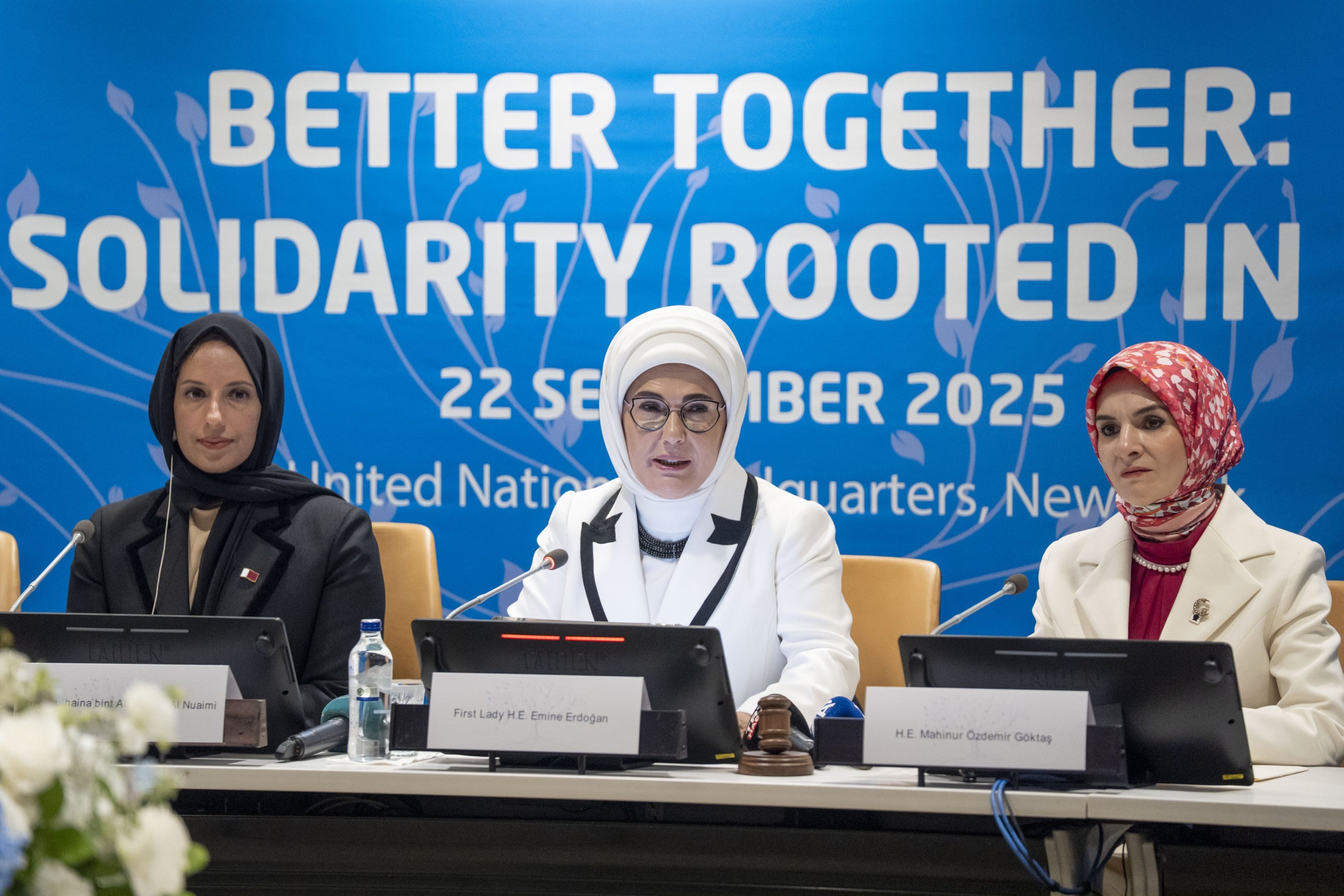
On the sidelines of the 80th United Nations General Assembly in New York, first lady Emine Erdoğan, Chairperson of the U.N. High-Level Advisory Board on Zero Waste, participated in a series of events on Monday, Sept. 22. They highlighted the importance of family, cultural heritage, and sustainable development.
The program began with a side event hosted by Türkiye’s Ministry of Family and Social Services at the U.N. headquarters. The event was themed “Together for Better: Global Solidarity Starting from the Family.”
Ministers, foreign officials and representatives from international organizations attended. Among them were the minister of Family and Social Services, Mahinur Özdemir Göktaş, Qatar’s Social Development and Family Minister Buthaina bint Ali Al Jabr Al Nuaimi, Hungarian Foreign Affairs and Trade Minister Peter Szijjarto, and Sierra Leone’s minister of Gender and Child Affairs, Isata Mahoi. Representatives from Nigeria, Serbia, Russia and the United States were also present.
Emine Erdoğan opened the program by emphasizing the family’s role as humanity’s most sacred institution. She described it as the first home and primary refuge. The family protects individuals from life’s challenges. It also nurtures moral and ethical values.
“The family is under siege from multiple directions today,” Erdoğan said. “Global threats such as climate change, wars, the popular culture industry and attempts to undermine traditional gender roles deeply affect the family institution. Values that cultivate inner richness and spiritual competence are being replaced by materialist consumption. We are moving toward a world dominated by post-family realities. Extended families have been replaced by nuclear families, and single-parent households are increasing.”
She highlighted global demographic trends, noting declining fertility rates and delayed marriages. The average number of births per woman has decreased from around 5 in 1950 to 2.3 in 2021. It is expected to drop further to 2.1 by 2050. Erdoğan warned that the world is aging and becoming more isolated. “Strengthening family-focused policies is no longer a choice but a necessity. The fate of societies is directly linked to the strength of family institutions.”
Erdoğan further stressed the family’s role as the state’s partner and the first problem-solving unit. Children raised in healthy families grow into compassionate, socially conscious individuals. Strong family bonds support the education of children, care for the elderly and assistance for the sick.
“Family is not just about living under the same roof. It is about sharing joy, sorrow, and resilience,” Erdoğan said. She called for the U.N. to adopt family strengthening as a central policy. She also suggested creating a dedicated U.N. structure to coordinate these efforts.
Addressing the global orphan crisis, Erdoğan drew attention to conflicts in Gaza, Sudan, Yemen, Myanmar and Ukraine. Millions of children are deprived of safety, education and care. “In times of war and crisis, families are hit first. Yet, families are also the source of hope, resilience and rebirth. To the extent we protect families, we can build a fairer, more peaceful and prosperous world.”
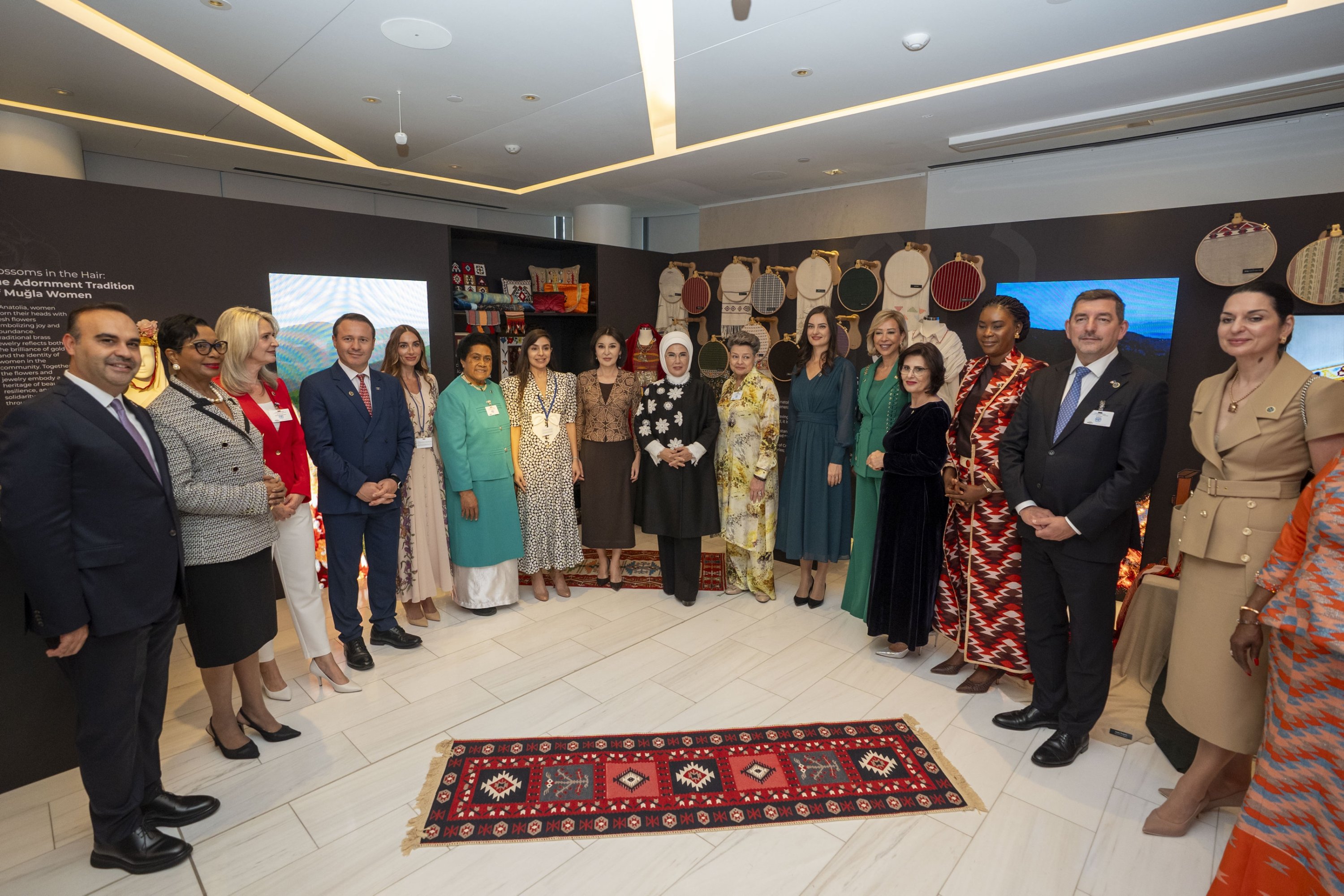
Following the event, Emine Erdoğan visited a promotional exhibition near Turkish House (Türkevi). The event was part of the “People of Anatolia” project. The project is coordinated by Türkiye’s Ministry of Industry and Technology with Development Agencies and Regional Development Administrations. Its goals include promoting local products, preserving cultural heritage and highlighting sustainable production practices.
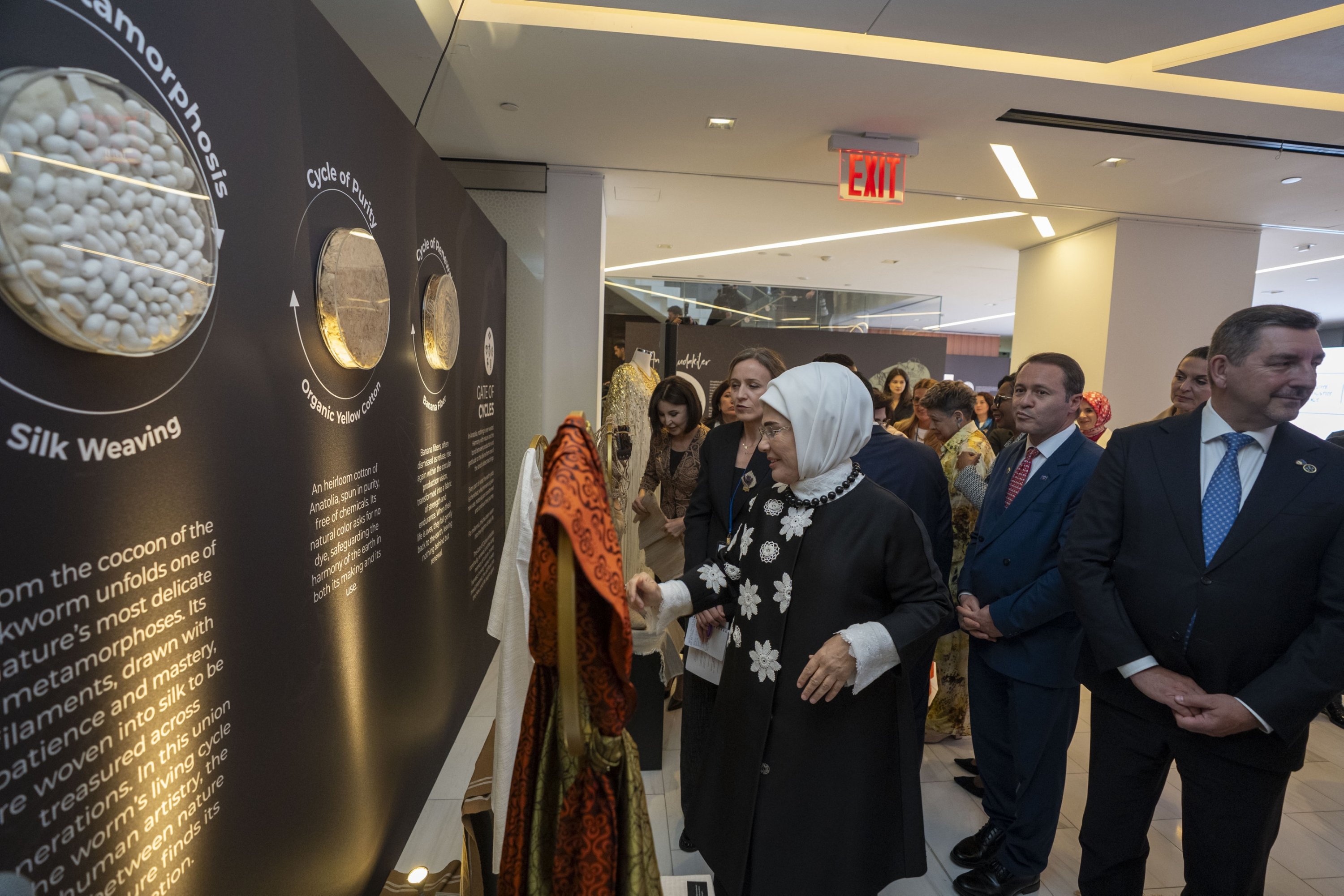
The exhibition displayed around 40 items, which included traditional fabrics, handmade carpets, filigree and kazaziye jewelry, ceramics, walnut chests and hand-hammered copper vessels. It was organized around four thematic doors: “Cycle,” “Continuity,” “Solidarity” and “Mastery.” Visitors learned about Anatolia’s production culture and craftsmanship.
Interactive activities allowed participants to experience traditional crafts firsthand. They could print on Tokat looms, emboss motifs on copper and create digital marbling ("ebru") artworks. Erdoğan highlighted Anatolia’s cultural and historical wealth as a model for sustainable development.
“Life in Anatolia shows how past wisdom can be connected to modern challenges. Its traditions, skills and communal spirit provide a roadmap for humanity,” she said. Erdoğan emphasized that ethical production, upcycling, sustainable fashion and support for women’s labor have long been part of Anatolian practices. These reflect principles of zero-waste and circularity.
Erdoğan also addressed the threats globalization poses to local cultures and languages. While over 7,000 languages are spoken worldwide, she warned that half may disappear by the end of the 21st century. “The death of a language is the death of a society’s culture, its way of thinking and its emotions,” she said.
She cited the destruction of cultural heritage in conflict zones, including Gaza, Ukraine, Syria and Yemen. Looting of Syria’s Palmyra, the inclusion of Ukrainian cities Lviv, Kyiv and Odessa in UNESCO’s endangered World Heritage list, and the destruction of hundreds of other heritage sites were highlighted.
Erdoğan stressed the importance of preserving humanity’s shared heritage. She mentioned historical figures such as Yunus Emre, Hacı Bektaş-ı Veli and Rumi as symbols of Anatolia’s philosophy of compassion, unity and human brotherhood. She urged participants to carry this spirit beyond the exhibition, particularly toward conflict zones like Gaza and Ukraine.
The first lady emphasized the importance of safeguarding Palestinian heritage. “We must not allow Israel to erase pre-1945 Palestine from memory. The future of Palestinian children depends on protecting their past,” Erdoğan said. She noted the humanitarian crisis in Gaza. Thousands of children have died in recent years. Many are malnourished and deprived of safety and education. Erdoğan called on the international community to open humanitarian corridors and support sustainable peace.
She also welcomed recent decisions by multiple countries to recognize Palestine as a state. She described these actions as a historic step toward justice and lasting peace.
During her visit, Erdoğan engaged with exhibition staff and sampled traditional Anatolian delicacies. She personally served "ashure" (Noah's pudding), a traditional Turkish dessert, to the guests. The exhibition also included products protected under European Union geographical indications. The aim was to foster appreciation of Anatolia’s culinary and artisanal traditions.
The “People of Anatolia” project categorizes local products into three themes: “Fertility of the Land,” “Accumulation of the Kitchen” and “Skill of the Hands.” It highlights agricultural, food, and handicraft items from across Anatolia. By establishing supply chains between producers and buyers, the initiative promotes sustainability and creates new markets for local producers.
Through both her speeches and the exhibition visit, Emine Erdoğan emphasized the interconnectedness of family, cultural heritage and sustainable development. She highlighted how traditional practices in Anatolia, combined with global cooperation, can address modern challenges.