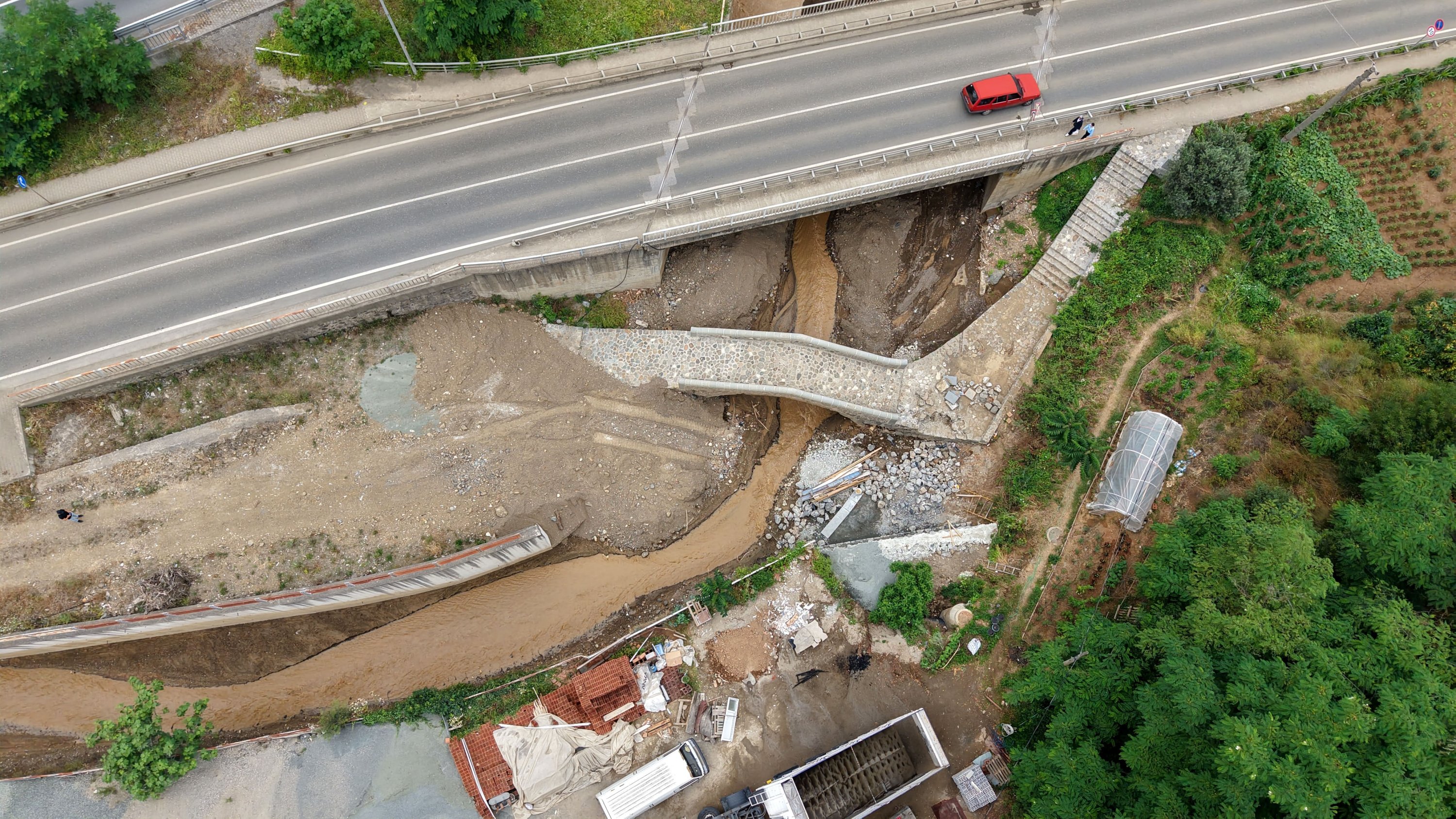
In Trabzon, northeastern Türkiye, a nearly 200-year-old Doğançay Bridge dating back to the Ottoman era is at risk of collapsing.
The latest flood, which occurred a month ago, caused damage to one of the bridge’s piers, leading to erosion at its base. Coşkun Erüz, president of the Association for the Protection of Natural and Historical Assets, emphasized: “The retaining walls along the streambed must be repaired, and experts must be consulted to ensure that the stream is redirected to flow directly beneath the bridge.”
Located in the Beşirli neighborhood of the Ortahisar district, Doğançay Bridge is the only historical arched example that has been preserved and restored to date in the city’s coastal area. Although it has withstood many floods, the recent flood caused scouring at one of its piers, resulting in wear at the base. Teams from the State Hydraulic Works (DSI) and the General Directorate of Highways are currently carrying out stream rehabilitation and sediment removal efforts around the bridge.
Erüz stressed the need to realign the streambed so that the water flow is centered under the bridge. He warned that the bridge might not survive the next flood, saying: “As the Association for the Protection of Natural and Historical Assets, we consider this 200-year-old structure, known as the Beşirli or Doğançay Bridge, one of Trabzon’s key historical assets. It is the only remaining engineering structure from the coastal road between Trabzon and Akçaabat."
He added: "It is also the only historical arched bridge within Trabzon's city center. Although it has withstood many floods and has been restored, a mistake in redirecting the streambed has caused water flow to target the bridge’s pier. As a result, the last flood caused damage, and the next one could cause even greater erosion and lead to the bridge’s collapse.”
Erüz added that the retaining walls along the stream should be revised and the flow redirected to run directly under the bridge, based on expert consultation. If not, while individuals may take their own precautions during intense rainfall, this public structure remains at serious risk. If the situation continues, the next flood could destroy the bridge.
DSI and the General Directorate of Highways are conducting stream rehabilitation to remove sediment, but simply clearing the sediment is not enough. The streambed must be widened to allow an unhindered flow that protects the bridge and prevents sediment accumulation. The DSI or the Trabzon Metropolitan Municipality must reassess this area and redesign the surrounding infrastructure.
Local resident Adnan Yavuz expressed concerns about the damage caused by the strong current: “This is the oldest Ottoman bridge here. It has survived many hardships and floods but has never collapsed. In the past, the streambed was wider, and there wasn’t this much construction. Now the stream has been confined to a channel, but when water flows with a lot of force, it damages the bridge."
"One of its piers has already been eroded. The streambed must be thoroughly cleared and left in its natural state. When its sides are filled in, the channel can’t contain the flow, causing destruction. It’s uncertain whether the bridge can survive the next flood. The damage has started from the base. Also, tree debris coming from upstream causes blockages and adds extra pressure,” he said.