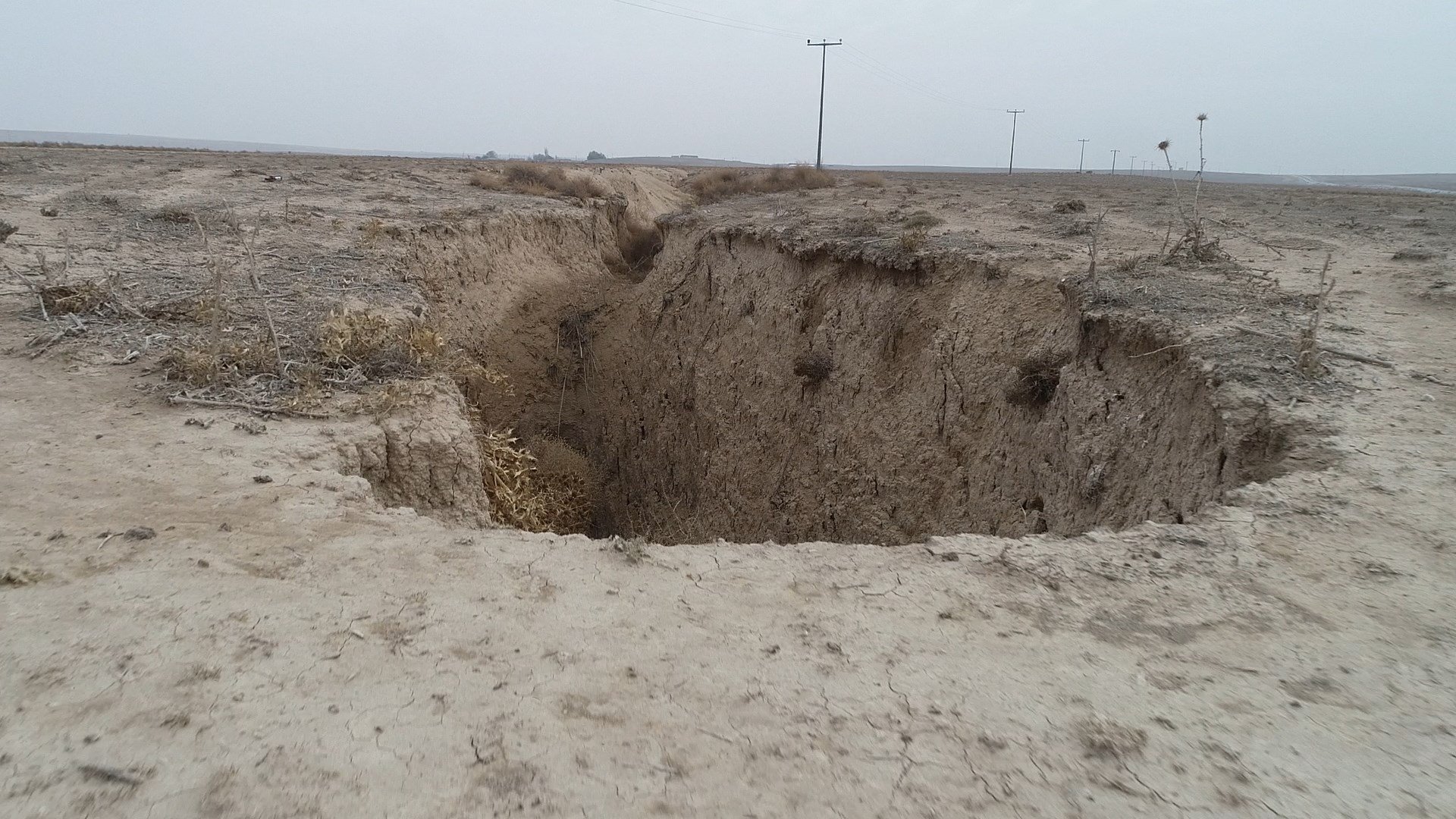
The Konya Basin, one of Türkiye’s most critical agricultural and geological regions in central Türkiye, is experiencing accelerating ground deformation as prolonged drought and declining groundwater levels trigger sinkholes, surface cracks and vertical subsidence, experts warn.
According to the Chamber of Geological Engineers’ Konya branch, satellite-based monitoring shows that parts of the Konya Closed Basin are sinking by up to 10 centimeters (3.9 inches) annually, signaling an ongoing and active subsidence process with growing implications for infrastructure, industry and settlement safety.
Şükrü Arslan, head of the chamber’s Konya branch, said on Monday that the basin is being closely tracked using satellite data, allowing year-over-year comparisons of ground movement.
“The Konya Closed Basin is a subsidence basin and remains actively sinking,” Arslan said. “In some locations, satellite measurements clearly show annual collapses reaching 10 centimeters. This is not a one-off phenomenon; the basin continues to subside.”
Experts attribute the deformation to a combination of tectonic dynamics, climate-driven drought and excessive groundwater extraction, particularly for agricultural irrigation. As groundwater levels drop, underground voids and weakened soil structures lose support, leading to collapses that manifest at the surface as sinkholes, fissures and stepped subsidence.
Arslan explained that Türkiye sits on the Anatolian Plate, which is compressed by the Arabian Plate to the south and the Eurasian Plate to the north. “Beyond this broader tectonic pressure, the Konya Basin is affected by internal expansion within the Anatolian Plate,” he said. “When this geological movement is combined with intensive groundwater withdrawal, subsidence becomes unavoidable.”
The visible consequences of this process are no longer confined to rural landscapes. While sinkholes and surface cracks were previously observed mainly in pastures and sparsely populated areas, ground fissures are now increasingly appearing in urban and industrial zones, raising concerns about structural safety.
“In recent years, surface cracks have expanded into Konya’s central districts,” Arslan noted. “These fissures can cause serious damage to buildings and infrastructure. We have observed cases in industrial zones where factories have been affected, as well as multiple locations in the Karatay district where ground cracking has led to structural instability.”
Geologists also point to the role of clay-rich geological layers along active or dormant fault lines. As groundwater is depleted and drought intensifies, clay minerals shrink at varying rates depending on their composition and depth. This uneven contraction causes fractures to emerge along fault lines, often forming step-like, terraced ground structures over time.
The developments have intensified calls for more sustainable water management, stricter regulation of agricultural irrigation and expanded geological monitoring across the basin. Experts warn that without coordinated intervention, subsidence risks could escalate, threatening both economic assets and public safety in one of Türkiye’s most productive inland regions.