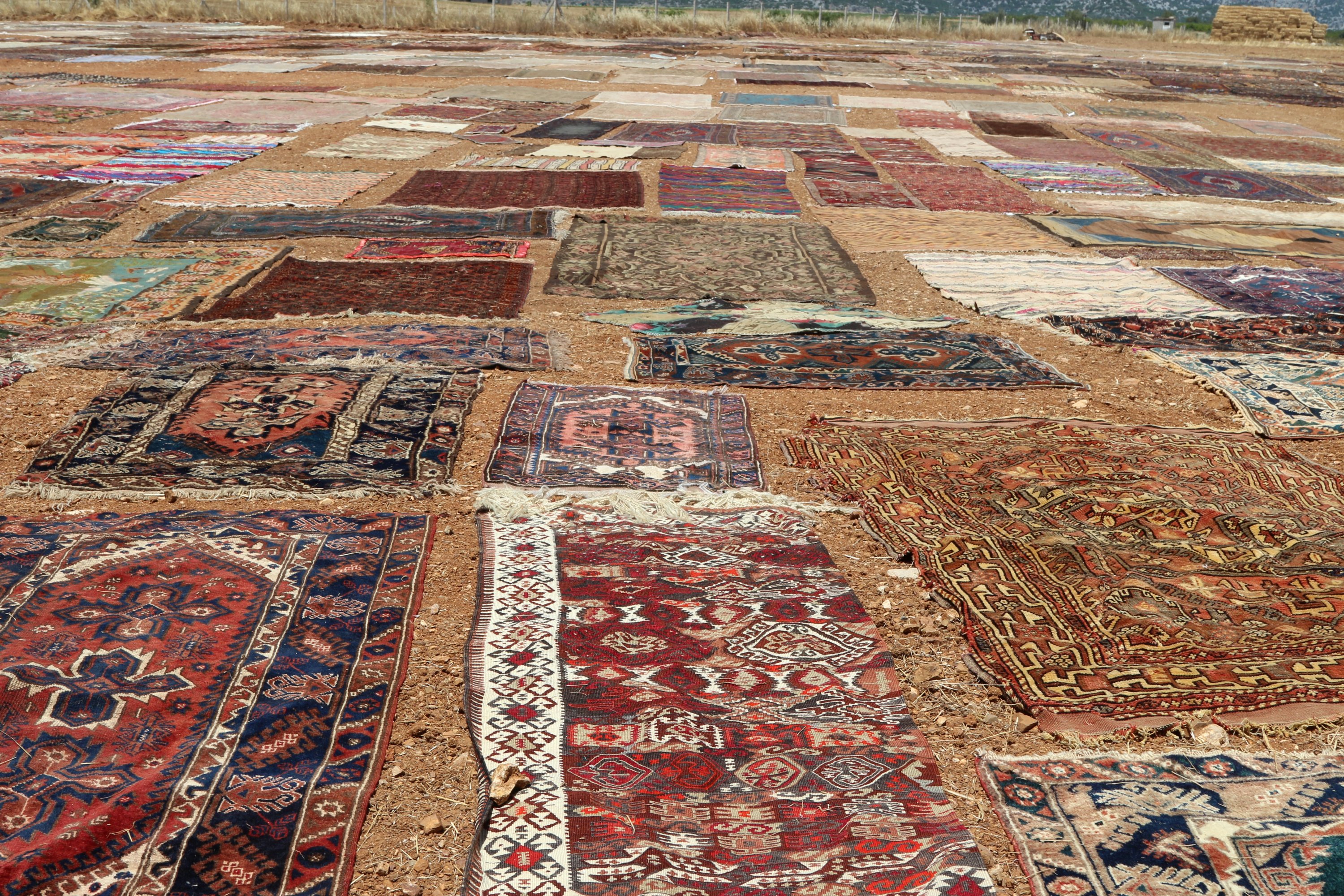
In Antalya, southwestern Türkiye, the lands turn into vast carpet fields during the blazing summer months. Handmade carpets collected from all across Türkiye are spread out under the sun, where they fade into pale and pastel shades.
These carpets, primarily exported to the U.S. and European countries, undergo a natural sun-drying process. Rare carpets woven over 100 years ago with collectible value sell for up to $8,000.
During the summer, fields in Döşemealtı district of Antalya become like an art tableau as handwoven carpets brought from various parts of Türkiye are laid out.
These carpets, woven with organic dyes and containing no synthetic materials, are prepared for export through this natural process. Once dried, they are shipped to destinations worldwide.
Halil Börekçi, who has been working in carpet sun-drying since 1971, stated: “I started this work many years ago. I also sold carpets in Niğde. I have been doing this in Antalya for 25 years. In 1988-1989, I won the third-place medal in Türkiye’s carpet export; my son is also involved in this business. I inherited it from my father, and my son will continue this tradition from father to son."
"The used carpets collected from across Türkiye are woven only with natural dyes. No synthetic threads are used because Antalya’s temperature sometimes reaches 45 to 48 degrees Celsius (113 to 118 degrees Fahrenheit), and synthetic carpets cannot withstand this heat. They almost turn into plywood. We lay out only completely natural, original and sun-resistant carpets,” he explained.
Describing the sun-drying and cleaning stages of the carpets, Börekçi said: “We also collect used carpets from various parts of Türkiye. First, we sterilize them to remove microbes. Then, we wash them with soap and shampoo and lay them in the sun. These carpets are entirely organic, with no synthetic threads or chromium dyes.
"Some chemicals used in dyeing, such as indicators, evaporate under the sun’s effect and the dew at night. This process reveals the carpets’ natural colors – pastel hues remain pastel, vibrant colors stay bright. No artificial acid fading is applied. At the same time, microbes cannot survive under these high temperatures,” he added.
Börekçi noted that carpets are sent to shops in mid-October. “This season, we will spread about 15,000 carpets in the fields. So far, we have laid out 7,000. We export these carpets all over the world. The U.S. is the largest buyer, but we also export to Europe, Japan, Australia and even South Africa. We prepare our fields in the first week of May and start laying carpets from the 15th. This continues until the end of July. We begin collecting the carpets from mid-August, and this process continues until mid-October,” he said.
Börekçi also mentioned that carpet prices have declined due to wars in the Middle East.
“Sales have decreased because of the conflicts. Our main season begins in September and October. A worker earns about TL 1,000 ($25) per day. A carpet woven in 20-25 days costs around TL 25,000. The thread costs are about TL 7,000 to TL 8,000. So, the total cost of a carpet can reach TL 32,000 to TL 33,000. Currently, regular carpets sell between TL 15,000 and TL 20,000,” he explained.
Börekçi also spoke about collectible carpets, saying: “These are antique carpets woven 50, 100 or even 150 years ago. They are sold in dollars. Their prices start at $5,000 and can go up to $8,000. Previously, such carpets could sell for $15,000 to $20,000, but prices have dropped recently.
"These types of carpets are usually preferred by collectors and private buyers,” he concluded.