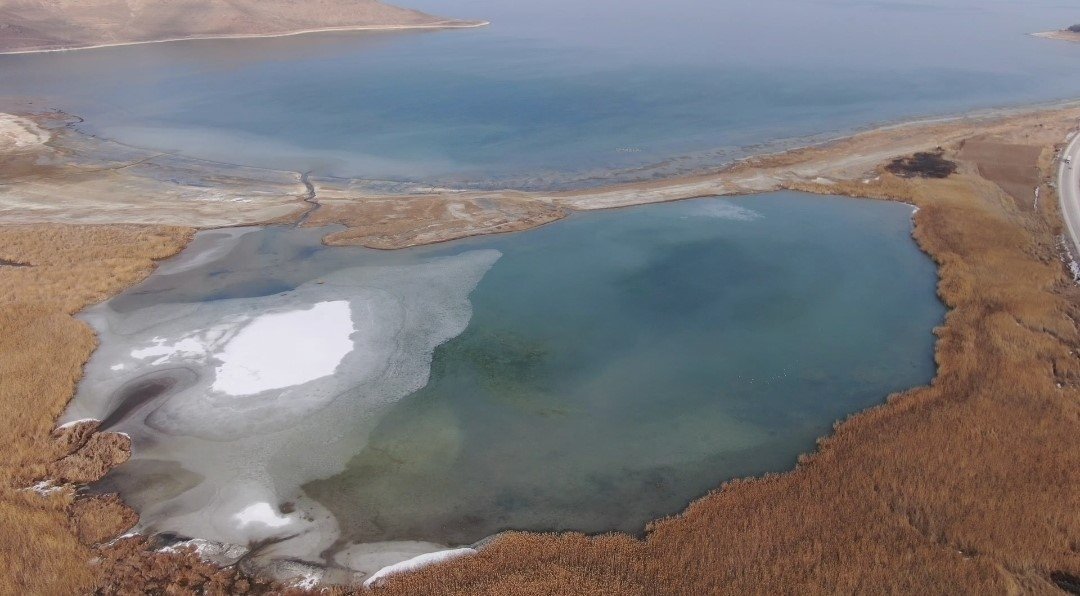
If the water in Lake Van, the largest lake in Türkiye that lies in the easter Anatolian region, doesn't cool down in the near future, it's ecosystem will face distressing consequences, warned Mustafa Akkuş, a faculty member at Van Yüzüncü Yıl University's (Van YYÜ) Fisheries Faculty.
"At this time of year, the surface water temperature of Lake Van should be around 3.5 to 4 degrees Celsius (38.3 to 39.2 degrees Fahrenheit), but it is currently at 6 to 6.5 degrees Celsius (42.8 to 43.7 degrees Fahrenheit)," said the expert.
Akkuş highlighted that Lake Van covers an area of 3,712 square kilometers (1,433 square miles) and forms a massive aquatic ecosystem with its own ecological structure.
"For this ecological system to function healthily, certain conditions must be met. One of these requirements is that during the winter season, the surface water temperature of Lake Van should drop below 4 degrees Celsius. When that happens, their density increases, causing the surface water to sink while the deeper water rises. This creates a circulation in the lake. This allows nutrient-rich bottom waters to reach the surface, where they interact with sunlight and promote the growth of plankton, which serves as the primary food source for pearl mullet in the lake," the expert said.
Akkuş noted that the lake staying above 4 degrees means that it has effectively been unable to breathe this year.
"The water at the surface and the bottom has not exchanged places, preventing nutrient-rich bottom waters from reaching the surface, we hope that in the coming days, temperatures will drop, and Lake Van’s surface water will cool down," he said.
The specialist reported that the warmest area of the lake is near Çarpanak Island, where temperatures drop to around 5 degrees near the shores.
"The coldest region of the lake is Erciş Bay, where the temperature is approximately 4.5 degrees Celsius. If the surface temperature does not drop below 4 degrees Celsius soon, Lake Van will be unable to cool down and will effectively struggle to breathe," he concluded.
Lake Van is a saline soda lake with high alkalinity, which means the water is less acidic. This limits marine life, except for the native Van fish.
The lake is surrounded by historical landmarks, including Akdamar Island. The region also features remnants of the ancient Urartian civilization, that developed in the Bronze and Iron Age.