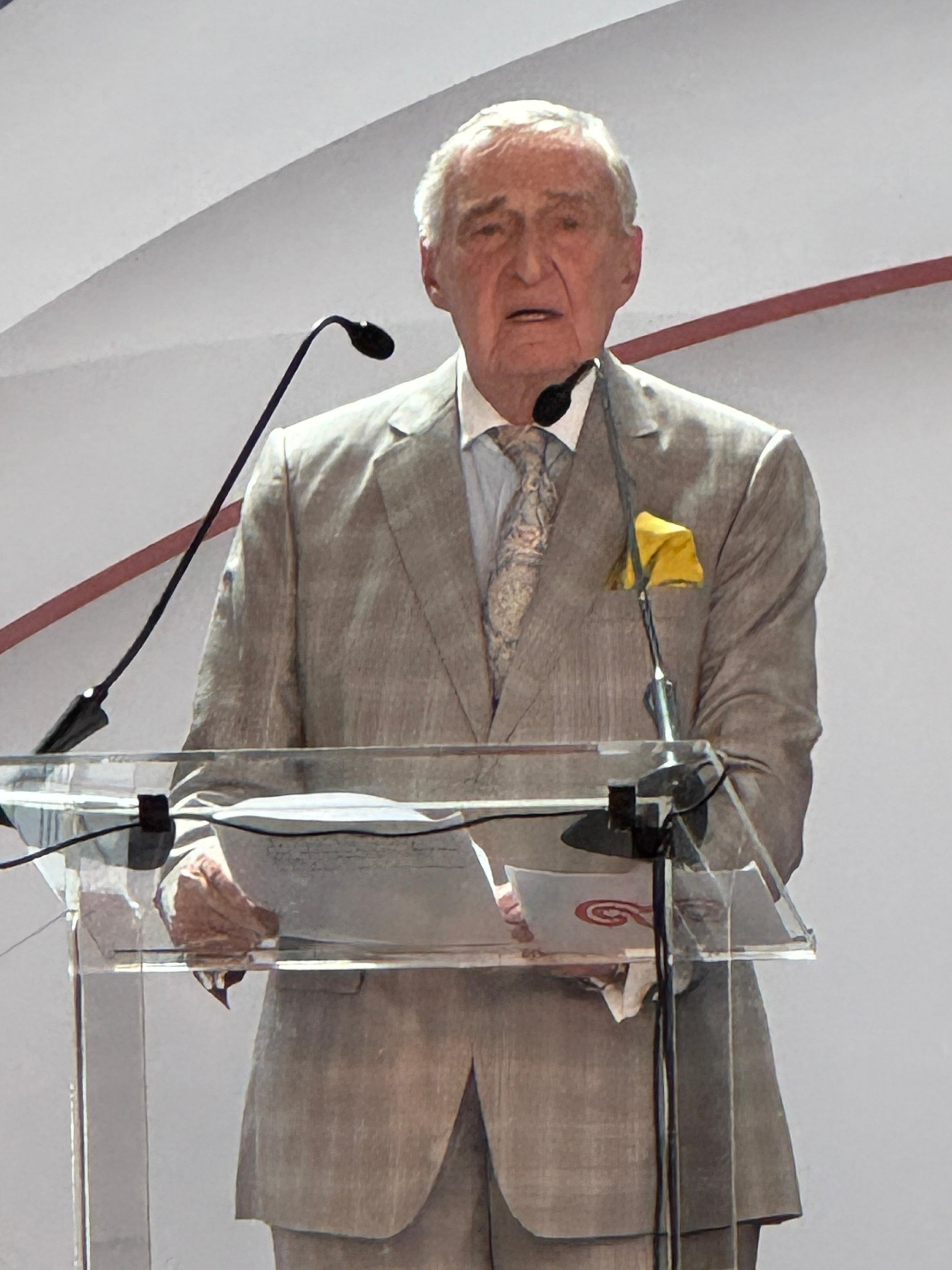
A "joke" told by Turkish businessperson Rahmi Koç during a public event on Saturday has sparked widespread criticism and renewed debate over harmful stereotypes in Türkiye.
Video of the remarks quickly circulated on social media, drawing criticism from Kurdish and Turkish voices across Türkiye as well as international observers. The backlash reignited debate over prejudices, sexism and the continued use of harmful stereotypes in public discourse.
Koç recounted the "joke" during the inauguration of a hospital in Izmir, western Türkiye. In the story, a medical doctor asks a "Kurdish woman" to undress behind a curtain for an examination, only for her to allegedly reply that the doctor should undress first. The audience responded with laughter.
For many critics, the controversy extends beyond a single joke. They argue that the story derives its humor from portraying a Kurdish woman as incapable of understanding a simple medical instruction, reducing both an ethnic identity and a gender to stereotypes for "comedic effect."
The backlash soon moved beyond social media and into the political and legal arena, with the Izmir Chief Public Prosecutor's Office launching an investigation under Article 216 of the Turkish Penal Code on publicly degrading a segment of society.
The controversy also drew reactions from senior government officials, who condemned the comments and emphasized the principles of equality, human dignity and social cohesion.
Vice President Cevdet Yılmaz, a Kurd, likewise criticized the comments, saying no one should be subjected to offensive stereotypes or negative perceptions because of their gender, ethnic identity or social background. He emphasized that respecting differences and strengthening a culture of coexistence are essential to preserving national unity and social harmony.
Kurdish community makes up a sizable portion of Türkiye’s population and has been under spotlight recently during the terror-free Türkiye initiative. The initiative aims to dissolve the PKK, a terrorist group claiming to fight for Kurdish rights.
Devlet Bahçeli, leader of Nationalist Movement Party (MHP), is one of the architects of the initiative and advocates that it will cement Turkish-Kurdish unity in the country. Koç’s remarks came at a time for growing calls for this unity after decades of the PKK campaign which held hostage the struggle for Kurdish rights.
Bahçeli, a good friend of Koç who attended an event to mark the anniversary of the Koç conglomerate earlier this week, said in a written statement that it was “wrong” to launch an investigation into Koç over a joke. He underlined that the Koç conglomerate had major responsibility in helping Türkiye’s development for a century and they also backed Türkiye’s national values.
Rahmi Koç now serves honorary president of the business dynasty established by his father Vehbi in early 20th century. Between 1984 and 2003, he served as chairman of the board at the conglomerate which operates companies in various sectors, from electronic appliances to automotive, energy and banking.
Justice Minister Akın Gürlek said expressions that undermine women's dignity and target citizens based on their identity cannot be justified as humor. Announcing the launch of the investigation, Gürlek stressed that justice does not distinguish between wealth, status or social standing, adding that discriminatory remarks are unacceptable regardless of who makes them.
Family and Social Services Minister Mahinur Özdemir Göktaş also condemned the remarks, arguing that statements that demean or target women because of their identity, origin or gender cannot be legitimized under the guise of humor. She added that violence against women extends beyond physical acts and includes language that humiliates, insults or undermines human dignity.
Justice and Development Party (AK Party) spokesperson Ömer Çelik also condemned the remarks, saying that associating the phrase "Kurdish woman" with a derogatory expression was "very wrong and ugly."
In a statement on social media, Çelik said the comments had offended both Kurdish citizens and women, adding that hate speech cannot be justified under the guise of humor. He called for respectful language when discussing issues related to ethnicity, identity and gender, and said all citizens deserve equal dignity and respect.
The Women's and Democracy Association (KADEM) also condemned the remarks, saying statements that demean women cannot be legitimized under the guise of "humor" or a "joke" and are unacceptable in public discourse.
Koç issued a public apology shortly after the remarks sparked controversy, saying he had no intention of offending anyone. However, the apology did little to stem the criticism, with many arguing that the issue was not merely one of intent but of the stereotypes embedded in the joke itself.
The controversy also brought back criticism that parts of Turkish society have long directed at the Koç family. During the 2013 Gezi Park protests, the family and its companies were accused of supporting anti-government movements, a claim the company has denied.
Journalist Erhan Güleç, whose team recorded and published the "joke" footage, said he was professionally proud to have brought the remarks to public attention. Güleç also alleged that after the video began circulating online, he received a phone call from a person he later learned was the head of a Koç-affiliated health institution, who asked him to remove the footage.
According to Güleç, after he refused the request, the caller warned him that "it would be very bad" if the video remained online, remarks he interpreted as a threat.
Many people took to social media to demand an apology from Koç, while others called for boycotts of Koç Group brands, businesses and venues. Hashtags criticizing Koç and urging consumers not to support the group's companies quickly spread online.