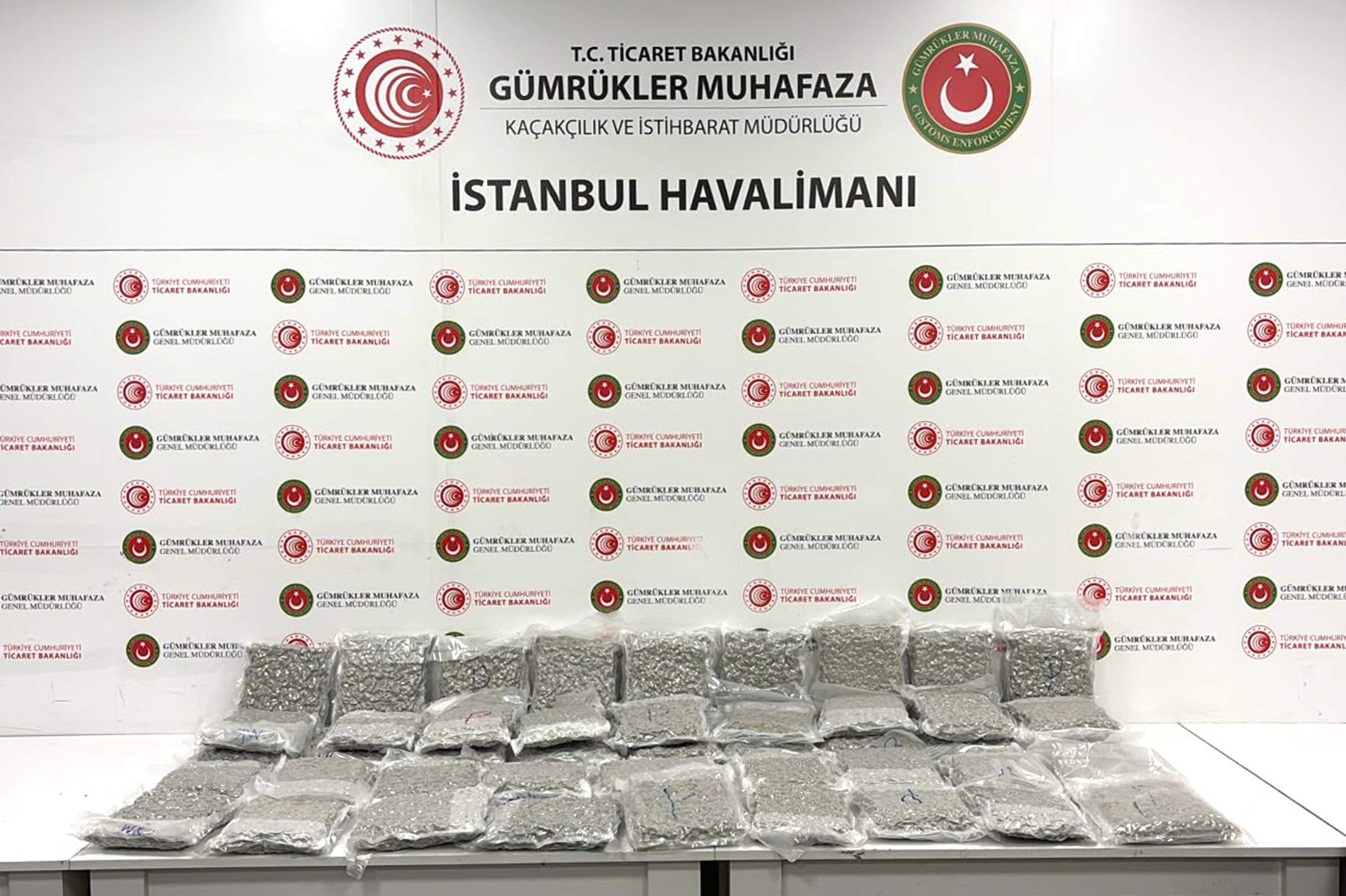
Customs enforcement teams at Istanbul’s two major airports have seized nearly 9 tons of drugs in 253 separate incidents since the beginning of 2026, using advanced detection technology and intelligence-led inspections to combat international narcotics trafficking.
Authorities seized a total of 8,875 kilograms (19,566.03 pounds) of drugs and synthetic narcotics at Istanbul Airport and Sabiha Gokcen International Airport, according to figures shared by customs officials.
The operations also led to the apprehension and subsequent arrest of hundreds of people linked to drug smuggling cases.
Customs enforcement teams affiliated with the Trade Ministry continue to inspect passengers, baggage and cargo at the two airports, which serve as major international aviation hubs connecting Türkiye with destinations across Europe and the rest of the world.
The teams combine intelligence gathering, risk analysis and technological screening to identify suspicious shipments and passengers, with particular attention paid to routes considered high-risk for international drug trafficking.
Narcotics detection dogs and advanced screening devices are also deployed to counter increasingly sophisticated concealment methods used by smugglers.
Nurhak Demirtaş, head of the Anti-Smuggling and Intelligence Department at Istanbul Airport Customs Enforcement, said the airport’s heavy passenger and cargo traffic required sustained efforts to prevent illegal activities.
“We inspect a very large number of passengers, cargo shipments and goods here. Smugglers can be very creative in their attempts to smuggle both drugs and commercial goods. As they develop new methods, we do everything we can to uncover their tactics and continue working tirelessly,” Demirtaş said.
He added that the seizures made since the beginning of the year totaled approximately 8.875 tons of drugs and synthetic narcotics across 253 separate incidents.
Smugglers employ increasingly diverse methods to evade security checks, hiding narcotics in suitcase linings, luggage compartments, commercial goods and other products, Demirtaş said.
Some suspects also attempt to transport drugs inside their bodies, a method commonly known as body packing.
Describing a recent case, Demirtaş said authorities had discovered a substantial quantity of narcotics concealed in an unusual substance.
“We recently made a seizure involving 500 kilograms of drugs. We detected narcotics infused into pineapple puree,” he said.
Customs officials assess international flight routes according to the types of narcotics trafficked and the risks associated with specific routes, enabling them to focus inspections on passengers and cargo considered more likely to be involved in smuggling.
Demirtaş said customs enforcement teams use a range of technological tools, including X-ray machines, devices designed to detect swallowed drug packages, chemical detection equipment and narcotics detection dogs.
One of the most significant advantages comes from chemical detection devices capable of identifying substances through an extensive database of chemical profiles.
“Our chemical detection device currently contains approximately 20,000 chemical profiles. Without sending a substance to a laboratory, it provides us with preliminary information about what the substance may be. This gives us a significant advantage,” he said.
The technology helps officers obtain preliminary results more quickly, reducing the time needed to identify suspicious substances and supporting more efficient inspections.
Demirtaş emphasized that speed is particularly important at Istanbul Airport, where thousands of passengers and large volumes of cargo pass through daily.
“We are operating at a point where thousands of passengers and hundreds of thousands of cargo shipments pass through every day. Speed is extremely important to us. Being able to obtain rapid results plays a crucial role in ensuring the efficiency and effectiveness of our operations,” he said.
Demirtaş added that the operations also serve as a deterrent against drug trafficking, as authorities continue efforts to identify smuggling networks and prevent illicit substances from entering or passing through Türkiye.