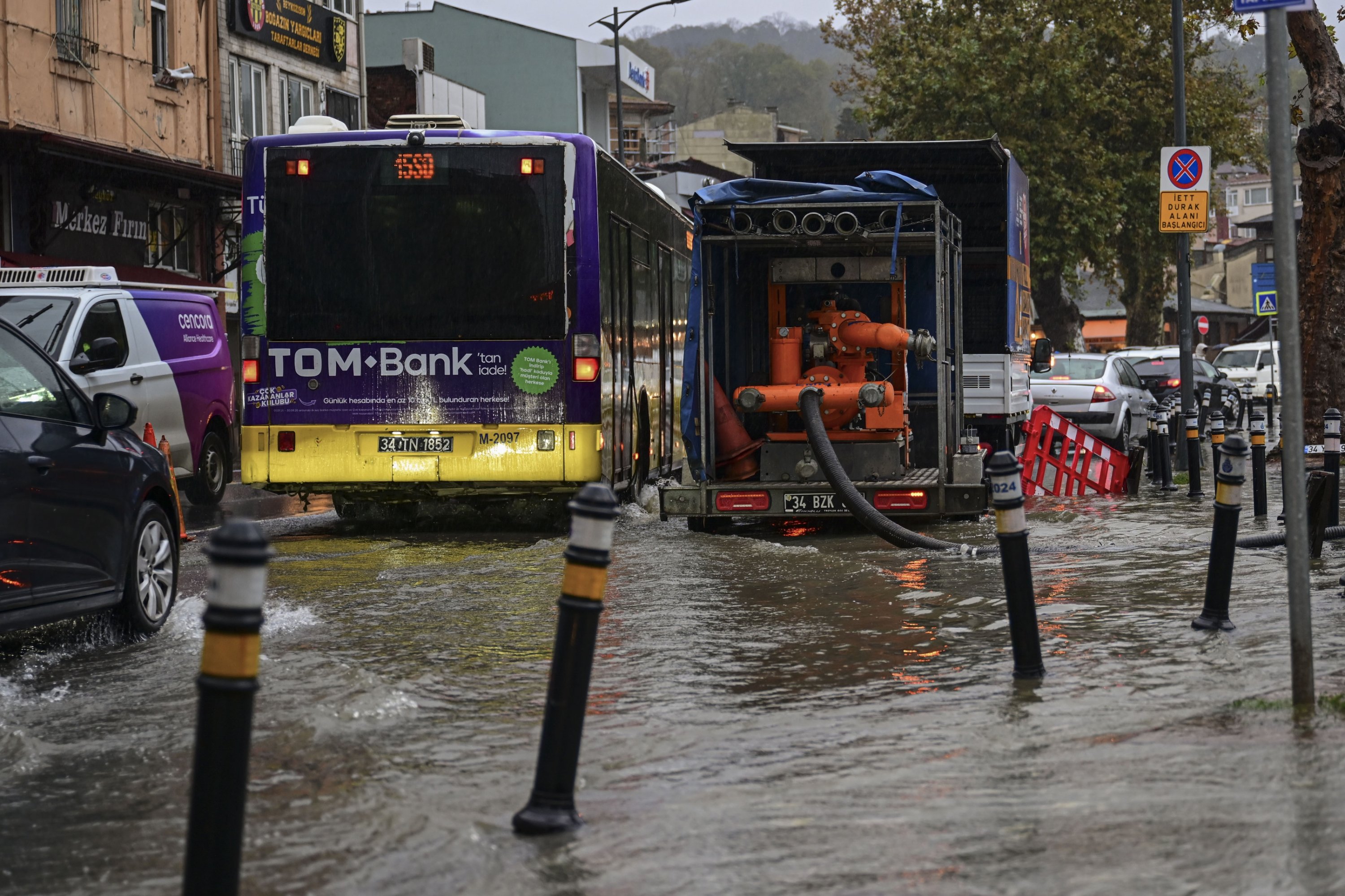
Heavy rainfall that hit Istanbul has triggered 48 landslides and caused 53 retaining walls to collapse across the city’s 39 districts, Environment, Urbanization and Climate Change Minister Murat Kurum said Thursday, as authorities continued damage assessments and recovery efforts.
Speaking after an Istanbul Disaster Coordination Meeting at the provincial Disaster and Emergency Management Authority (AFAD) directorate, Kurum said the coordination center had received 9,755 reports, with response teams intervening in 7,800 cases.
Istanbul recorded its highest rainfall in 83 years, receiving 186 millimeters per square meter in 24 hours and a cumulative 273 millimeters, Kurum said. The downpour increased the filling rate of the city’s dams by 7% in a single day.
The minister said authorities had rescued 3,057 people and moved them to safe locations, with some accommodated at public guesthouses. He added that no residents remained unreachable or awaiting search-and-rescue operations, although teams had continued efforts to find six people reported missing in Ayazağa, Istanbul and Kocaeli.
Three people died in Istanbul during the flooding, Kurum said, extending his condolences to their families and offering support to residents affected in Istanbul, in northwestern Türkiye, Antalya, on the Mediterranean coast, and Sakarya and Kocaeli, in the Marmara region.
Damage assessments are underway, with 300 businesses and 200 vehicles identified as damaged in Istanbul’s Ayazağa district alone. Authorities aim to complete the assessments by the weekend, Kurum said, adding that the government would provide assistance for damage to homes and other property.
The Agriculture and Forestry Ministry is also assessing damage to farmers, with 109 animals reported dead. Authorities plan to provide support for livestock losses and supply essential materials, including animal feed, straw and greenhouse coverings.
Flooding has also affected Sakarya and Kocaeli. Sakarya received around 140 millimeters of rainfall per square meter, causing one house to collapse and a bridge to give way, Kurum said. Flooding and overflowing streams particularly affected Kocaeli’s Başiskele and Kartepe districts.
Six road routes in Istanbul’s Eyüpsultan, Sarıyer and Şile districts were closed as a precaution. Electricity supplies were also cut as a safety measure for around 40,000 residents, including 10,000 on the Asian side and 30,000 on the European side of the city.
Further rainfall expected
Weather warnings remain in place for Istanbul and other provinces, with further rain expected across the city on Friday and Saturday, Kurum said.
He urged residents to avoid unnecessary travel and contact district governor’s offices or municipalities if they needed assistance. Orange weather warnings were also in effect for Zonguldak and Düzce.
Kurum linked the extreme rainfall to changing weather patterns associated with climate change, saying cities could no longer rely solely on historical data when preparing for future disasters.
“Climate change is unfortunately affecting rainfall patterns, and we are now experiencing much heavier rainfall over much shorter periods that we cannot always predict,” he said.
He called for stronger drainage systems, regular maintenance of stream beds and reassessments of flood risks, urging central and local authorities to work together to make Istanbul more resilient to disasters.
“These responsibilities can no longer be postponed,” Kurum said, emphasizing the need to prepare cities for increasingly severe weather events.