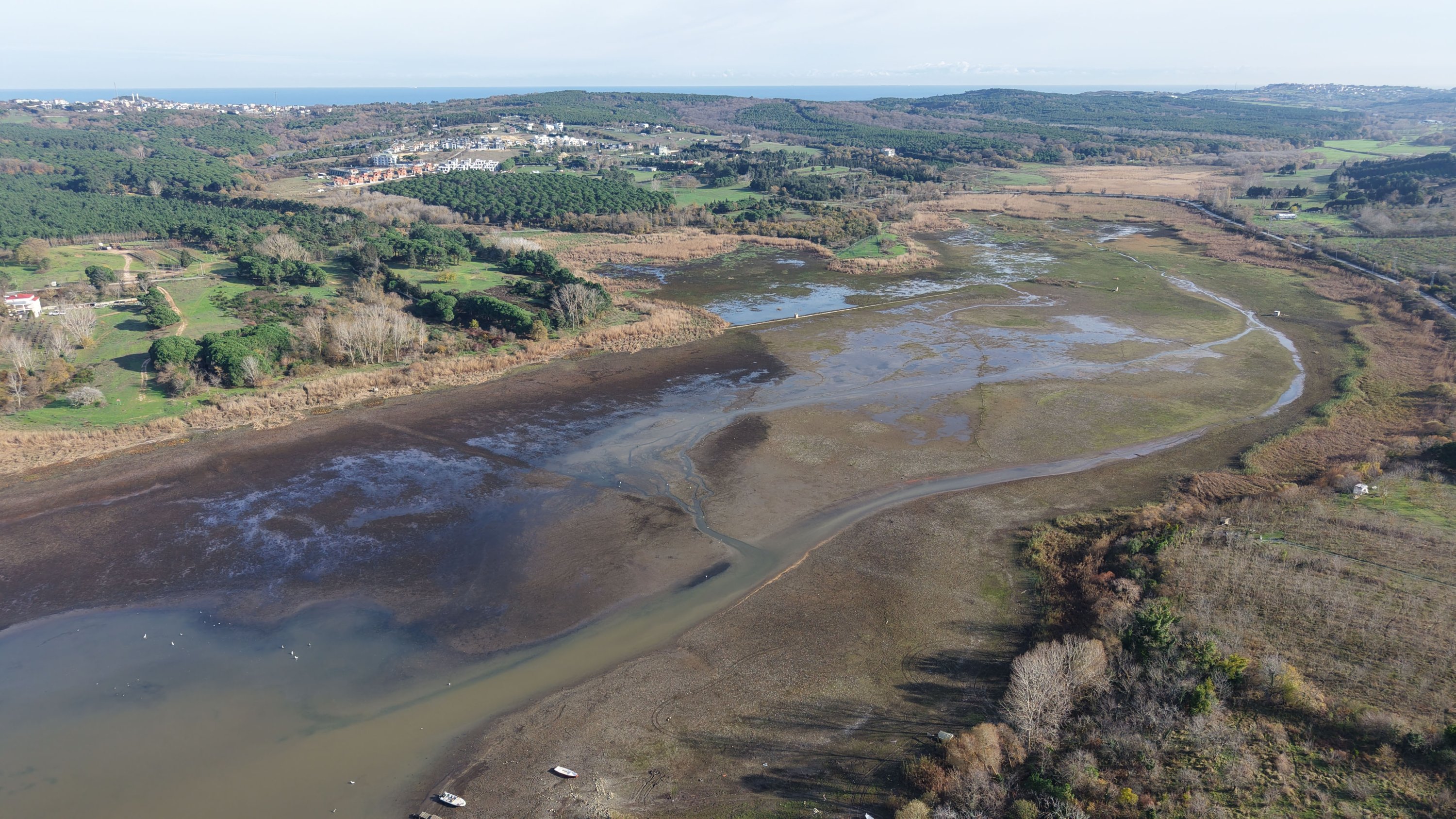
Istanbul is consuming water at a pace never before recorded, setting a historic annual usage record in 2025 as climate pressures, rapid urban growth and structural supply vulnerabilities converge to push Türkiye toward internationally defined water-poverty conditions.
According to official recent data from the Istanbul Water and Sewage Administration (ISKI), the city used 1.17 billion cubic meters of water last year, a volume nearly five times greater than the total capacity of the Ömerli Dam, Istanbul’s largest reservoir. The figure represents the highest annual water consumption ever recorded in the city’s history.
In 2025, Istanbul provided water services to just over 7 million subscribers, underscoring the scale of demand exerted by the country’s largest metropolitan economy.
Of the total water consumed, 767.7 million cubic meters were used on the European side, while 405.7 million cubic meters were consumed on the Asian side. The European side accounted for 65.43% of total usage, compared with 34.57% on the Asian side.
Istanbul’s supply network drew 470.2 million cubic meters from the Melen system, 97.3 million cubic meters from Yeşilçay and 456.9 million cubic meters from dams. The remaining water was sourced from seven streams in the Istranca region and from underground wells.
The city’s highest daily consumption was recorded on July 24, when usage surged to 3.8 million cubic meters, a peak that reflected both seasonal heat stress and rising baseline demand. The lowest daily consumption occurred on March 31, at 2.7 million cubic meters. The annual daily average stood at 3.2 million cubic meters.
Reservoir storage levels fluctuated sharply throughout the year, reaching a low of 17.12% on Dec. 7 and peaking at 82.36% on April 15. Rainfall over Istanbul’s reservoir basins totaled 619.95 millimeters in 2025.
As consumption reaches unprecedented levels, academics from Istanbul Technical University (ITU) warn that Türkiye is entering a structurally fragile water era, driven not only by climate change but by urban expansion patterns that are no longer aligned with natural resource capacity.
Professor Mikdat Kadıoğlu, a faculty member in ITU’s Department of Climate Science and Meteorological Engineering, said the core systemic threat lies in uncontrolled metropolitan growth.
“The real risk is cities growing without regard for their natural resources, infrastructure and living spaces,” Kadıoğlu said.
He said scientific indicators show Türkiye is approaching formal “water-poor country” status, defined internationally as less than 1,000 cubic meters of usable water per person annually, a threshold expected to be crossed within the next few years.
Kadıoğlu described Istanbul, Ankara and Izmir as “obese cities,” where water demand is rapidly overtaking sustainable supply limits.
“Scientific studies show that Istanbul’s sustainable population capacity is far below its current population,” he said. “Ankara stands at a critical threshold, while Izmir still has a limited window to manage risk through controlled planning. Dam levels provide short-term relief, but unless population growth, zoning and water governance are addressed together, urban vulnerability will intensify.”
Climate projections further compound the outlook. Winter precipitation in the Aegean, Mediterranean and Southeastern Anatolia regions is expected to decline by up to 50% by 2070, he said.
In response, ITU researchers have developed a seven-point next-generation water management model aimed at restructuring how cities manage, monitor and allocate water.
The first pillar calls for municipal meteorology units capable of monitoring groundwater, surface water, soil moisture, evaporation and drought indices through centralized early-warning systems.
The second introduces a water-year budgeting framework, aligned to hydrological cycles beginning Oct. 1, integrating available reserves, expected rainfall, consumption levels and deficits into planning.
The third establishes mandatory drought management plans, allowing cities to predefine irrigation restrictions, industrial limits and mitigation strategies before shortages escalate.
The fourth pillar requires that population growth and zoning be scientifically calibrated to water availability.
The fifth mandates rainwater harvesting systems for new buildings, while incentivizing cistern installation in existing structures.
The sixth enforces separation of potable and utility water, reserving drinking-quality water solely for human consumption while diverting treated wastewater and rainwater for irrigation, sanitation and industrial uses.
The final pillar rejects unscientific cloud-seeding narratives, emphasizing that the World Meteorological Organization does not recognize such methods as permanent solutions.
Kadıoğlu warned that failure to adopt systemic reforms will expose Türkiye’s cities to escalating economic, social and public-health risks.
“When water runs out and day zero arrives, there is nothing left to do,” he said. “Industry stops, agriculture collapses, unemployment rises, migration accelerates, hygiene deteriorates and epidemics emerge. Water is civilization, and civilization is the art of managing water.”
“We must take precautions before scarcity arrives,” he said, “not search for remedies after.”