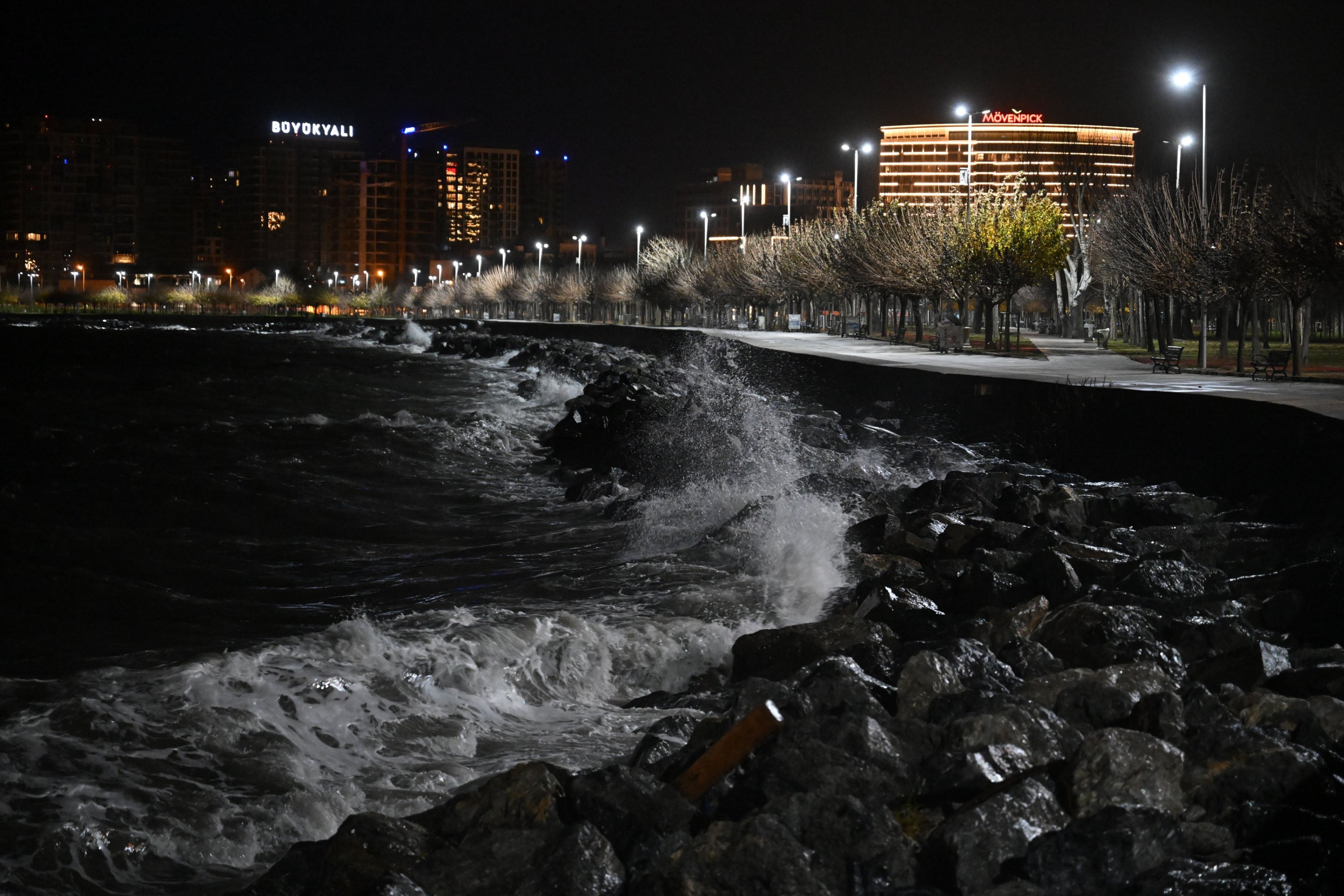
A climate and meteorology expert has warned that Türkiye remains structurally and socially unprepared for severe weather, saying that strong storms affecting Istanbul earlier this week were meteorologically normal but revealed deep vulnerabilities in urban planning, infrastructure resilience and public awareness.
Professor Mikdat Kadıoğlu of Istanbul Technical University said the heavy rain and strong winds that intermittently affected Istanbul were the result of intensified winds associated with a cold front passage, with gusts reaching 70-90 kph (43-55 mph), a range he described as fully consistent with typical mid-latitude weather patterns.
The storm disrupted daily life across the city, tearing roofs off buildings, uprooting trees and causing damage in several districts.
Kadıoğlu noted that public discussion following the storm once again reflected a widespread misunderstanding of how weather and climate function, particularly regarding the interpretation of “seasonal norms.”
He emphasized that seasonal averages are computed from 30-year climate datasets and serve as statistical reference points rather than fixed expectations for daily weather.
“You often hear on television that temperatures are ‘around seasonal norms,’ and people assume this means the weather is supposed to stay there,” he said.
“Weather is inherently chaotic. It changes constantly, fluctuates and surprises. One day may be 15 degrees, the next 8 degrees; both are normal. Expecting the weather to remain exactly at the average means misunderstanding how the atmosphere works,” he added.
He emphasized that while climate change is altering long-term patterns, this does not necessarily mean that every extreme weather event should be labeled as abnormal.
“Yes, the climate is changing, but that does not mean every strong storm we experience is extraordinary,” Kadıoğlu said. “Severe weather has always existed in mid-latitude regions and will continue to occur.”
He added that storms and strong winds are part of natural atmospheric processes that redistribute heat from the equator to the poles to maintain the planet’s energy balance, sometimes gently and sometimes through destructive systems.
Kadıoğlu said that countries exposed to frequent storms have long integrated climate resilience into urban and infrastructure design. In the U.K., the Netherlands and Germany, roadside trees are supported and pruned in ways that allow wind to pass through while roots strengthen.
In Japan, he said, all buildings are tested for resistance to typhoon-force winds, and roofing systems are installed using specialized anchoring methods.
He also cited international transportation safety measures, including automatic speed-reduction systems on wind-exposed bridges and airport runway orientations aligned with prevailing wind patterns.
Türkiye, he said, has not adopted comparable adaptation standards at the necessary scale.
“Our cities have become what I call ‘obese cities,’” Kadıoğlu said. Istanbul has a population of approximately 15.7 million, but its livable capacity is between 8 and 12 million. Ankara is at the limit. We build on every square meter, cut down trees and cover stream beds. Then, when a storm hits, we ask why damage occurs.”
He warned that climate change is increasing the frequency of heavy rainfall, extending drought periods, raising sea levels and making heat waves longer and more frequent, trends that will further strain cities that are already densely built and environmentally degraded.
Kadıoğlu urged residents to take basic personal precautions ahead of storms, including securing loose items on balconies and terraces, avoiding parking vehicles under trees, remaining indoors when storm warnings are issued and having roofs inspected annually.
“Nature is not our enemy,” he said. “Storms, rain and wind are part of the planet’s life cycle. We cannot stop them. The only rational response is preparation. The recent storm was not extreme, but we were not ready. And while we are not even prepared for today’s conditions, discussing future climate scenarios is a luxury. The real question is when we will strengthen our infrastructure.”