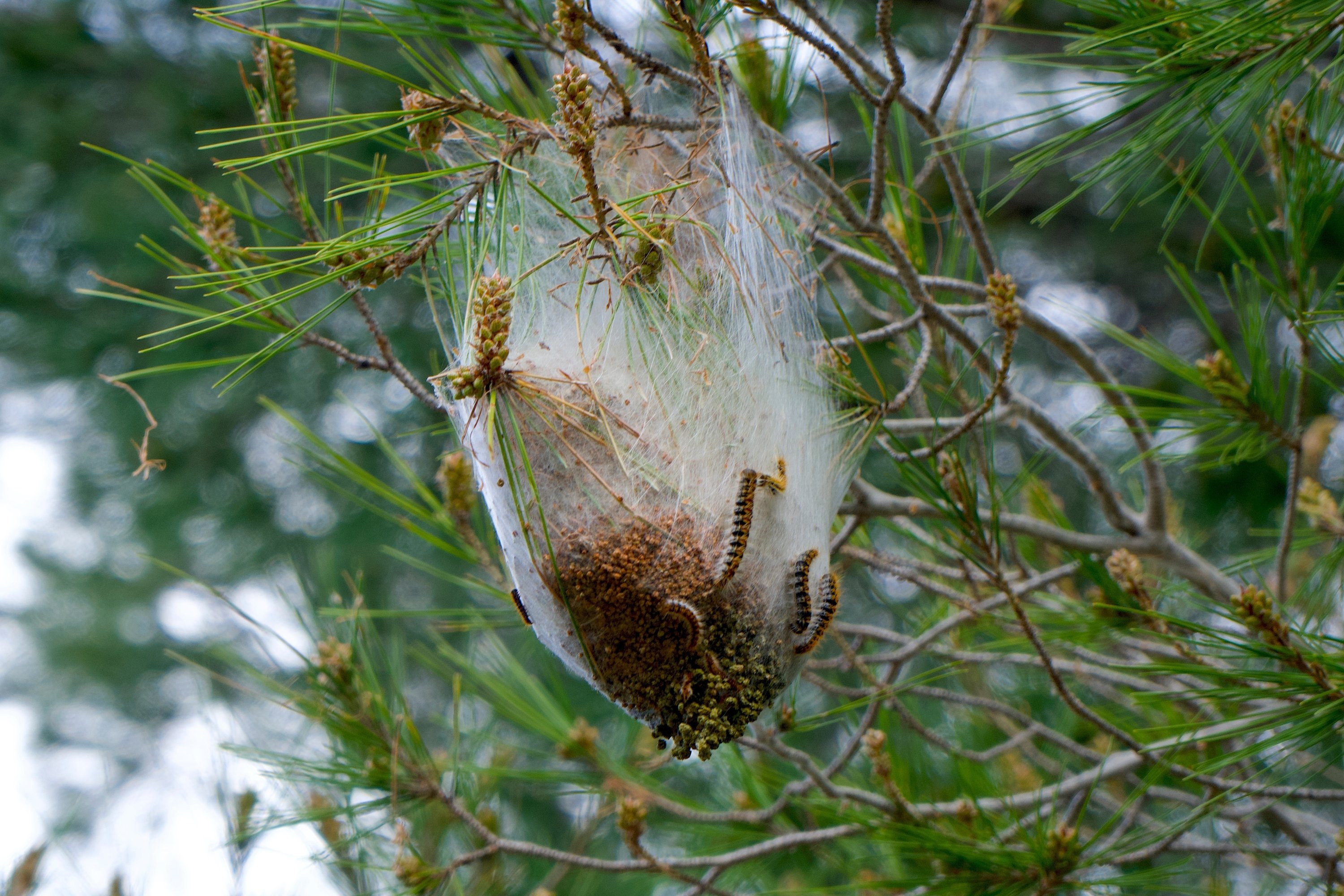
Rising temperatures in Istanbul have led to an increase in sightings of pine processionary caterpillars in forested areas, with experts warning that the insects can trigger allergic reactions in both humans and pets.
The caterpillars, commonly found in regions with dense pine forests, are becoming more visible in mid-spring, particularly in districts where pine woodlands are widespread. They are often seen moving in long, train-like formations as they descend from trees to the ground.
Typically brown to dark grey in color and covered with fine white hairs along their backs, the caterpillars also form white, cotton-like nests on pine branches. While these structures may appear harmless, experts say contact with the insects or their remains can lead to skin irritation and allergic reactions.
Prof. Dr. Hamit Ayberk from the Department of Forest Engineering at Istanbul University-Cerrahpaşa explains that the species is most active between mid-April and mid-May, when it leaves the trees to complete its life cycle underground.
“During this period, they move from pine trees to the soil or roads, lining up in long chains like train wagons,” he said. “Their purpose is to reach the ground, enter the soil, and pupate. By the end of summer, they emerge as brown moths.”
He noted that the species is more commonly seen in Türkiye’s Mediterranean and Aegean regions but is also increasingly present in Istanbul, particularly in forested areas such as the Princes’ Islands and districts including Sancaktepe and Çekmeköy, where red pine and black pine trees are dense.
The nests seen on trees serve as winter shelters for the caterpillars. Ayberk warned that in cases of heavy infestation, the insects can cause significant damage to trees. “If you see five or ten nests on a single tree, that can mean thousands of caterpillars feeding on its needles,” he said. “This weakens the tree and makes it more vulnerable to other pests.”
He added that while pine trees are evergreen, the caterpillars mainly feed on older needles, which means they do not completely destroy the tree but can significantly weaken it over time.
Ayberk stressed that the caterpillars are not poisonous but are strongly allergenic. “Their tiny hairs, which are not always visible, can cause allergic reactions such as itching, skin irritation, mild swelling, and rashes, especially on sensitive areas like the wrists, neck, and face,” he said. “The severity varies from person to person depending on their sensitivity.”
He also warned that pets are at risk. “For animals, especially dogs and cats, contact can cause swelling in the tongue, mouth, or neck area, and in some cases more serious reactions,” he added.
Authorities advise caution during outdoor activities, especially in forested areas during spring. Ayberk noted that the timing of picnics and outdoor gatherings often overlaps with the period when the caterpillars descend from trees to the ground.
“If there are visible nests under pine trees, it is better not to sit or stay in those areas,” he said. “Even after the caterpillars leave, their hairs and residues remain in the environment and can still trigger reactions.”
He also highlighted ongoing control efforts, including biological and integrated pest management methods. One of the main biological controls used is the release of Calosoma sycophanta, a natural predator known locally as the “terminator beetle,” which is bred in laboratories and released into affected forests.