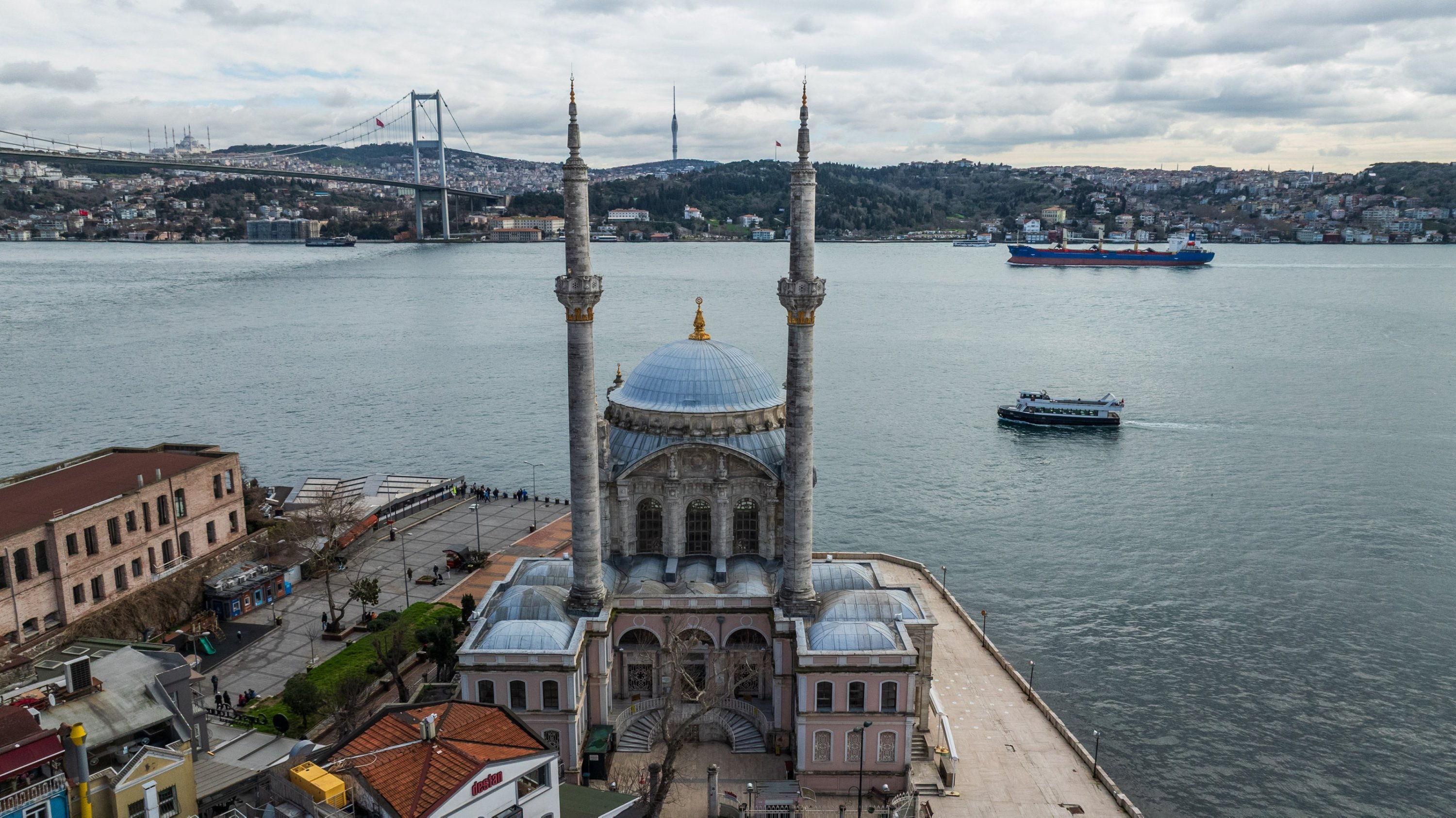
Located at the northern end of Ortaköy Pier Square along the Istanbul Bosphorus, the Büyük Mecidiye Mosque, commonly known as Ortaköy Mosque, is a landmark of both historical and architectural significance, drawing attention for its striking waterside location and elegant 19th-century design.
Historically, a small mosque originally stood at this site in 1721, commissioned by Mahmud Ağa, son-in-law of Grand Vizier Ibrahim Pasha, and was reportedly renovated in the 1740s by Mahmud Ağa’s son-in-law, Mehmed Ağa.
The current mosque, according to the inscription above its entrance, was built in 1854 under the order of Sultan Abdülmecid.
As with other 19th-century "selatin" mosques, the structure consists of a prayer hall and a sultan’s pavilion positioned in front of the entrance.
The "harem" is a roughly square space with sides measuring approximately 12.25 meters (40.19 feet), covered by a dome set on pendentives with a blind drum.
The mosque’s interior features tall and wide windows, with walls adorned in red-and-white patterned plaster mimicking pink stone. Inscribed panels hang on the walls, while the minbar displays the "kalima" ("declaration of faith") written by Sultan Abdülmecid. The dome and pendentives include intricate landscape and architectural motifs.
There is a clear contrast in design and surface treatment between the harem and the sultan’s pavilion, while the prayer hall is richly decorated, the pavilion presents a more restrained aesthetic.
Externally, the mosque features baroque and rococo-inspired stone ornamentation with carved and embossed detailing.
Prof. Dr. Kadir Pektaş, Head of the Art History Department at Istanbul Medeniyet University, highlighted that the Büyük Mecidiye Mosque is located in the Ortaköy neighborhood of Beşiktaş and was built in 1854 by Sultan Abdülmecid.
Most inscriptions in the mosque were written by Ali Haydar Efendi, a student of Yesarizade Mustafa İzzet Efendi. The names of the four caliphs and the kalima on the minbar were written by Sultan Abdülmecid himself, while the inscription above the entrance is attributed to Ziverbey.
Pektaş added, “the Büyük Mecidiye Mosque is one of Istanbul’s most distinguished structures. It comprises a single-domed prayer hall and a sultan’s pavilion at the entrance, a design similar to many mosques of that era. Both minarets are positioned adjacent to the pavilion.”
"The sultan’s pavilion is located on the west side, accessible via an elegant elliptical staircase. Upon entering, one passes through a corridor and a wider space before reaching the central area under a dome roughly 12 meters in diameter,” he added.
He emphasized that while the mosque maintains a traditional single-dome layout with pendentives, its interior and exterior decoration reflects the Westernization trends of the period.
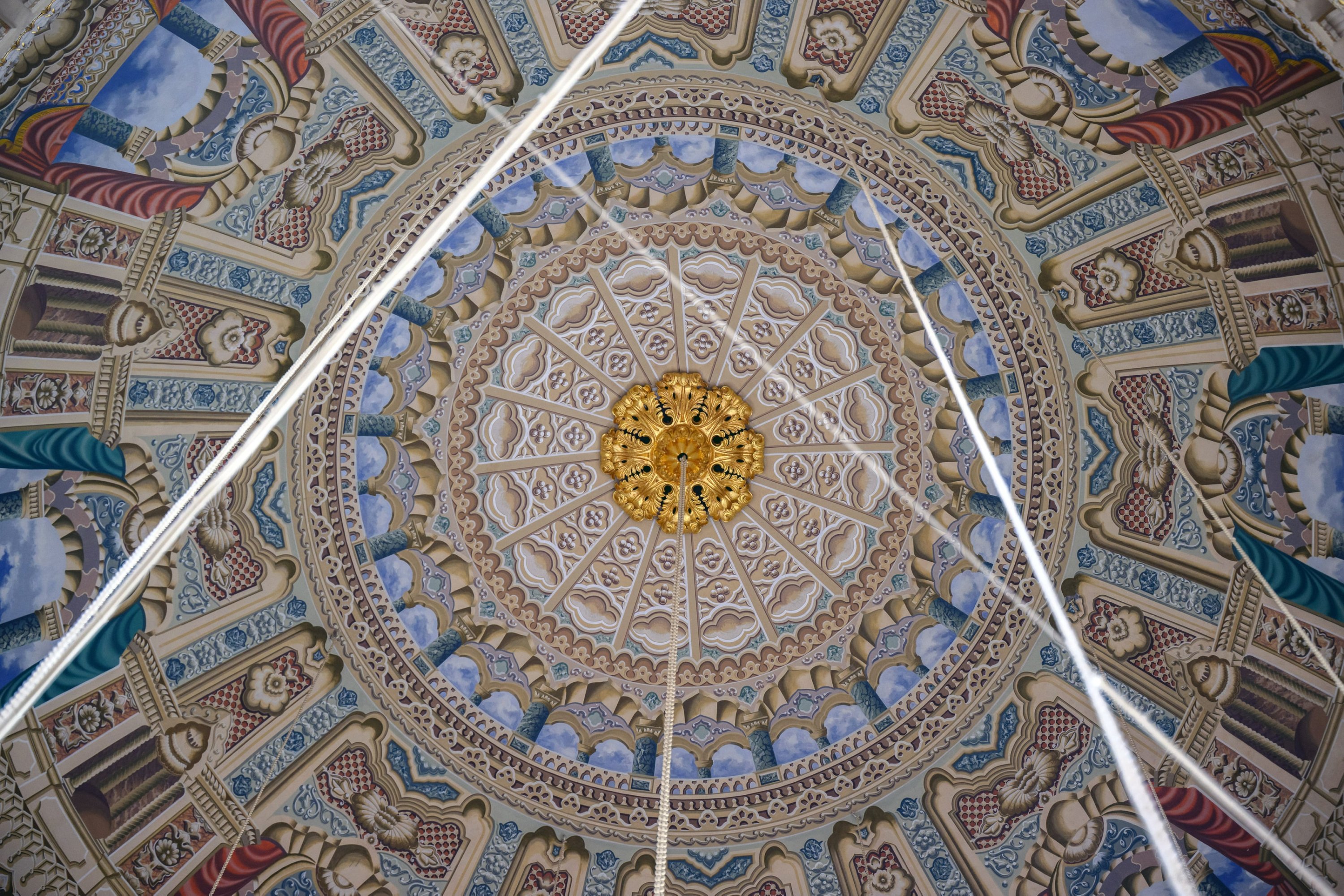
Inside, plaster imitating pink stone with red and white patterning is used extensively, a common practice in 19th-century mosques.
The interior is illuminated through tall, rounded windows, and the exterior is articulated with broad stone consoles that visually divide the walls into sections, adding dynamism.
The central dome sits atop a short drum, while the sultan’s pavilion extends outward, creating a small courtyard at the center.
The mosque has undergone multiple restorations since its original construction. It was repaired twice in the 1860s, sustained major damage in the 1894 earthquake, and was restored in 1904.
Between 1960 and 1969, the mosque underwent significant restoration, reopening in 1969. After extensive fire damage in 1984, it was again restored, and recent interventions have preserved both its architecture and ornamental character.
The Büyük Mecidiye Mosque represents a key example of Ottoman architecture during the Westernization period. Its exterior, including arches, window pediments, and consoles, exhibits baroque and rococo elements with occasional neoclassical (empire) influences.
The sultan’s pavilion demonstrates empire-style features, while the marble mihrab niche similarly reflects this style.
The mosque is built just 2 meters above the quay along the Bosphorus. While some sources attribute its design to Nikoğos Balyan or Hovsep Serveryan, archival records from 1848 identify Seyit Abdülhalim Efendi as the architect, further distinguishing the mosque.
Pektaş explained the mosque’s urban significance, “In the 19th century, the Ottomans built wooden, later stone, palaces on both sides of the Bosphorus, accompanied by mosques."
He continued, “Dolmabahçe Palace, for instance, is complemented by Dolmabahçe Mosque. Similarly, Ortaköy Mosque is located near palace areas. On the Anatolian side, Beylerbeyi Palace and Mosque mirror this arrangement.”
"The Bosphorus was adorned with palaces and mosques like a necklace, reflecting the urban planning of the era. The Büyük Mecidiye Mosque remains a valuable structure in this context,” he added.