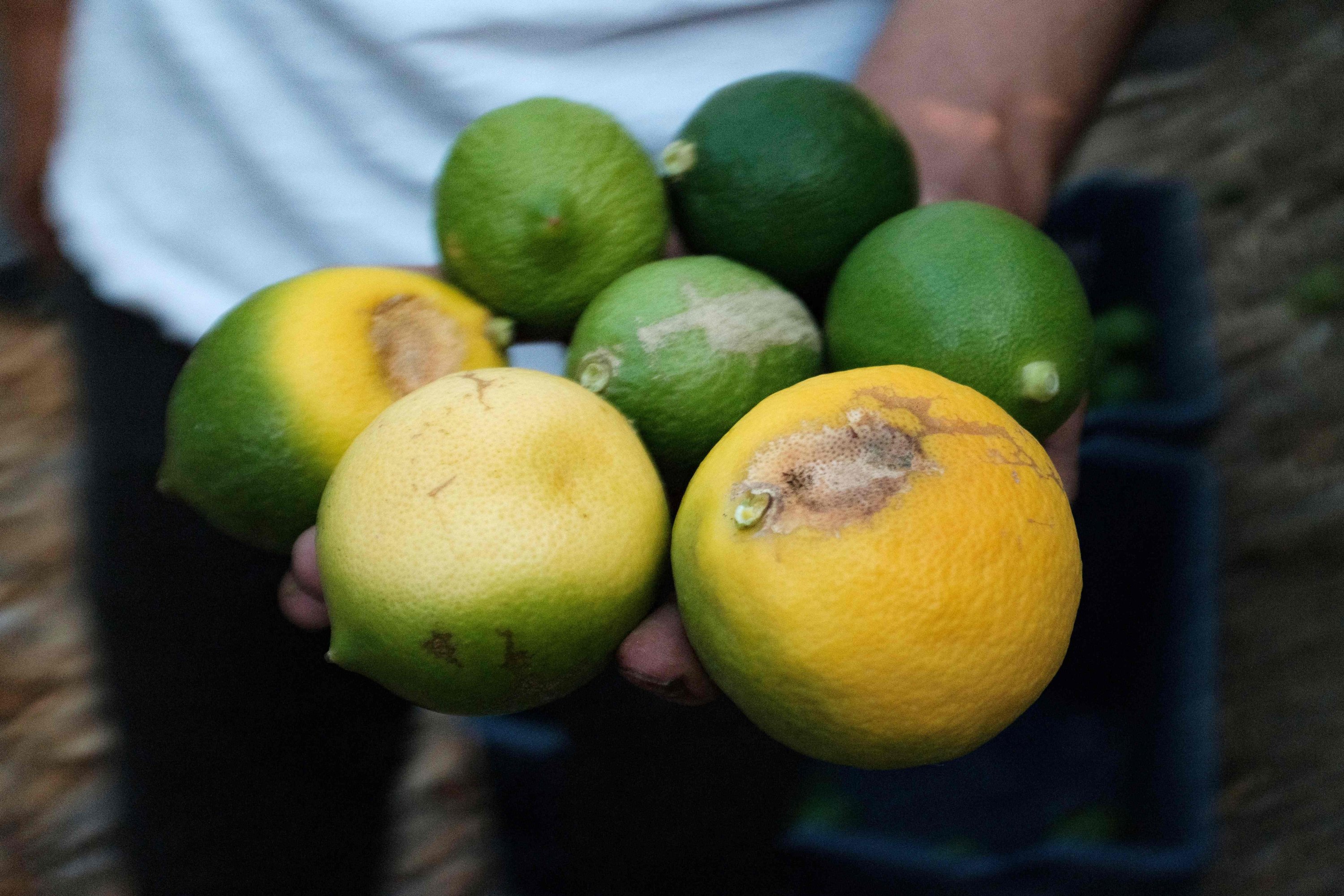
Lemon farmers in Türkiye’s fertile Çukurova region are reeling after a series of unprecedented weather events destroyed a significant portion of their crops, highlighting the mounting impact of climate change on the country’s agriculture.
“At first, there was frost and we lost a lot of blossoms. Then came a severe hailstorm when the fruits were still small,” said Aleaddin Coğal, a 42-year-old farmer. “Then a heatwave struck, and the sun was so intense that it literally boiled the fruit, killing it.”
Coğal estimates that nearly 40% of his produce has been lost. His trees, still bearing green fruits, show deep skin splits and brown blisters caused by August’s intense heatwave.
Farmworker Kemal Sığa, who was working during last month’s record temperatures, likened the scene to a wildfire. “I’ve never experienced a day like this; it felt like the crop was on fire. It ruined the groves,” he said.
Türkiye, like many Mediterranean countries, has seen a growing number of extreme weather events in recent years as global warming accelerates, with rural farming communities particularly vulnerable.
Mehmet Akın Doğan, head of the Yüreğir Ziraat Odası, highlighted the mounting pressures on farmers in Çukurova, which produces about 40% of Türkiye’s citrus crops. “Çukurova is one of Türkiye’s most important agricultural regions, contributing significantly to food production and security. But in recent years, climate change has begun threatening our agricultural activities,” Doğan said. “We’ve faced unprecedented frosts and extremely powerful heatwaves.”
A severe frost in late February dropped temperatures to minus 8 degrees Celsius, with another frost striking in April. In early August, Adana recorded its hottest day in 95 years at 47.5 degrees Celsius (117.5 degrees Fahrenheit). Farmers also faced hailstorms and even tornadoes.
Globally, temperatures have been rising as human-induced climate change creates increasingly erratic weather patterns. Türkiye’s average July temperature, historically 25 degrees Celsius between 1991 and 2020, rose to 26.9 degrees Celsius this year, according to the MGM weather service.
The extreme weather also affected other crops. Apricot farmers in Malatya, the world’s top exporter of dried apricots, described devastating losses. Orhan Karaca, head of a local ziraat odası, said: “I’ve been growing apricots for 40 years, and I’ve never seen anything like this. Farmers are no longer trying to save the harvest but their trees. The frost was harsher for us than the February 2023 earthquake.”
Hazelnut farmers, too, were hit hard. Türkiye, which produces 70% of the world’s hazelnuts, faced frost damage worth TL 2.3 billion ($56 million), according to Agriculture Minister Ibrahim Yumaklı.
Doğan summarized the growing despair among farmers: “We’ve faced all kinds of disasters; the only thing that hasn’t happened is a meteor strike. Now the effects of climate change are visible, farmers don’t know what to do anymore.”
President Recep Tayyip Erdoğan recently said the extreme weather caused an estimated TL 23 billion in damage for 50,000 farmers covered by TARSIM insurance. The government will also provide an additional TL 23 billion in support to 420,000 uninsured producers.
Farmers warn that crop losses will drive up prices. “Lemons will be the biggest shortage this winter. Prices will rise sharply. In Çukurova, lemons are now more expensive than in Finland: there you pay around 2.33$ per kilo, here it’s 3.33$,” Coğal said.
“It’s a loss for Türkiye. I was going to export this crop and bring money into the country, but now that’s not happening because global warming is disrupting the climate,” he added.