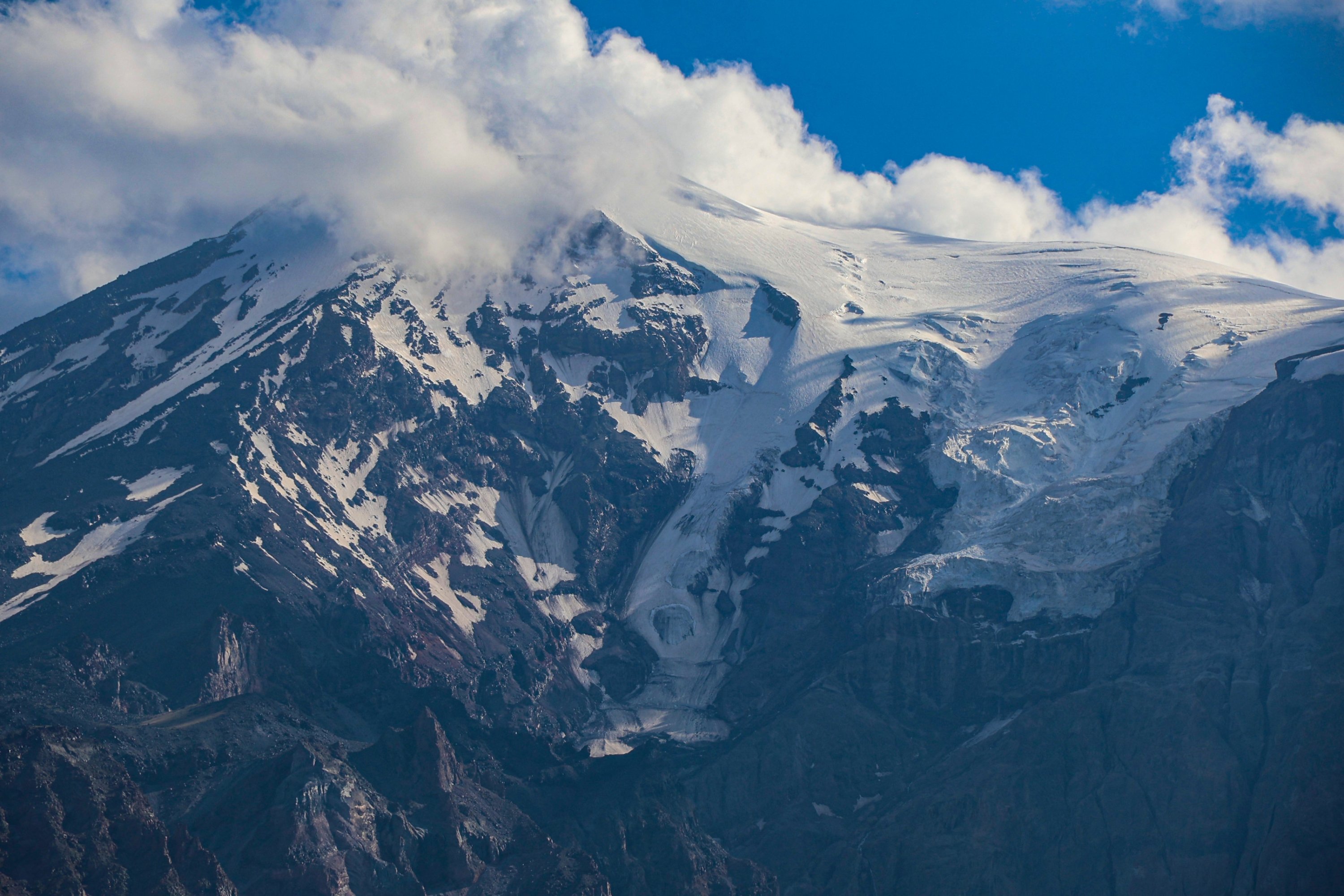
Approximately half of the "cap glacier" covering the summit of Mount Ağrı, Türkiye’s highest peak, is expected to melt by 2050 due to global warming and rising temperatures.
Mount Ağrı, standing at 5,137 meters (16,853 feet), draws attention not only for its height but also for hosting the country’s largest cap glacier, a glacier mass covering the upper parts of the mountain.
The mountain, which attracts many domestic and foreign climbers throughout the year, has seen the cap glacier surrounding the summit disappear from its southern slope due to the effects of global warming and increased heat. However, glaciers are still visible on the northern and northwestern slopes of the mountain.
Associate professor Mehmet Ali Çelik, a faculty member of the Geography Department at Iğdır University’s Faculty of Science and Letters, said that global warming is adversely affecting the glacier dynamics on Mount Ağrı.
He explained that glaciers on Mount Ağrı once covered much larger areas in the past. Today, the glaciers on the mountain are melting rapidly.
Çelik emphasized the dramatic rate of glacier retreat, stating, “During the Paleozoic period, millions of years ago, there was a glacier area of 70 square kilometers (27 square miles) here on Mount Ağrı. By the early 1900s, this area had decreased to 15 million square meters."
"Today, research shows that Türkiye’s largest Mount Ağrı cap glacier covers between 4.5 and 5 square kilometers. The cap glacier area, which was 15 square kilometers in the early 1900s, has now shrunk to between 4.5 and 5 square kilometers. This is a rapidly melting glacier area,” he said.
He highlighted the serious problems caused by the fast melting of glacier areas on the mountain: “Because ecology is a chain of interconnected systems. The melting of these glaciers triggers disasters, adversely affects local wildlife, disrupts water balance and causes many other negative consequences.”
Pointing to the shrinking glacier areas, Çelik continued, “We are talking about a total glacier area of approximately 8 square kilometers here, including cap and ice-sheet glaciers. However, this glacier area is expected to shrink significantly in the coming years."
"By 2050, about half of the cap glacier on Mount Ağrı is expected to melt. We observe that almost no glacier area remains on the southern slope of Mount Ağrı. On Mount Ağrı, glaciers begin to appear above approximately 4,500 to 4,700 meters in elevation,” he said.
He added that glaciers mainly cover the northern and northwestern slopes of Mount Ağrı, where they still exist in relatively large areas.