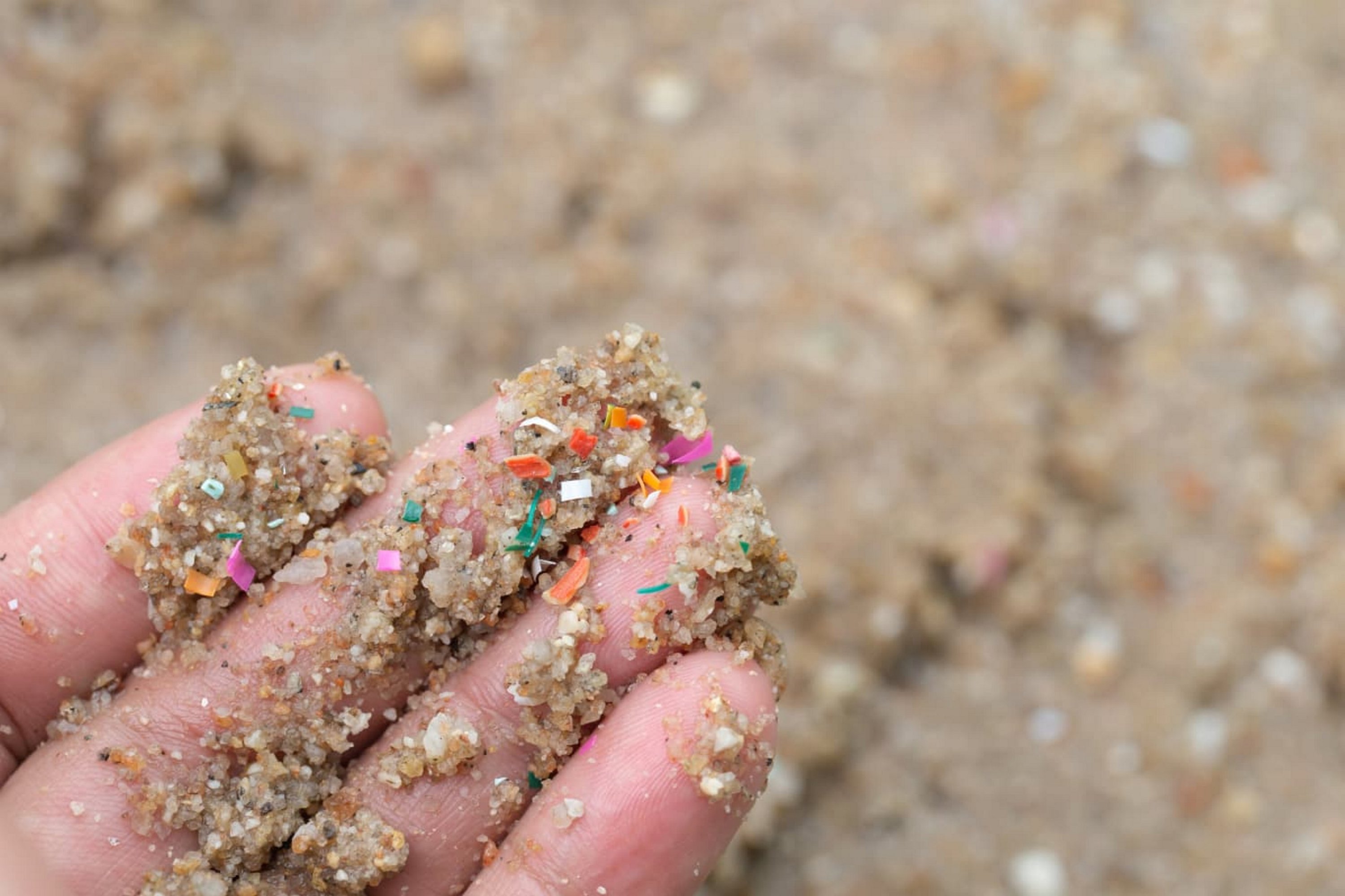
Microplastics were detected at all 17 stations in the Datça-Bozburun Special Environmental Protection Area, in southwestern Türkiye, with peak levels in Bozburun and Yazı.
Comprehensive surface-water sampling across the Datça-Bozburun Special Environmental Protection Area, positioned along the ecologically sensitive southwestern coastline of Türkiye between Marmaris and Datça, confirmed microplastic pollution at every one of the 17 monitored stations. The highest concentrations were measured in Bozburun and Yazı, underscoring the escalating environmental threat facing even formally protected marine corridors.
Microplastics, defined as insoluble plastic particles smaller than 5 millimeters, originate from commercial textiles, cleaning agents, packaging products and the fragmentation of larger plastics. Due to their scale and structure, these contaminants bypass standard filtration systems and disperse rapidly through currents and winds, ultimately accumulating in seas, bays and coastal ecosystems. Their presence in a legally protected stretch of Türkiye’s Mediterranean shoreline signals a deepening risk to biodiversity and overall marine health.
The joint scientific assessment, conducted by the Mediterranean Conservation Society and Akdeniz University, documented a total of 3,105 microplastic particles per cubic meter of seawater across the region. Recorded quantities reached 97 in Bördübet, 110 in Alayar, 127 in Emecik, 80 in Karaköy, 130 in Cumalı, 267 in Knidos, 287 in Yazı and 217 in Palamutbükü.
Additional findings logged 110 in Kızılbük, 173 in Datça Center, 197 in Karaincir, 140 in Aktur, 150 in Lindos, 127 in Inbükü, 163 in Selimiye, 177 in Tavşanbükü Island and 553 in Bozburun, the latter marking the highest pollution density in the protected zone.
Fiber-form plastics, largely associated with synthetic clothing and textile washing discharge, constituted 93.7% of all samples. Film-type particles, such as bag and sack remnants, followed at 3.2%, with rigid plastic fragments recorded at 2%. The predominant particle color was black at 72.2%. Seasonal data showed clear acceleration during peak tourism months, with counts reaching 1,207 in summer, followed by 833 in spring, 623 in autumn and 440 in winter per cubic meter.
Akdeniz University Faculty of Fisheries academic associate professor Olgaç Güven stated that surface sampling was accompanied by coastal sampling at adjacent beach points, confirming pollutant transport mechanisms and non-local origins. “We detected microplastics at all 17 stations. Even the lowest concentration, 16 particles, counts as definitive contamination. Considering that Datça-Bozburun is a Special Environmental Protection Area without heavy industrial presence, these results demand heightened operational and regulatory attention,” Güven emphasized.
The data revealed that the northern coastal stretch of the peninsula remains cleaner than the southern curve, where marinas, tourism corridors and agricultural proximity converge. Elevated readings in Knidos, despite its spatial detachment from local settlement zones, were linked to a vortex circulation system near Rhodes, enabling offshore pollutants to accumulate and deposit onto Türkiye’s shoreline.
Güven highlighted that summer concentrations correlate directly with marina density, vessel traffic, tourism-based consumption and textile shedding via recreational water activity. Conversely, winter measurements confirmed oceanic circulation as a pollution driver rather than solely local population behavior.
A significant share of microplastics identified in Datça-Bozburun originated from agricultural interfaces located immediately behind seaside zones. The team identified irrigation hoses, seedling fasteners, cultivation containers, fertilizer sacks and pesticide bottles among primary contaminant contributors. Although regulatory frameworks apply to the designated protection zone, Güven underlined that surrounding communities must be incorporated into enforcement, as their unregulated operational footprint directly influences marine quality.
Güven reiterated that microplastic contamination remains a borderless and rapidly escalating pollutant class, requiring integrated national and international governance, community-level regulation and technology-based filtration adoption. Public guidance included reducing disposable plastics, equipping washing machines with microplastic filtering systems and limiting overall consumption. Industrial and agricultural sectors were urged to eliminate plastic-dependent growing materials, implement pre-discharge filtration and redesign waste handling mechanisms.
“Once plastics disperse across coastlines and agricultural surfaces, retrieval becomes exponentially more expensive and operationally prohibitive. Eliminating leakage at the source is the only realistic strategy,” Güven said, concluding that marine remediation is both technically ineffective and economically unsustainable.
The study constitutes the initial operational year of a five-year monitoring program, designed to capture and benchmark three-year contamination trajectories in one of Türkiye’s most ecologically significant and officially protected marine zones.