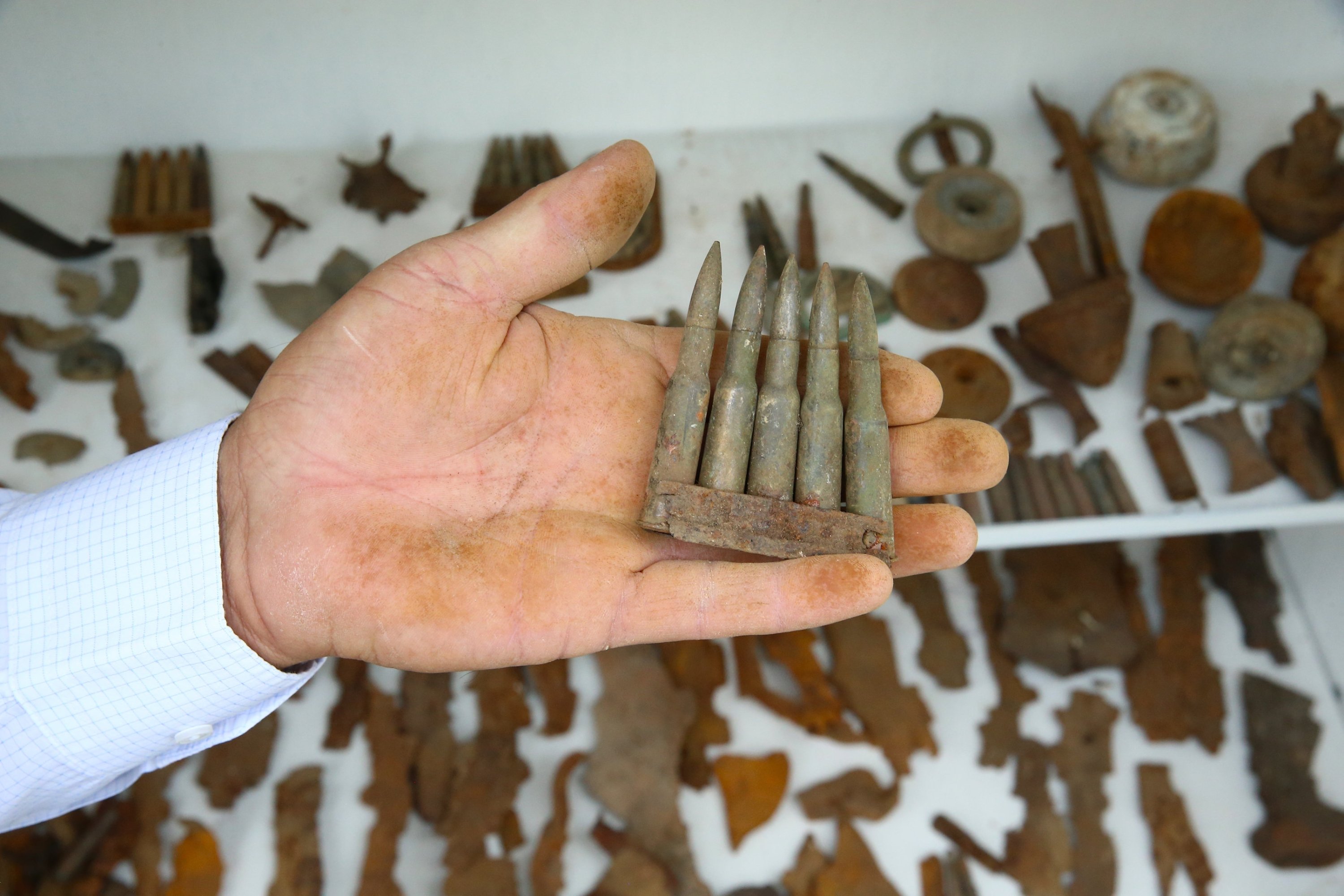
Abdullah Kuş, 64, a resident of Bingöl, has uncovered and exhibited remnants from the Ottoman-Russian War, fought in the region between 1916 and 1917, in Bingöl, located in eastern Türkiye.
Kuş discovered ammunition, shrapnel fragments, horseshoes and other war relics while tending livestock in the Şerafettin Mountains, which rise about 2,700 meters (8,858 feet) near his childhood village of Sudurağı in Karlıova district.
Initially unaware of the historical value of the items, Kuş said he gave much of the material to scrap dealers. His interest grew after visiting museums in Çanakkale, northwestern Türkiye, years later and seeing similar wartime artifacts on display.
After moving to Kocaeli in 1993 and working as a contractor, Kuş began returning to his village each summer about a decade ago to collect and preserve wartime relics scattered across the mountains.
Using an off-road vehicle to access the remote battlefield areas once held by Russian forces, Kuş found evidence of intense combat at every step.
In 2024, Kuş and locals applied to the Ministry of Culture and Tourism to have the area designated as a protected site. Following an inspection by the Erzurum Regional Board for the Protection of Cultural Heritage, the region was officially declared a protected archaeological site.
Kuş has since created a small open-air exhibit near the Azizan Martyrs’ Monument, built by the government on the Bingöl-Karlıova highway to honor those who died in the conflict. His collection includes rifles, artillery shells, hand grenades, shrapnel and other personal effects recovered from the area.
Visitors stopping at the monument often learn about the artifacts from Kuş, who volunteers to maintain the memorial and share the region’s history. Sometimes he brings his grandson and relatives to the battlefield sites to explore together.
Speaking to Anadolu Agency (AA), Kuş said, “In the past, we did not realize the value of the war relics and gave them away to peddlers. After visiting museums in Çanakkale, I understood their importance.”
He added: “The Şerafettin Mountains were the site of the main battle in the Ottoman-Russian War. From this front to Kiğı, Solhan and Bitlis, many battles took place. Our elders said the Russians stayed here for a year, and there was fierce hand-to-hand combat.”
“I have been coming here every summer for nearly 10 years, collecting whatever I can to create this small museum. Because many martyrs were lost here, our government built a monument along the road connecting eastern and southeastern Anatolia with the Black Sea region.
“I gathered the materials and made a museum near the Martyrs’ Monument. My goal is for people to appreciate the value of this land and understand the sacrifices made,” he explained.
Kuş noted that many soldiers’ graves are scattered across the region. His exhibit includes buttons, helmets, box keys, bullets, knives, rifles and stocks collected from the battlefield.
Bingöl University Faculty of Theology member and Turkish-Islamic art history lecturer professor Nebi Butasım, who has researched the city’s historical heritage since 2003, explained that Russian troops advanced through Karlıova to Azizan, the Şerafettin Mountains and Şeref Pass during 1916-1917.
Butasım said fierce resistance by Ottoman forces resulted in heavy fighting around Azizan, with Russian troops concentrating near Elmalı village and the Şerafettin Mountains.
“Fortifications still visible on the northeastern slopes of the Şerafettin Mountains mark the defense lines of the era,” he said. “Our research shows trenches and defensive positions dug along routes from Solhan to Karlıova, with abundant surface-level war remnants including artillery shells and bullet casings.”
“Since 2019, we have identified numerous cartridges, shell fragments and other military artifacts. Many are displayed in glass cases collected by Abdullah Kuş at the Azizan Martyrs’ site. A detailed archaeological survey could reveal even more artifacts and historical insight,” Butasım added.