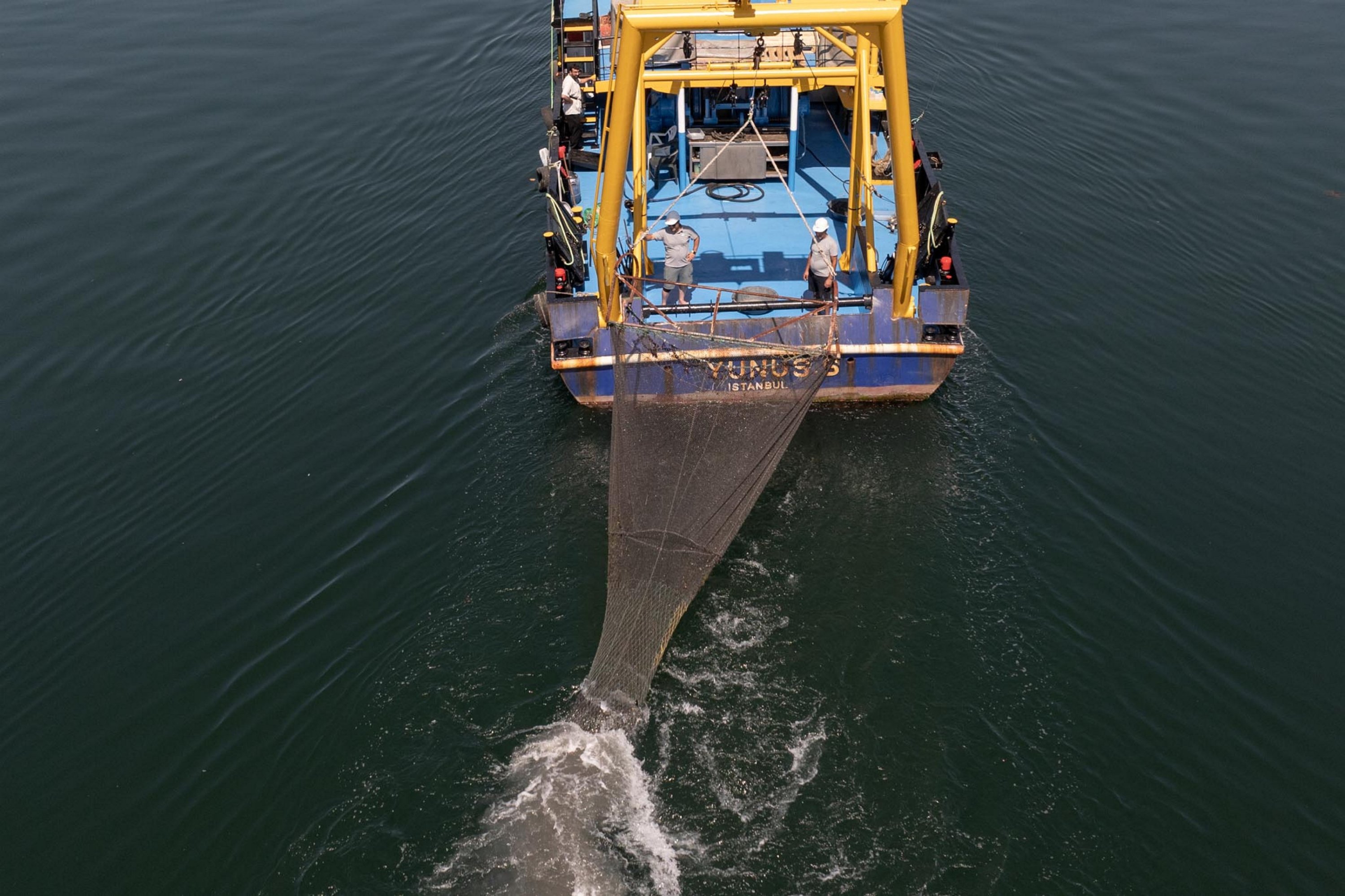
Recent research conducted by Istanbul University (IU) Faculty of Aquatic Sciences has found that due to sea surface temperatures remaining around seasonal averages, mucilage formation in the Marmara Sea has stayed at low levels this season.
Monitoring activities are being regularly carried out by the faculty’s research vessel “R/V Yunus-S.”
As part of the study, a CTD device was used at predetermined station points to measure the physical and chemical properties of the seawater. The device recorded parameters such as temperature, salinity, dissolved oxygen, pH and conductivity. The collected data were then transferred to a computer system to determine sampling depths.
Samples were collected at designated depths, including nutrient salts, indicator bacteria, phytoplankton, and others from various layers. The researchers also monitored the region’s biological diversity.
Uğur Uzer, a faculty member at IU Faculty of Aquatic Sciences, explained that planktonic organisms are among the main causes of mucilage formation. These organisms reproduce rapidly under specific temperature ranges and, upon dying, release mucus-like substances into the environment.
Uzer explained that in 2021, favorable temperature conditions and external nutrient inflows led to an overgrowth of these planktonic organisms in the Marmara Sea, resulting in a significant mucilage event. “Under normal conditions, the growth of these organisms in the Marmara Sea remains balanced. We observe them every year. After mucilage forms beneath the surface, it typically disappears as water temperatures rise or fall, making it less visible to the public,” he said.
Recalling that in 2021, mucilage reached the surface in eastern parts of the Marmara Sea, forming thick layers, Uzer said the IU Faculty of Aquatic Sciences closely monitors these developments. “With our vessel R/V Yunus-S, we particularly track the eastern basin of Marmara. We study the water’s temperature, oxygen levels, salinity, conductivity, bacteria concentrations, and the organisms living on the sea floor. This monitoring helps us understand where the Marmara Sea is headed,” he added.
Uzer noted that earlier this year, mucilage formation had intensified, raising concerns, especially when high water temperatures and other contributing factors were recorded.
However, conditions later changed. As temperatures dropped, the mucilage gradually dissipated. “Right now, we can say there is almost no mucilage in the eastern Marmara Sea, practically none at all. But in the southern parts of Marmara, small amounts are still being reported, particularly in deeper zones,” Uzer explained.
He emphasized that concerns about a future resurgence of mucilage remain. “The excessive pollution load entering the Marmara Sea continues. Water temperature is a major factor. If it rises again, and planktonic organisms reach favorable breeding conditions, mucilage will reappear,” he warned.
Uzer added that mucilage formation tends to start in the Gulf of Izmit, but recent sediment cleaning projects there have significantly reduced bacterial loads. “That’s a good sign. We’re seeing a decrease in mucilage emergence from that region,” he said.
“Our recent measurements also show oxygen levels consistent with expectations. Sea temperatures have remained within seasonal norms since 2022, after peaking in 2021. Because they are now within normal ranges, mucilage formation has decreased,” Uzer said.
Uzer stated that improvements in the Gulf of Izmit would positively affect the entire Marmara Sea and help reduce mucilage formation.
He emphasized that there is currently no mucilage either above or below the surface in eastern Marmara. “We collect underwater samples and work with divers who also conduct visual observations. There’s no mucilage around Istanbul,” he confirmed.
Highlighting the university’s strong research in the Marmara Sea, Uzer concluded: “We continuously visit and collect samples from critical points, especially in the Gulf of Izmit. The Marmara Sea is as close and important to us as our backyard. That’s why we’ll keep working there.”