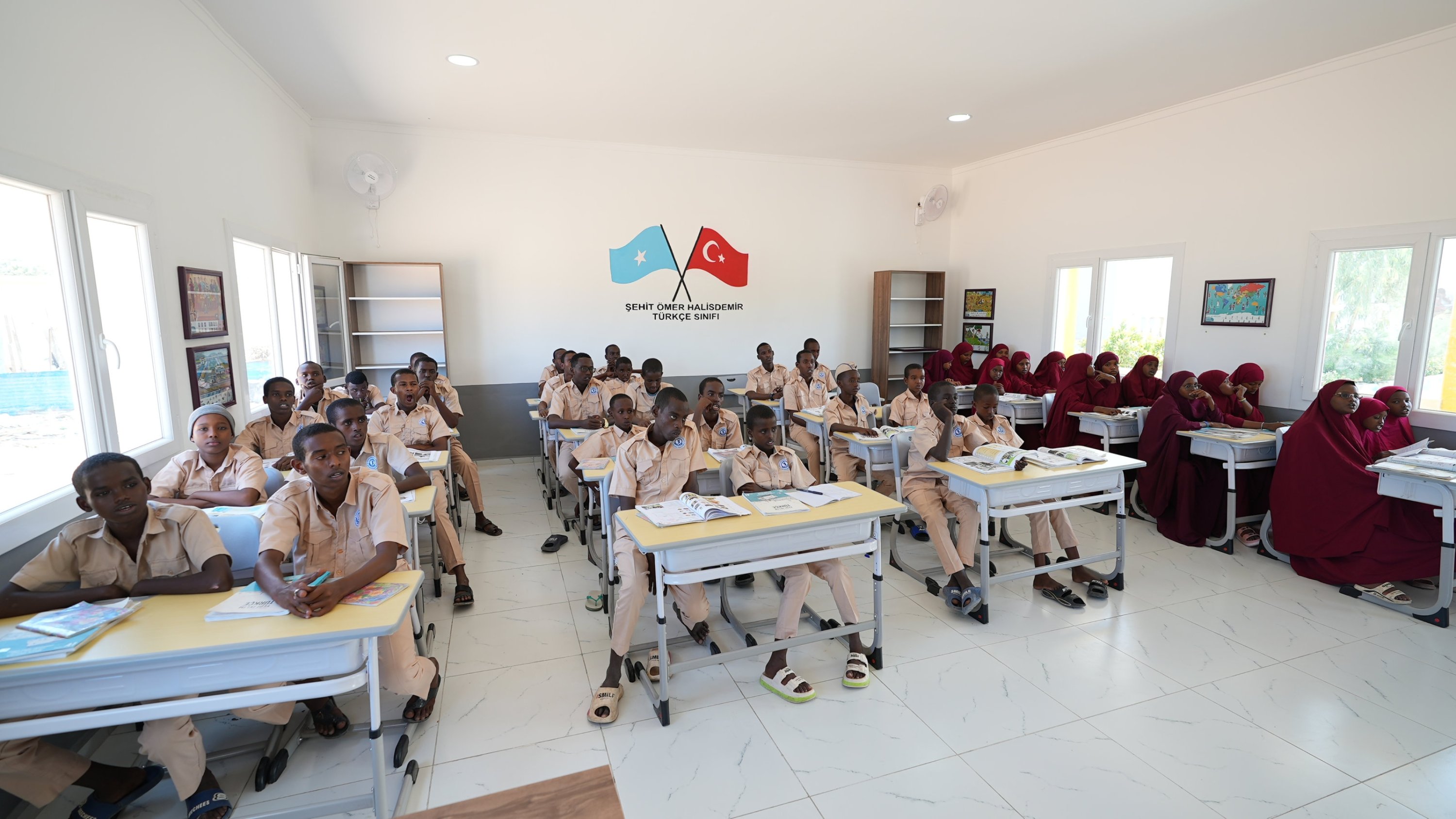
The Turkish Cooperation and Coordination Agency (TIKA) is playing a crucial role in Somalia’s development through a range of educational and social projects. These include opening a Turkish language classroom in an orphanage, establishing a laboratory at Mogadishu University and supporting a center for children with special needs.
Ilyas Abdulkadir Mohamed, a teacher at the Şehit Ömer Halisdemir classroom, Abdirizak Elmi Mohamud, director of the Mustaqbal Center for Children with Special Needs, and Abdullahi Abdi Mahamoud, a technician at the laboratory at Mogadishu University, spoke about the impact of TIKA’s projects.
Mohamed, who works at the Mogadishu Yunus Emre Institute (YEE), completed his high school, university and graduate studies in Türkiye. He said he now shares Turkish culture, language and knowledge with Somali students. “We help them benefit from Türkiye’s knowledge and opportunities,” he stated.
The Şehit Ömer Halisdemir classroom, restored with TIKA’s support in an orphanage run by the Somali Police Force, provides primary, secondary and high school education to children of martyrs. Mohamed emphasized that the classroom is supported by various Turkish institutions. “TIKA built this classroom. The Yunus Emre Institute covers the educational expenses, and TÜRKSOM also provides support. That’s why various institutions regularly come here,” he said.
Mohamed also noted that Turkish civil society organizations contribute to the orphanage by distributing sacrificial meat not only during holidays but once or twice a week. He stressed that the classroom ensures orphaned students do not fall behind their peers and can receive education on an equal footing.
Reflecting on his own journey, Mohamed said returning to Somalia after studying in Türkiye was a moral responsibility. “I went to Türkiye and benefited from the Turkish government’s scholarship. I see this as a debt to my country. Returning here and contributing is a moral obligation for me,” he said.
He explained that he went to Türkiye in 2012 and returned to Somalia in 2024, observing that numerous bilateral projects are being implemented between the two countries. Mohamed also highlighted the positive changes in Somalia, noting that people are now more hopeful and confident about the future. “There are now fewer people suffering. Both food and security situations have improved. That’s why we believe a brighter future awaits us and the next generations,” he said.
Mohamed also encouraged Turkish investors to explore opportunities in Somalia, pointing to the country’s untapped potential in agriculture and the maritime sector. “Considering the geographical importance of East Africa, Somalia offers significant investment opportunities. Its local resources are still largely untouched. That’s why I recommend investing here,” he added.
Abdirizak Elmi Mohamud, director of the Mustaqbal Center for Children with Special Needs, explained that the center aims to develop and support children with developmental disorders, including autism, Down syndrome, and other neurodevelopmental conditions. He emphasized that the center is the only institution in Somalia providing such comprehensive support and is fully backed by TIKA.
“TIKA is currently the only institution providing support in education, equipment and infrastructure. This support is vital for these children to integrate into society and access all services. The presence of Mustaqbal is therefore extremely important and crucial at this time,” Mohamud said.
Abdullahi Abdi Mahamoud, a technician at the laboratory established by TIKA at Mogadishu University, said the facility consists of three main sections: concrete, asphalt and soil, and water quality. He explained that the laboratory allows students to learn technical requirements and gain hands-on experience under the guidance of technicians. Many students benefit from the lab, and external companies also conduct experiments in fields such as soil, concrete, and steel.
Mahamoud expressed gratitude to TIKA and the Turkish government for their contributions. “I am extremely thankful to TIKA for establishing the laboratory, and I am also grateful to the Turkish government for the collaborations here,” he said.