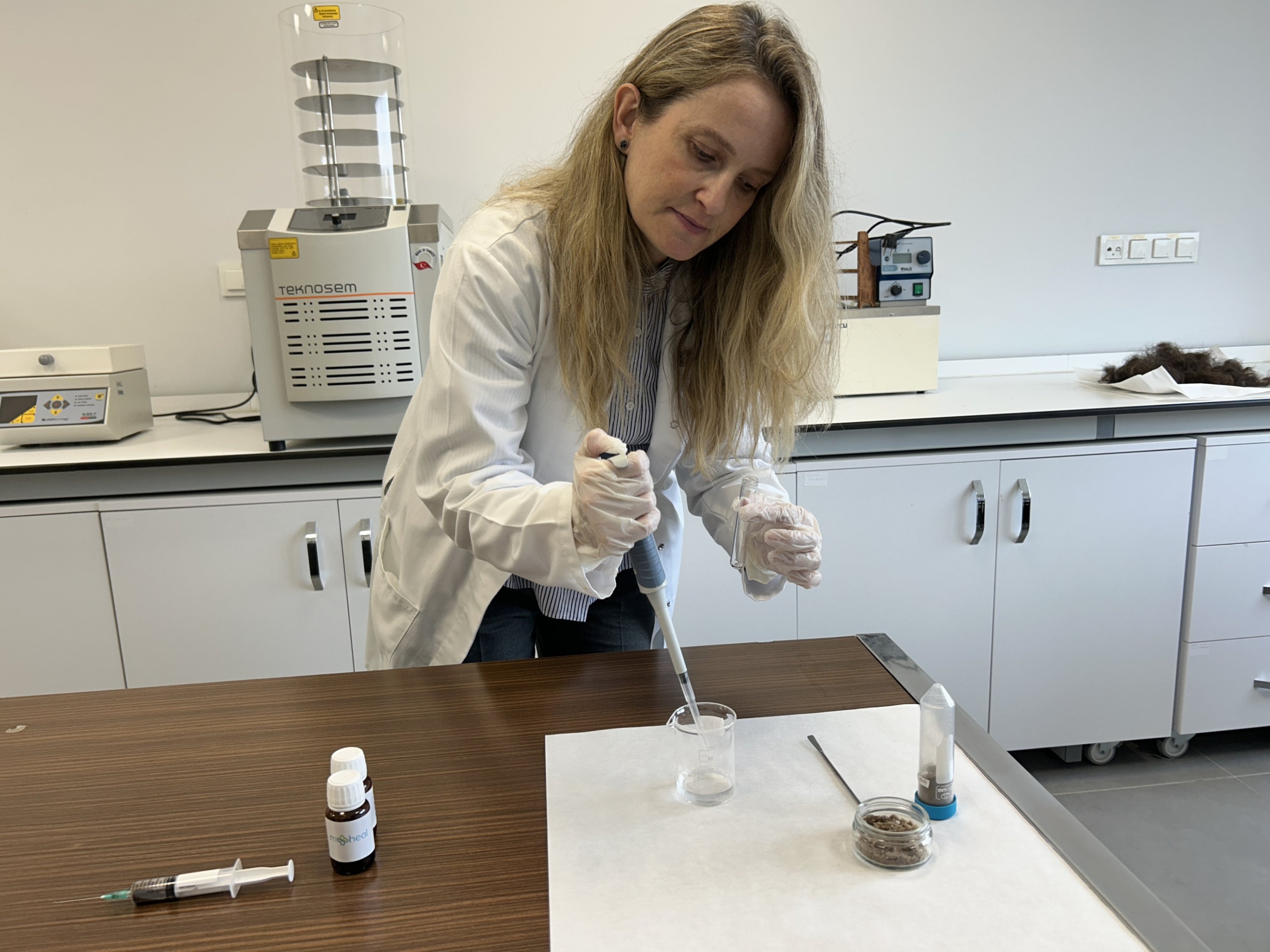
A Turkish scientist has developed a medical product that may replace stitches and bandages. Dr. Rumeysa Tutar, assistant professor at Istanbul University-Cerrahpaşa Faculty of Engineering's Chemistry Department, has produced an injectable tissue adhesive from keratin extracted from human hair.
The project was developed under Mplusheal Biotechnology Inc., a startup established within Entertech Istanbul Technopark, a joint initiative of Istanbul University and Istanbul University-Cerrahpaşa, with the support of TÜBITAK’s 1812 Entrepreneurship Program.
To start the process, Tutar collected untreated and chemical-free hair clippings from barbershops and salons. After cleaning the hair, she dissolved it in a chemical solution on a laboratory magnetic heater until it turned into a liquid.
The liquid was then placed in a cellulose membrane and dialyzed in pure water for two days. After adjusting the pH level to 5.0, she froze the solution and dried it to obtain powdered keratin. This keratin was then combined with phosphate-buffered saline (PBS) to form a composite material.
Applied by syringe onto wounds, the compound quickly turned into an elastic structure that sealed cuts, acting as both a bandage and surgical stitches.
Tutar said the idea emerged in 2021, when she considered treatments for nail bed injuries. During her doctoral research fellowship at the University of California, Los Angeles (UCLA), she had worked on bladder injuries. Returning to Türkiye, she found that nearly 5 million patients visit emergency rooms annually with nail bed injuries.
"We asked what could be done in this area. Since nails are rich in keratin, we focused on keratin. And because the aim was to develop a product for humans, we chose human hair waste as the source," she said.
Keratin can be obtained from other sources, such as animal hair or feathers, but these methods were not feasible in her laboratory. Her team instead created a new method in seven months, producing keratin that is water-soluble and of lower molecular weight.
"This gives us an advantage because a lower molecular weight allows better integration with tissue. This supported both the adhesive study and other research we are doing," she explained.
The main feature of the product is that it can be injected and solidifies on its own without requiring light. Once in contact with tissue, it undergoes a natural gelation process.
"Since it is derived from human hair, its immunological effects are very low. As a hydrogel, it holds water and absorbs blood like a sponge, which makes it effective in wound treatment," Tutar said.
The goal is to make the adhesive usable in injuries that require surgical intervention, thereby reducing the need for conventional stitches or bandages.
Tutar said the product is ready to move toward commercialization but requires investment.
"Keratin is already used in cosmetics when extracted from animal byproducts, but our focus is on health applications. Using human hair waste reduces risks and provides a local solution. What we need now is investment support to make this product available in health care," she added.
The research demonstrates how waste materials can be utilized in biotechnology and may provide a local alternative for medical treatments in Türkiye.