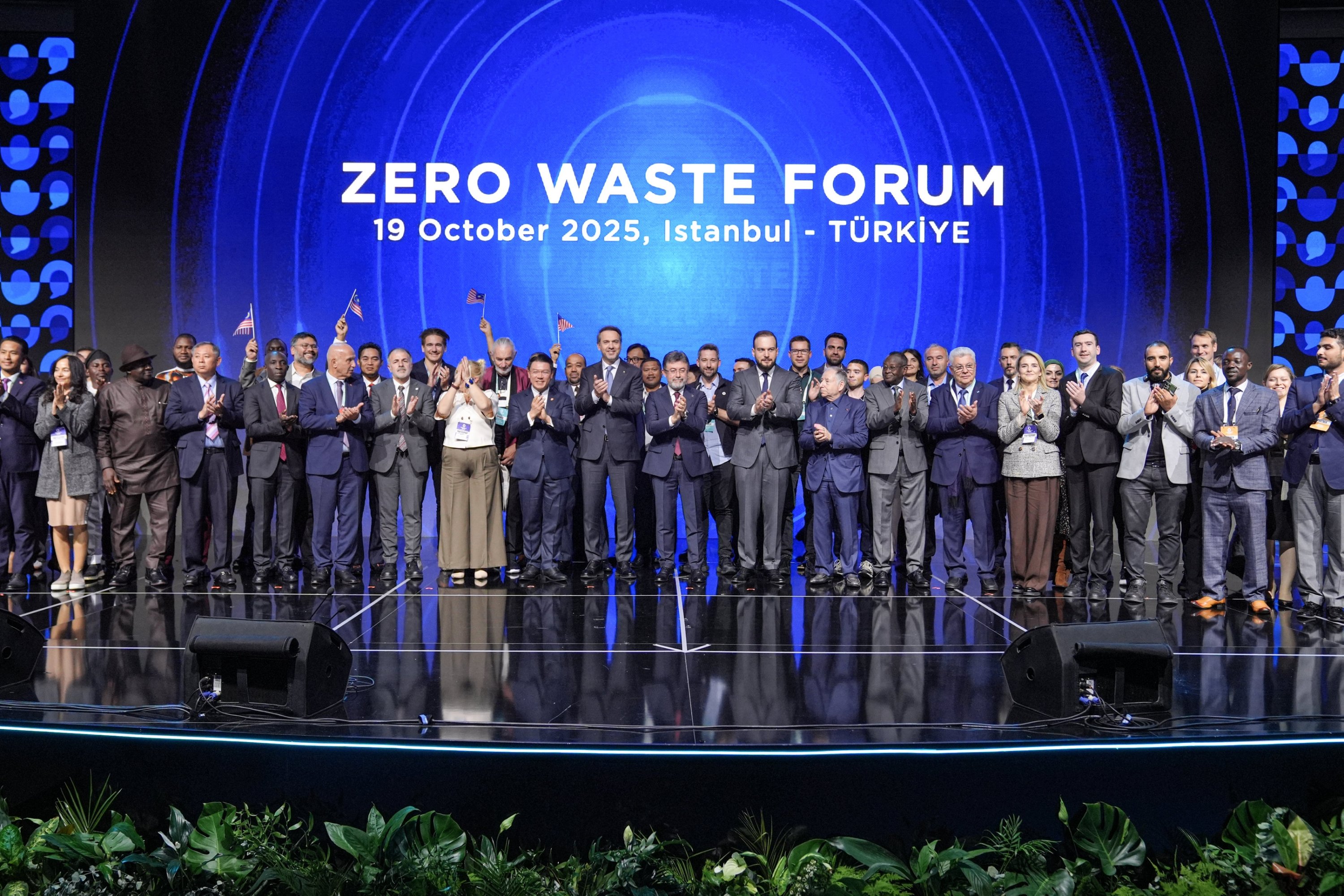
The first Global Zero Waste Forum 2025 concluded its three-day session in Istanbul on Oct. 19, marking a significant milestone in global environmental diplomacy. The forum brought together over 100 countries and 118 international organizations, including the United Nations, to endorse the Istanbul Declaration. This declaration solidifies a collective commitment to advancing zero waste principles and fostering sustainable development worldwide.
Held under the theme “People, Places, Progress,” the forum featured closing speeches and an awards ceremony celebrating individuals and organizations contributing to the zero waste movement.
The forum started on Oct. 17 with a keynote address by first lady Emine Erdoğan, who highlighted both the urgency and cultural roots of the movement, asking: “If we knew that producing a single pair of jeans consumes 3,781 liters of water, would we still call it a bargain? If we knew that electronic waste poisons our soil and water, would we rush to buy the newest phone every year?”
Erdoğan also reflected on Türkiye’s traditional practices. “In Anatolia, ‘throwing away’ was an unfamiliar concept. What we now call upcycling used to be a way of life, repairing broken items, repurposing materials, passing children’s clothes from one sibling to another,” she said.
On Oct. 18, the forum hosted the fourth official meeting of the United Nations High-Level Advisory Board on Zero Waste, chaired by Erdoğan. The board's discussions focused on advancing global zero waste initiatives and strategies for sustainable development. Erdoğan reiterated Türkiye's commitment to promoting zero waste practices worldwide and emphasized the importance of international cooperation in achieving sustainability goals.
On the final day, the Global Zero Waste Awards ceremony recognized individuals and organizations for their outstanding contributions to the zero waste movement. The awards highlighted achievements in areas such as industrial solutions, sustainable business practices, innovation, city-level zero waste initiatives and efforts to promote zero waste living globally.
In his closing remarks, Samed Ağırbaş, president of the Zero Waste Foundation, highlighted the participation of representatives from 108 countries and emphasized the forum’s collaborative spirit: “For three days, experts discussed the past, present and future of zero waste. Our foundation prioritizes cooperation, shared vision and common goals. The forum was organized with over 150 partners, reflecting a shared approach and collective impact.”
Ağırbaş expressed gratitude to Agriculture and Forestry Minister Ibrahim Yumaklı for initiatives on water efficiency, food waste reduction and preservation of ancestral seeds. He also outlined the foundation’s vision: “We are determined to make Istanbul a global hub for zero waste initiatives. With the support of the first lady and Türkiye’s commitment, we are working to establish U.N.-Habitat’s zero waste office in Istanbul, and over the next five years, more than 10 international organizations will open their global offices here.”
He further noted the forum’s lasting influence: “Although the Zero Waste Foundation is only 8 years old, it has had the impact of 80 years. Today, the zero waste movement is recognized in all 193 U.N. member countries, becoming one of Türkiye’s most important contributions to global civil initiatives.” Ağırbaş also confirmed that the forum will return to Istanbul next year.
During the closing ceremony, Yumaklı said, “The Zero Waste Movement is not only an environmental policy but also a global expression of respect for resources, labor and life.” He emphasized the initiative’s cultural roots in Türkiye, adding, “We must not waste blessings.”
He also highlighted Istanbul’s growing global role in the movement, noting, “Istanbul has become one of the global centers for the zero waste vision,” and stressed the forum’s lasting impact: “Every experience shared at the forum will shape not only today’s but also tomorrow’s environmental policies.”
On the broader significance of zero waste, Yumaklı explained, “We define zero waste not as a technical system, but as a behavioral, cultural and economic transformation process.” He concluded by emphasizing collaboration, saying, “By working together, we can increase values, not waste; grow solidarity, not indifference.”
The forum was organized by the Zero Waste Foundation in collaboration with Türkiye’s Ministry of Environment, Urbanization and Climate Change, Ministry of Agriculture and Forestry, the United Nations Environment Programme (UNEP) and the U.N. Human Settlements Programme (U.N.-Habitat).