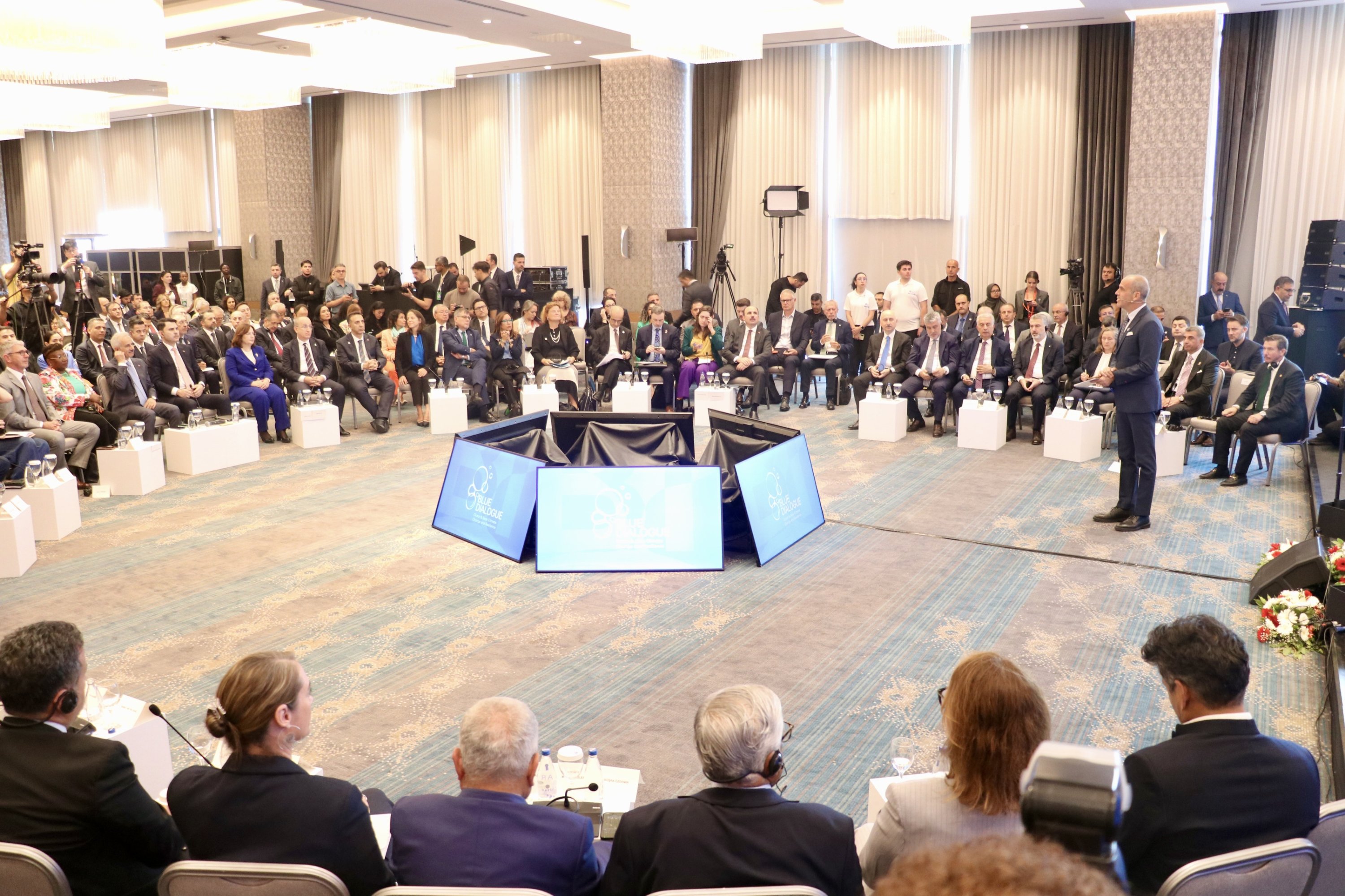
The Ocean and Seas Summit began Thursday in Trabzon, northeastern Türkiye, and continues through Friday as part of Türkiye’s preparations for the COP31 climate summit, bringing together discussions on the impacts of climate change on oceans and seas, marine ecosystem protection, the blue economy, financing and international cooperation.
The summit is one of the key milestones on the COP31 Presidency’s road map ahead of the U.N. climate conference in Türkiye this year.
During the High-Level Ministerial Session on Oceans, Climate and the Blue Economy, COP31 President-Designate and Environment, Urbanization and Climate Change Minister Murat Kurum said Türkiye is ready to share its experience and successful practices in protecting marine ecosystems.
“Changing the course is in our hands, and for this we need stronger cooperation among countries, the sharing of knowledge and experience, and joint action,” Kurum said.
He said oceans provide livelihoods for more than 3 billion people and produce half of the air humans breathe, while warning that their future faces significant risks from climate change and other environmental pressures.
Research indicates that the economic cost of deteriorating ocean ecosystems could exceed $400 billion by 2050, Kurum said.
He acknowledged that existing efforts to address the multiple challenges facing oceans remain insufficient, but pointed to progress in some areas, including a 15% improvement in fish stocks in the Mediterranean and Black seas.
Kurum linked the discussions in Trabzon to the increasingly severe climate-related disasters experienced across the Black Sea region.
Trabzon has experienced more than 100 meteorological disasters over the past 50 years, he said, highlighting floods, wildfires, landslides and extreme rainfall.
“Because of climate change, we are now witnessing and experiencing how unexpected heavy rainfall can cause streams flowing toward the sea to devastate cities, districts and people,” Kurum said.
“Waste released into the Black Sea can appear in the Mediterranean,” he said, adding that problems in the Black Sea can extend to the oceans, while problems originating in the oceans can also reach the region.
Türkiye has therefore made oceans and seas one of the priorities of the COP31 action agenda, he said.
“As the COP31 Presidency, we want to cross borders in the face of these challenges, take a holistic approach and establish a common and determined will to overcome every problem together,” Kurum said.
Kurum also highlighted the Black Sea’s role in international cooperation, noting that the grain corridor established during the Russia-Ukraine war passed through the Black Sea.
Kurum said Türkiye is expanding protected marine areas, advancing marine spatial planning and digital twin technologies, and promoting blue economy initiatives under U.N. Sustainable Development Goal 14, “Life Below Water.” He also highlighted the launch of a Mediterranean climate adaptation center, an initiative first proposed by Türkiye in 2021.
Another initiative highlighted by Kurum is the mooring buoy system in the Fethiye-Göcek area.
The system serves 856 boats across 17 bays and is designed to prevent anchors from dragging across the seabed and damaging seagrass meadows, marine ecosystems and fish breeding grounds.
He added that Türkiye is monitoring seas and lakes in real time and conducting cleanup operations as part of a broader environmental mobilization, while imposing serious penalties for violations.
Kurum said governments now need to move beyond statements and translate climate commitments into concrete measures.
Türkiye is continuing to strengthen cooperation with Australia, Pacific and African countries, climate champions and other stakeholders working on ocean-related issues, he added.
Kurum concluded by outlining Türkiye’s vision for marine climate action, “Our course is clean seas; our course is resilient coasts.”