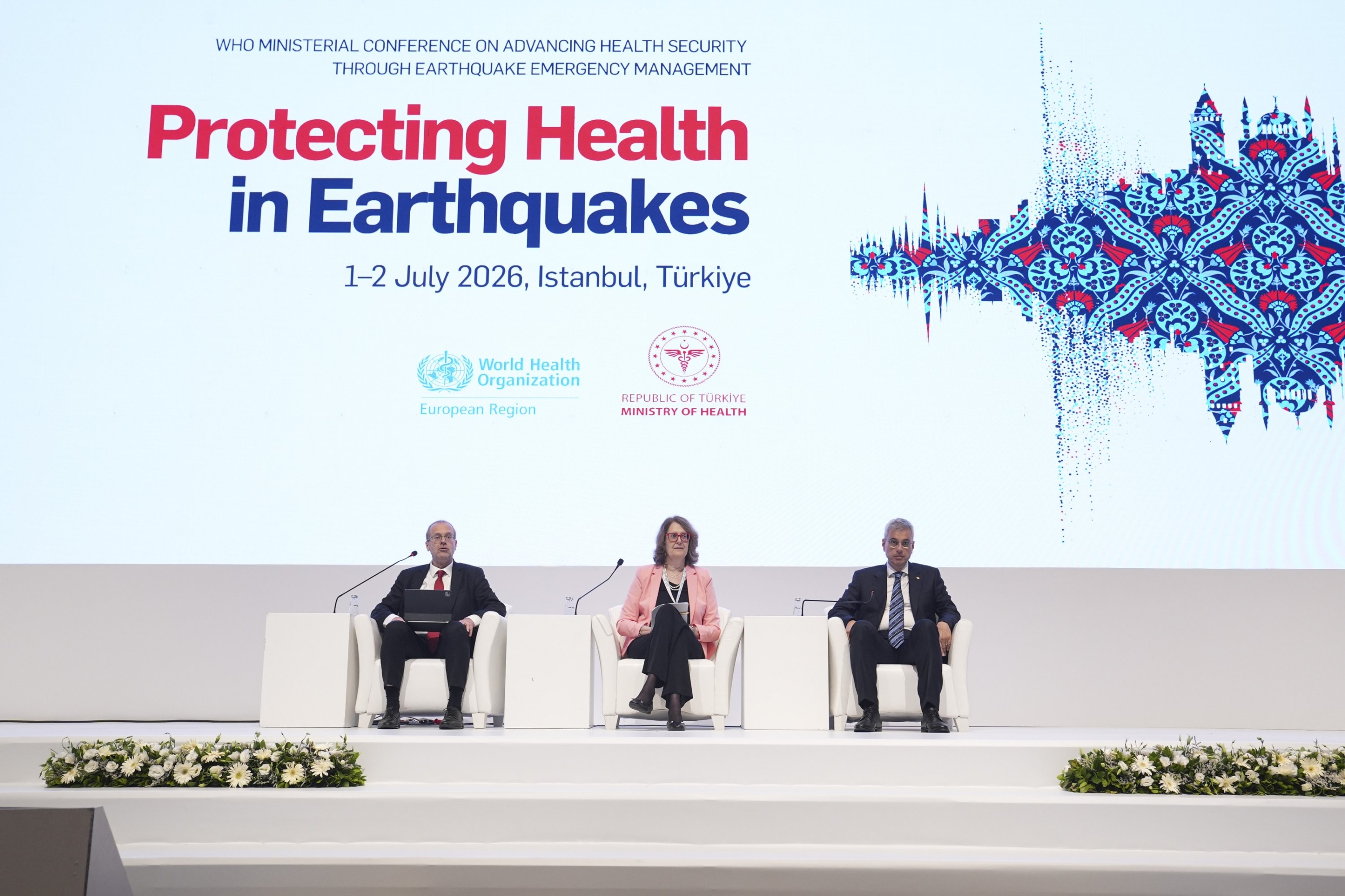
Türkiye is committed to sharing its disaster management expertise with countries in need as part of its humanitarian responsibility, Health Minister Kemal Memişoğlu said on Thursday, highlighting the country's experience in responding to major earthquakes and its efforts to strengthen global health security.
At the World Health Organization (WHO) Ministerial Conference on "Protecting Health in Earthquakes – Strengthening Health Security Through Earthquake Emergency Management," held in Istanbul, Health Minister Kemal Memişoğlu said health transcends national borders and that international cooperation is essential in responding to disasters. The event was hosted by Türkiye's Ministry of Health in cooperation with the WHO.
The conference brought together representatives from around 40 countries, including ministers and deputy ministers from 12 nations.
Describing the gathering as the first international conference dedicated exclusively to the health dimension of earthquakes while bringing together countries from the WHO's European, African, Eastern Mediterranean and Western Pacific regions, Memişoğlu said the event marked an important step in strengthening cooperation on disaster preparedness.
"Earthquakes are a common challenge for all humanity. Therefore, the strongest response to this global threat is collective wisdom, scientific cooperation and international solidarity. We have gathered here because protecting human life is our shared responsibility," he said.
Türkiye sits on one of the world's most active seismic belts and has experienced numerous destructive earthquakes throughout its history. According to Memişoğlu, each disaster has contributed to improving the country's disaster preparedness and health care response capacity.
He said Türkiye has adopted a comprehensive approach that includes building resilient health care infrastructure, training qualified personnel, establishing effective coordination systems and ensuring uninterrupted health care services under all circumstances.
In recent years, the country has invested heavily in city hospitals, reinforced health care facilities, emergency medical services, digital health infrastructure, air ambulance operations and its National Medical Rescue Teams (UMKE), significantly strengthening the resilience of its health care system.
Memişoğlu also highlighted the development of the domestically produced GÖKBEY ambulance helicopter, describing it as one of the major health care achievements under the Century of Türkiye vision.
Capable of operating in challenging terrain and harsh weather conditions, the helicopter functions as a flying emergency department equipped to provide intensive care to two patients simultaneously, helping maintain uninterrupted medical services during disasters.
The minister also shared details of Türkiye's response to the devastating Feb. 6, 2023, Kahramanmaraş-centered earthquakes, describing them as one of the largest natural disasters in the country's modern history.
The twin earthquakes directly affected 11 provinces, causing widespread destruction to cities, transportation networks and health care infrastructure while disrupting the lives of millions of people.
Memişoğlu said the Ministry of Health's Health Disaster Coordination Center (SAKOM) became fully operational immediately after the disaster and national emergency response plans were activated without delay.
Health care workers, ambulances and UMKE teams from across the country were coordinated through a central command and rapidly deployed to the affected provinces despite damaged roads and severe winter weather.
Before the earthquakes, 113,759 Ministry of Health personnel were serving in the disaster zone. Following the disaster, an additional 35,470 health care workers were dispatched from other provinces to reinforce medical services.
More than 138,000 personnel, including 5,075 UMKE members, over 21,000 physicians, more than 73,000 health care workers and over 38,500 support staff, worked in the region during the emergency response.
A fleet of 1,810 ambulances, 245 UMKE vehicles and 16 air ambulances operated continuously throughout the disaster response.
Memişoğlu said Türkiye also carried out one of the largest medical evacuation operations in its history, transporting 51,665 patients and injured people by land, air and sea to hospitals in neighboring provinces.
The operation eased pressure on hospitals in the earthquake zone while ensuring patients requiring advanced treatment continued receiving uninterrupted care.
To sustain health care services, authorities established 34 field hospitals, 176 emergency intervention units and 130 accommodation units for health care personnel within a short period. Together, these facilities provided medical services to nearly 600,000 people.
The Turkish navy's TCG Bayraktar and TCG Sancaktar landing ships, each with a capacity of 560 beds, were also converted into floating field hospitals, providing both medical treatment and temporary shelter for earthquake survivors.
Expressing gratitude to the international community, Memişoğlu thanked Azerbaijan, the first country to send assistance following the Feb. 6 earthquakes, along with all other countries that supported Türkiye during the disaster.
Looking ahead, the minister said Türkiye continues to strengthen its preparedness for future disasters, particularly a possible major Marmara earthquake that could affect Istanbul.
He announced that the country has developed a comprehensive preparedness model for all earthquake-prone regions and introduced what he described as the world's first Public Health Services in Earthquakes Guide.
As part of the plan, Istanbul has been divided into 10 health care regions, each paired with provinces across Türkiye that would provide coordinated support during a major disaster.
"Every detail has been planned in advance, including which province will send personnel and equipment, how they will arrive by land, sea or air, and exactly where they will be deployed," Memişoğlu said.
Reiterating Türkiye's commitment to international solidarity, he said the country views sharing its disaster management experience as a humanitarian responsibility.
"Health is a universal value beyond borders. We will continue supporting countries affected by disasters by sharing our qualified human resources and institutional capacity," he said.
Memişoğlu cited Türkiye's recent deployment of UMKE teams and fully equipped emergency response units to Venezuela following a major earthquake as an example of that commitment, adding that no country or health care system can face large-scale disasters alone and calling for stronger international cooperation to protect human life.