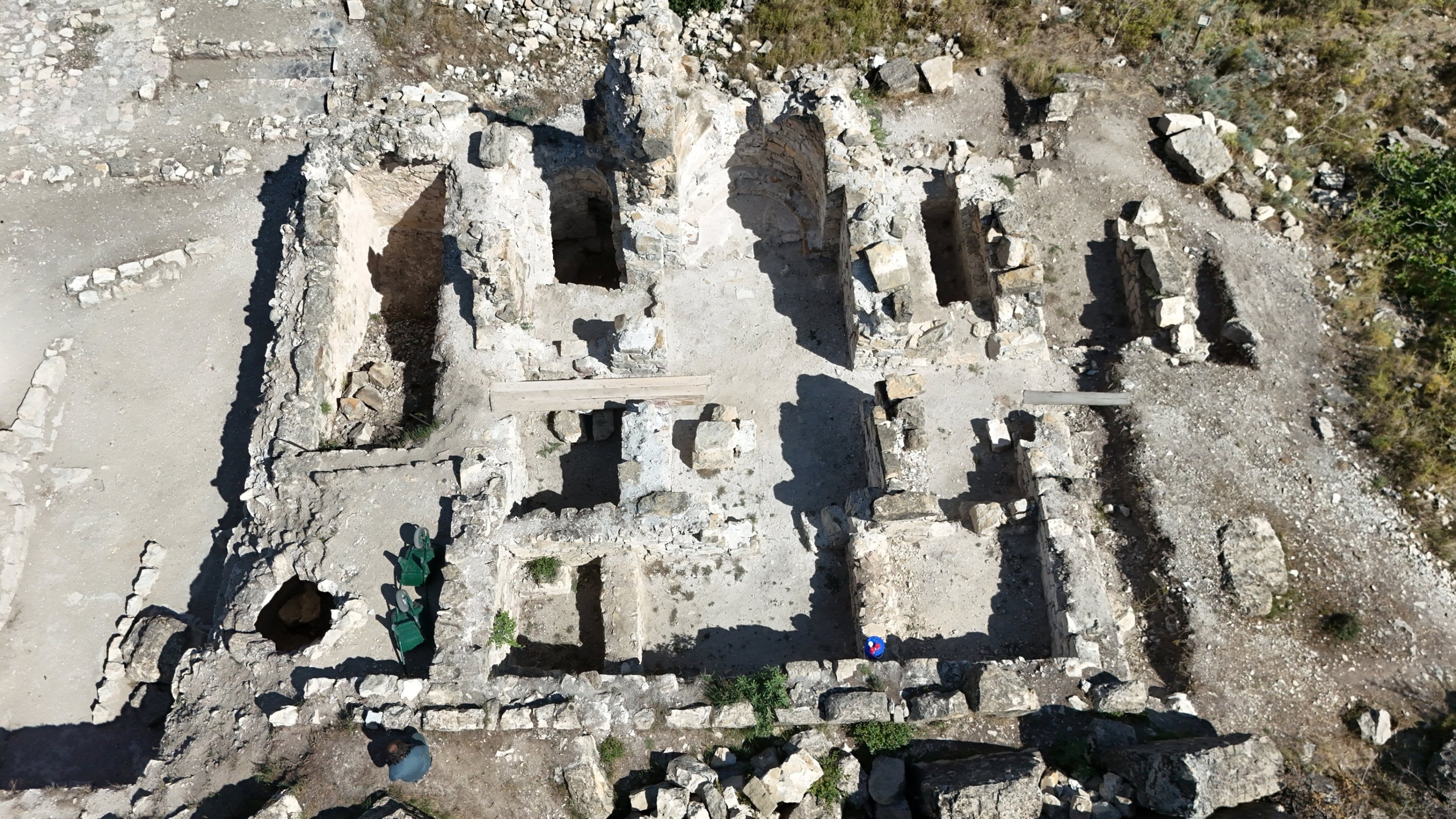
In Gevhernik Castle in the Ardanuç district of Artvin, northeastern Türkiye, archaeological excavations have uncovered a burial chamber, a kitchen, a cistern, coins and ceramic pieces.
The excavations, carried out in cooperation with the Ministry of Culture and Tourism and Van Yüzüncü Yıl University, are being conducted around the church within the castle and its surrounding area.
The castle, which served as a center of administration during the Georgian Kingdom in the Middle Ages and later during the Ottoman period, has revealed a kitchen, a cistern, coins and a burial chamber in this year’s excavations.
Dr. Osman Aytekin, head of the excavation and faculty member of the Department of Art History at Van Yüzüncü Yıl University, said that the work began in 2021 with the permission and support of the Ministry of Culture and Tourism.
Aytekin stated that the excavations are planned to continue for at least five more years. He emphasized that the castle, built in the fifth century and repaired in the ninth century by King Ashot of the Bagratid dynasty with an added urban section, was an important historical settlement.
He highlighted that the ruling class and their families lived in the inner castle, while merchants and wealthy residents lived in the walled city section. In the city area, there were structures such as tombs, baths, churches and fountains.
Recalling that work began last year at the Petrus and Paulus Church, Aytekin added: “This year, we are continuing excavations around the structures near this church. Immediately nearby, we discovered a large space identified as a tandoor house, or kitchen. Its foundations and tandoor remnants have been revealed. This indicates that an important population lived here."
"The presence of a kitchen and tandoor house confirms that there was a population significant both in religious and administrative terms. There are also numerous cisterns. We have completed the excavation of two cisterns and are continuing with the third. After completing them, we will move on to the administrative building,” he added.
Aytekin also referred to the Georgian historical book Kartlis Tskhovreba, which mentions that the burial of King Ashot of Georgia is located in the Petrus and Paulus Church. He said: “The tomb of Ashot has been sought both by Georgian scholars and our team. We discovered a burial chamber in the narrow apse section of the church, beneath the apse. The burial chamber is 2 meters long and 1.8 meters wide, covered with a vaulted roof."
"Unfortunately, when we conducted the excavation, we found no human remains or bone fragments inside the vault. In Georgia, two tombs were being sought, one of Queen Tamara, which was unknown, and the other of King Ashot. It was said that it was here, but the exact location was unknown. Scientifically, the tomb of King Ashot has been located by our team on behalf of Turkish archaeology,” he said.
Aytekin stated that portable cultural artifacts from the excavations, including Byzantine coins dating to the early 11th century, ceramic fragments and stone and metal projectiles, were also discovered. He noted that the findings would be delivered to the Artvin Museum at the end of the year.
Aytekin expressed his belief that, upon completion of the excavations, the site would become an important center for culture and tourism.
Dr. Turgay Beyaz, a faculty member from Pamukkale University’s Faculty of Engineering and part of the excavation team, stated that he worked on soil and rock mechanics in the excavation area.
Beyaz added that monolithic stones weighing up to 10 tons were used in the castle and that these stones were selected from local sources.