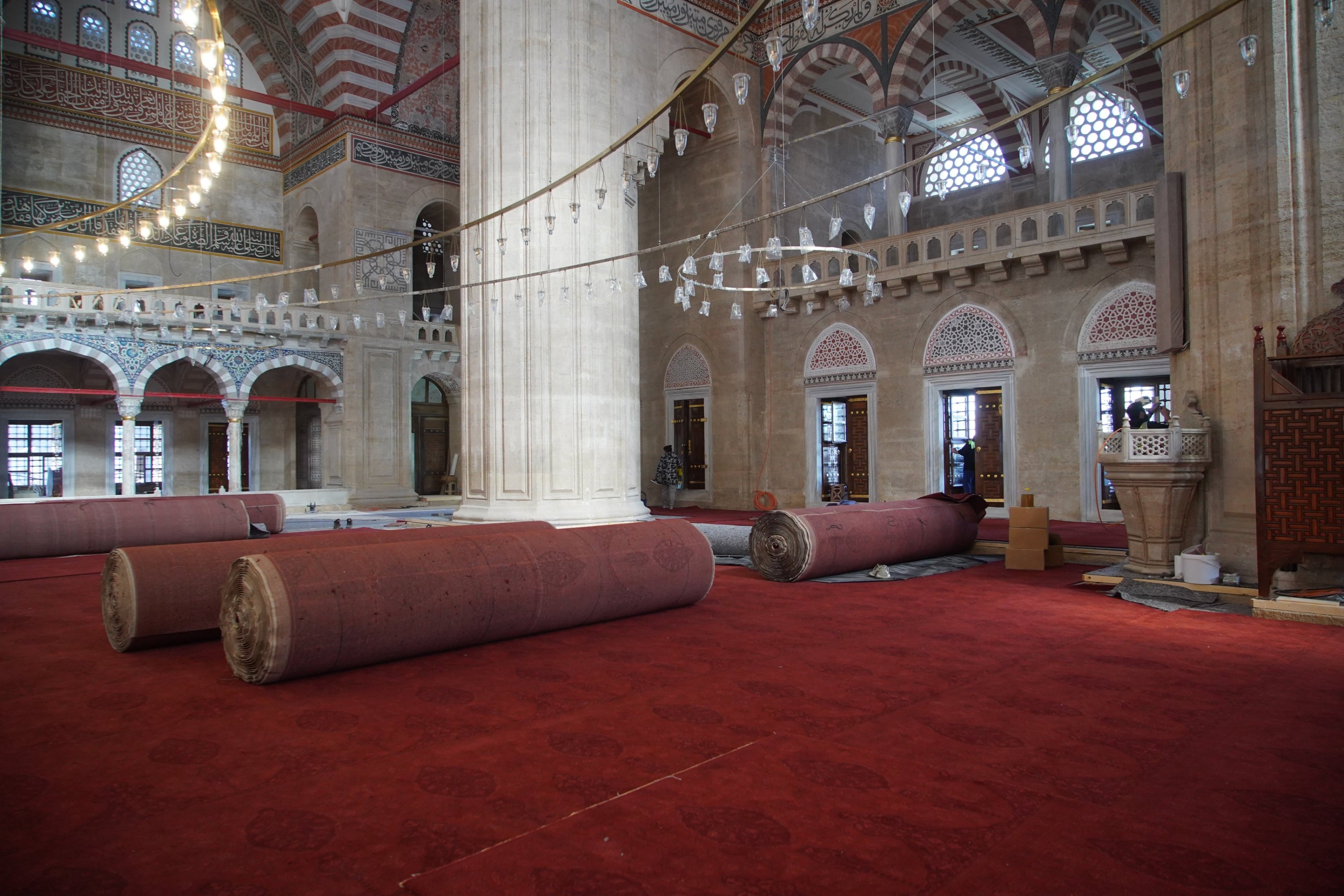
The historic Selimiye Mosque, in Edirne, northwestern Türkiye, widely regarded as the pinnacle of Turkish-Islamic architectural heritage, is entering the final phase of a comprehensive restoration program, with the historic site set to reopen for worship with the first Tarawih prayer of Ramadan.
Launched in November 2021, the large-scale restoration has been carried out under the supervision of a scientific advisory board, with each structural and decorative element of the mosque meticulously reviewed and rehabilitated in line with its original design principles. While the majority of the works have been finalized, finishing touches continue, particularly in the surrounding burial ground, alongside tile cleaning and landscape arrangements.
As part of the structural interventions, reinforcement works were completed on the main dome and all four minarets, while lead coverings were fully renewed. Cement-based additions applied during previous periods were removed to restore the building’s authentic material integrity. Window systems were comprehensively overhauled, with glass and wooden frames replaced, and deterioration in original wooden shutters and doors carefully addressed.
Inside the mosque, restoration teams focused on preserving visual and material authenticity. Of the 264 interior plaster window elements, sections altered during a 1983 renovation using flat glass or plexiglass were reconstructed using stainless steel structural systems and traditional bottle-bottom glass techniques, in keeping with the original form.
Exterior plaster elements were also replaced using water-resistant special mortar and stainless fittings. Decorative plasterwork and painted ornamentation in the main prayer hall and the domed courtyard arcades were restored to their historic condition.
Special attention was given to the mosque’s carpeting, a key component of its interior identity. Drawing on the original carpet preserved at Istanbul’s Museum of Turkish and Islamic Arts as a reference, a new carpet was handwoven in the Demirci district of Manisa. Inspired by traditional Anatolian prayer rug motifs, the carpet was produced to cover nearly 3,000 square meters of usable interior space, maintaining strict fidelity to the original design.
The forecourt section features an individual prayer rug layout, while the main prayer hall reflects the original pattern, woven using a tone-on-tone technique and incorporating “Edirne red,” a color internationally associated with the city. Produced entirely from locally sourced wool, the carpet features a density of 729,000 knots per square meter (32,300 square feet), matching the knot ratio and technical characteristics of the historic original.