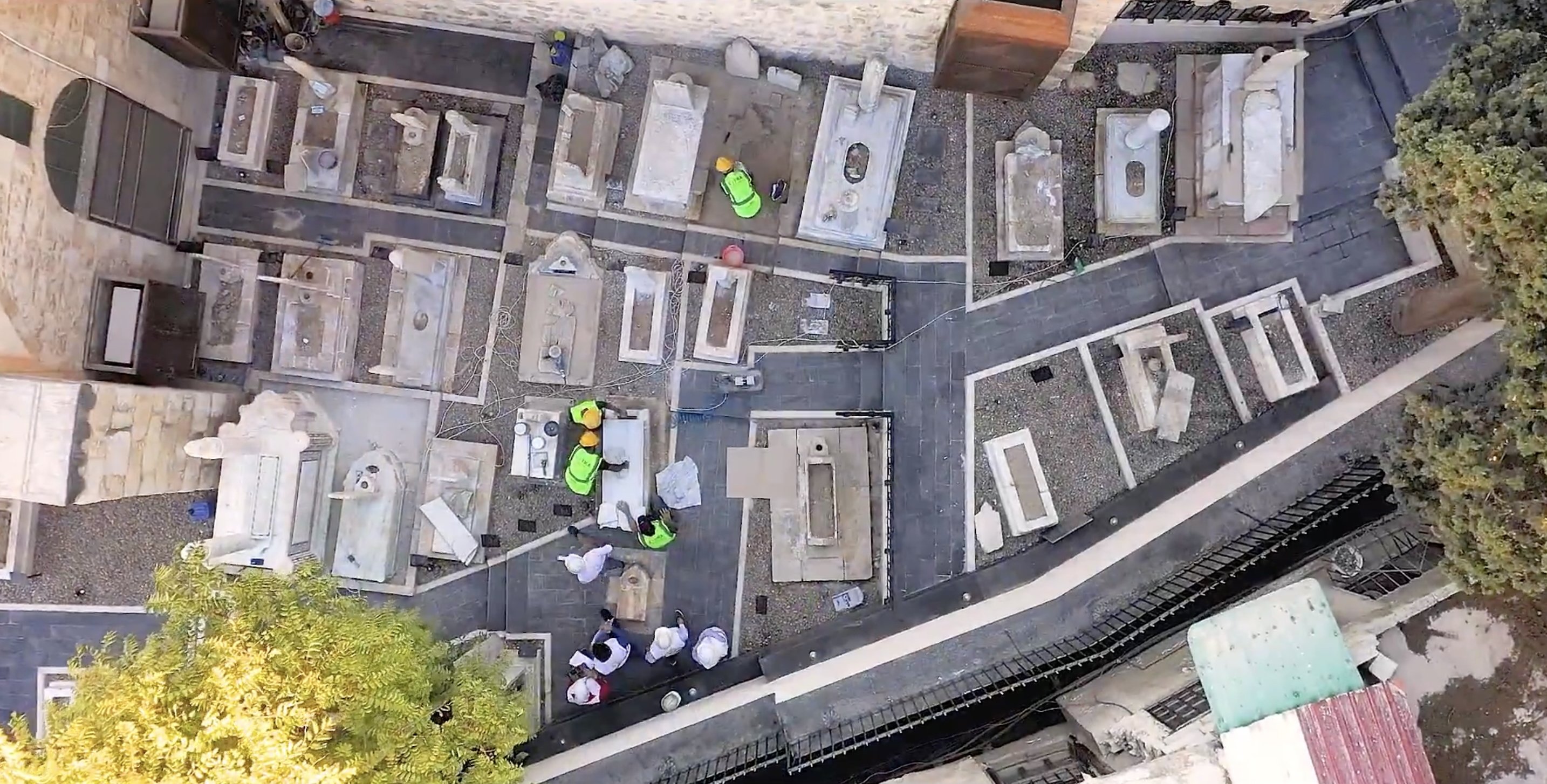
Türkiye has completed the restoration of the historic Ottoman-era cemetery located within the courtyard of the Sheikh Muhyiddin Ibn Arabi Mosque in Damascus, repairing decades of deterioration and damage to an important shared cultural heritage site, the Turkish Cooperation and Coordination Agency (TIKA) announced Monday.
The cemetery, which contains the graves of Ottoman statesmen and their families who played significant roles in the region, had fallen into neglect due to years of wear, intentional destruction and lack of maintenance, resulting in a condition described as incompatible with the spiritual integrity of the mosque and Türkiye’s historical legacy.
With the reopening of Syria to visitors from Türkiye and around the world, the site once again became a key stop for official delegations and cultural and faith-based tourists. As part of efforts to preserve the heritage, TIKA said the first phase of work included clearing accumulated debris and soil, uncovering graves buried beneath concrete and earth, and reorganizing the surrounding area. This stage was completed at the end of August.
The second phase, finished in November, involved restoring damaged gravestones in line with architectural conservation principles, cleaning and maintaining intact stones, and installing an Ottoman-style fountain inside the cemetery.
There are 48 graves in the courtyard, many dating back to the early 19th century, with the oldest dated 1543. Before the Syrian conflict, the Turkish Embassy documented the names on brass plaques, and the recent project corrected historical inaccuracies found in those inscriptions.
The mosque, also known as the Selimiye Mosque, stands near the tomb of the renowned Islamic scholar and Sufi mystic Sheikh Muhyiddin Ibn Arabi, born in Andalusia in 1165. Ibn Arabi traveled widely, produced some of his most influential works in Baghdad and Anatolia and eventually settled in Damascus, where he taught prominent students until his passing in 1240. His resting place was later identified and commemorated by order of Ottoman Sultan Selim I, who constructed a complex including a shrine, a mosque and a lodge in his honor.
TIKA said the restoration reflects Türkiye’s commitment to the protection of shared cultural and religious heritage.