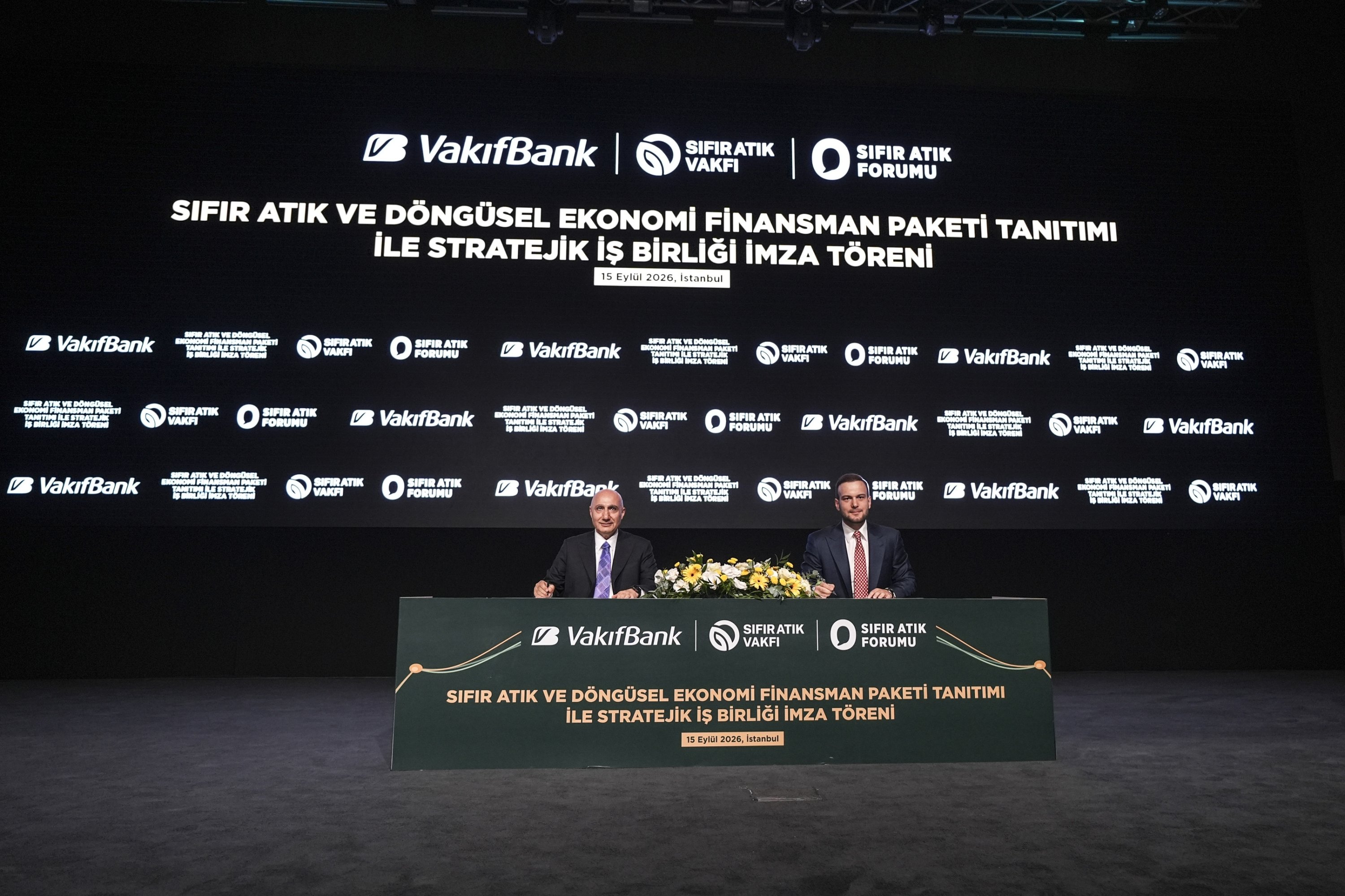
The Zero Waste Foundation and VakıfBank have signed a strategic cooperation protocol to support Türkiye’s transition to a zero-waste and circular economy through new financing models on Tuesday.
Speaking at an event held at VakıfBank’s General Directorate Conference Hall, Zero Waste Foundation Chair and COP31 Champion Samed Ağırbaş said the partnership aims to strengthen the financial sector’s role in reducing waste, increasing resource efficiency and turning waste into economic value.
Ağırbaş said zero waste should not be viewed solely as an environmental policy, stressing the importance of using energy, water, raw materials and labor more efficiently while returning waste to the economy.
Ağırbaş also stressed that zero-waste and climate initiatives cannot be separated from financing. He said high initial investment costs, lengthy payback periods, collateral requirements, co-financing needs and limited project-preparation capacity remain among the barriers preventing cities and businesses from turning their zero-waste potential into investments.
“We see the financial sector not merely as a provider of resources, but as a stakeholder that directs, facilitates and accelerates transformation,” Ağırbaş said.
He called for new, affordable and long-term financing models covering areas from clean production investments by small and medium-sized enterprises (SMEs) and recycling infrastructure to compost and biogas facilities and water and energy efficiency projects.
VakıfBank General Manager Osman Arslan said Türkiye’s recycling rate rose from 13% in 2017 to more than 37.5% in 2025. Approximately 90 million tons of recyclable waste were brought back into the economy between the launch of the Zero Waste Movement and the end of 2025, he said. Türkiye aims to raise the recycling rate to 60% by 2035 and 70% by 2053.
Arslan said VakıfBank secured $7.1 billion in new funding from international markets during the first half of the year, while sustainable finance accounted for 38% of its total international financing.
Under the 2025-2028 National Circular Economy Strategy and Action Plan, the transition to a circular economy is expected to generate TL 210 billion to TL 350 billion ($5.9 billion to $9.8 billion) in annual added value and contribute to more than 100,000 new jobs.
Arslan said VakıfBank has developed six financing areas covering the circular economy value chain, from responsible raw materials and sustainable production to collection, recycling, reprocessing and remanufacturing.
The bank will provide working capital financing of up to TL 10 million with maturities of up to 24 months and investment loans of up to TL 50 million with maturities of up to 60 months.
“In the first stage, we aim to reach a financing volume of TL 10 billion and bring more than 500 companies into the circular economy transformation,” Arslan said.
The partnership comes as Türkiye prepares to host COP31 in Antalya from Nov. 9-20, with zero waste and the circular economy forming part of the country’s broader climate action agenda.