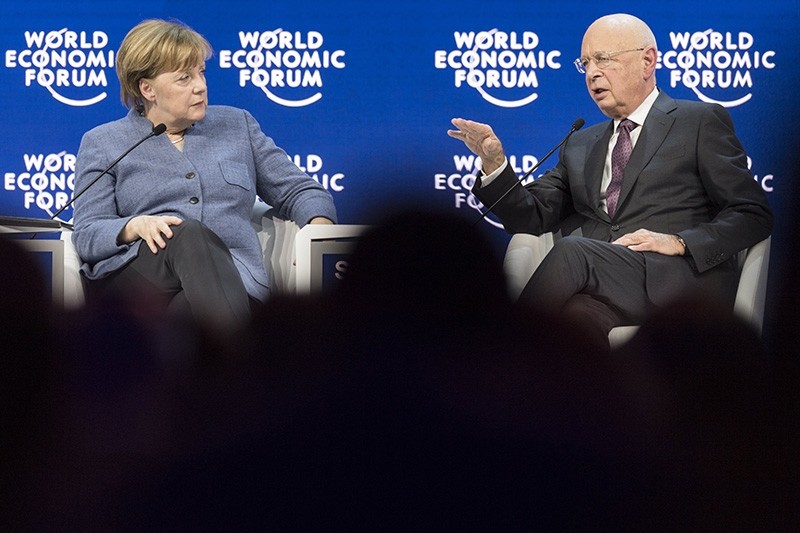
On the second day of the World Economic Forum in Davos, Switzerland, European and Asian leaders voiced both political and economic plans to meet the shrinking global role of the United States.
Saudi and German ministers made clear Wednesday that the current U.S. administration has left a power vacuum in the Middle East that Saudi Arabia and the European Union are now trying to fill.
Riyadh has taken on a more active role in the region to fight back the influence of its rival Iran, Saudi Foreign Minister Adel al-Jubeir said at a panel discussion.
Saudis are taking on a leadership role "because there is a vacuum, and America retreated, and evil forces flow into this vacuum," he said, referring to Iran.
Riyadh and Tehran have been supporting opposing sides of several regional conflicts and hot spots, including Yemen and Lebanon.
German Defense Minister Ursula von der Leyen said it has been difficult to work with U.S. President Donald Trump's administration on Middle East issues.
"It is quite a challenge because the unpredictability behind what we see is hard to cope with," she said.
Trump has irritated Western allies by drawing into question the nuclear deal with Iran, and by acknowledging Jerusalem as Israel's capital.
"Is this power vacuum not a call for us to step in and take our responsibility [as Europeans]?" the German minister asked.
The EU will have a role to play in Syria, because Russia will not be able to maintain its military presence there and rebuild the country without help from other countries, she said.
German Chancellor Angela Merkel Wednesday called on the EU must develop a stronger and more unified foreign policy.
"We need to take more responsibility, we need to take our destination into our own hands," Merkel said.
At the same time, she warned that the EU should not close itself off to migration.
"Ever since the Roman Empire, ever since the Chinese Wall, we know that only shutting yourself off doesn't help," the chancellor said, advocating international cooperation, development and adherence to global treaties.
In a veiled rebuke to the isolationist trade policies of U.S. President Donald Trump, Merkel said: "Protectionism is not the answer."
Countries complaining about unfair trade relations should seek multilateral rather than unilateral solutions, she said.
Days after Trump slapped tariffs on imported solar-energy components and large washing machines, U.S. Commerce Secretary Wilbur Ross fought back Wednesday, saying the U.S. is committed to free and fair trade while bracing itself for possible retaliation from China over the new tariffs.
"In terms of any trade action you take, there's always potential for retribution or retaliation and that's up to the Chinese to decide," Ross told journalists as part of the largest-ever U.S. delegation to the annual Davos gathering.
Ross insisted that the U.S. government is not protectionist and that the tariffs are meant to deal with what he termed "inappropriate behavior" by other countries.
Ross said it wasn't for him to set Chinese policy about whether to retaliate or not but he warned that if Beijing were to do so, there would be a question as to what the U.S. in turn would do.
Beijing, in turn, used to the summit to pledge a push forward in the country's four-decade reform and to further open the country to the world.
Liu He, President Xi Jinping's main economic adviser, echoed his boss's lofty pro-globalization words from last year's Davos summit, promising foreign companies greater access to China's financial services market, manufacturing and some service industries.
He promised to carry out China's financial services liberalization, which was unveiled late last year.
Banking, securities and insurance industries will allow more foreign access, Liu said, adding that these measures would be implemented one at a time.
China will work to increase imports, do better at protecting intellectual property and "gradually lower the imported automobile tariff rate," he said.
Liu reiterated China will focus on three battles in coming years: resolving risks, reducing poverty and controlling pollution.