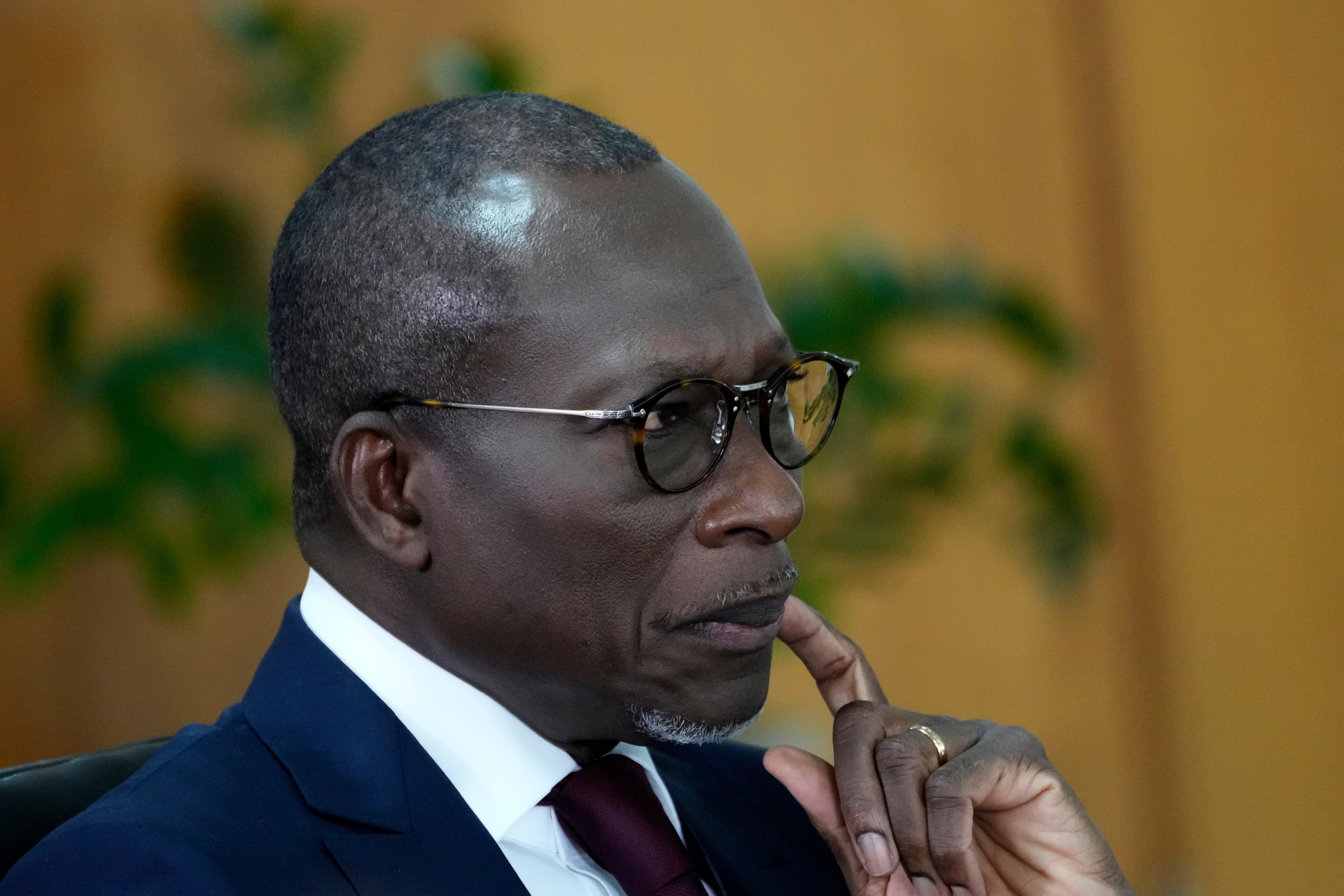
Benin’s president declared the “situation is completely under control” after loyalist forces, backed by Nigerian troops and air support, foiled an attempted coup.
The crisis erupted Sunday when a faction of soldiers appeared on state television claiming they had overthrown President Patrice Talon. Loyal forces moved quickly, with Nigeria deploying aircraft and troops to help restore order.
Military and security officials in Benin said about a dozen soldiers have been arrested, including key figures behind the failed putsch.
The attempted coup adds to a troubling pattern in West Africa, where Niger, Burkina Faso, Mali, Guinea and, most recently, Guinea-Bissau have all endured military takeovers in recent years.
“I would like to assure you that the situation is completely under control and therefore invite you to calmly go about your activities starting this very evening,” Talon said late Sunday on state broadcaster Benin TV.
Talon is due to hand over power in April next year after 10 years in office marked by solid economic growth but also a surge in jihadist violence.
Early Sunday, soldiers calling themselves the Military Committee for Refoundation, or CMR, announced on state television that they had met and decided that “Mr. Patrice Talon is removed from office as president of the republic.”
Shortly after the announcement, however, a source close to Talon told AFP the president was safe, calling the coup plotters “a small group of people who only control the television.”
“The regular army is regaining control. The city (Cotonou) and the country are completely secure,” the source said.
“It’s just a matter of time before everything returns to normal. The clean-up is progressing well.”
Interior Minister Alassane Seidou then appeared on state television to say the Beninese armed forces and their leadership “maintained control of the situation and foiled the attempt.”
Later Sunday, Nigerian fighter jets struck undisclosed targets as Beninese forces conducted countercoup operations, a source in the Nigerian presidency told AFP.
The West African regional bloc ECOWAS said troops from Ghana, Ivory Coast, Nigeria and Sierra Leone were being deployed to help the government “preserve constitutional order.”
A statement from Nigerian President Bola Tinubu’s office said Nigerian troops had already entered Benin and that its air force had been deployed at the request of Benin’s Foreign Ministry.
AFP correspondents reported hearing gunfire early Sunday on the streets of Cotonou, the economic capital, while soldiers blocked access to the presidential offices and the state television building.
Elsewhere, residents went about their day.
“The coup was foiled, thank God. But we have to think about what to do so this kind of thing doesn’t happen again,” Adam Aminou, a street vendor in Cotonou, told AFP.
“We had a few scary moments,” said retired teacher Jennifer Adokpeto.
“We really thought, seeing the statement being repeated on a loop on TV, that it was really a coup d’etat and that our country was going to go the way of some of our neighbors.”
A military source confirmed the situation was under control and that the coup plotters had taken neither Talon’s residence nor the presidential offices.
AFP could not immediately verify this, with access to those areas and several parts of the city blocked, including the five-star Sofitel hotel and districts housing international institutions.
The eight rebel soldiers who appeared on television were carrying assault rifles and wearing berets of various colors. They proclaimed Lt. Col. Pascal Tigri as president of their “refoundation committee” and justified their actions by citing the “continuous deterioration of the security situation in northern Benin.”
They also complained about the “neglect of soldiers killed in action and their families left to fend for themselves,” as well as “unjust promotions at the expense of the most deserving.”
The African Union said it “unequivocally condemns” the attempted coup.
U.N. Secretary-General Antonio Guterres said he was “deeply concerned by the attempt to unconstitutionally seize power in Benin,” warning that such actions could “further threaten the stability of the region.”
France, Benin’s former colonial ruler, and the International Organization of La Francophonie also condemned the coup attempt.
Benin’s political history has been marked by several coups and attempted coups since it gained independence from France in 1960.
Talon, a 67-year-old former businessman known as the “cotton king of Cotonou,” came to power in 2016 and has been praised for driving economic growth but is regularly accused by critics of authoritarianism.
He is due to reach the end of his second term in 2026, the maximum allowed by the constitution.