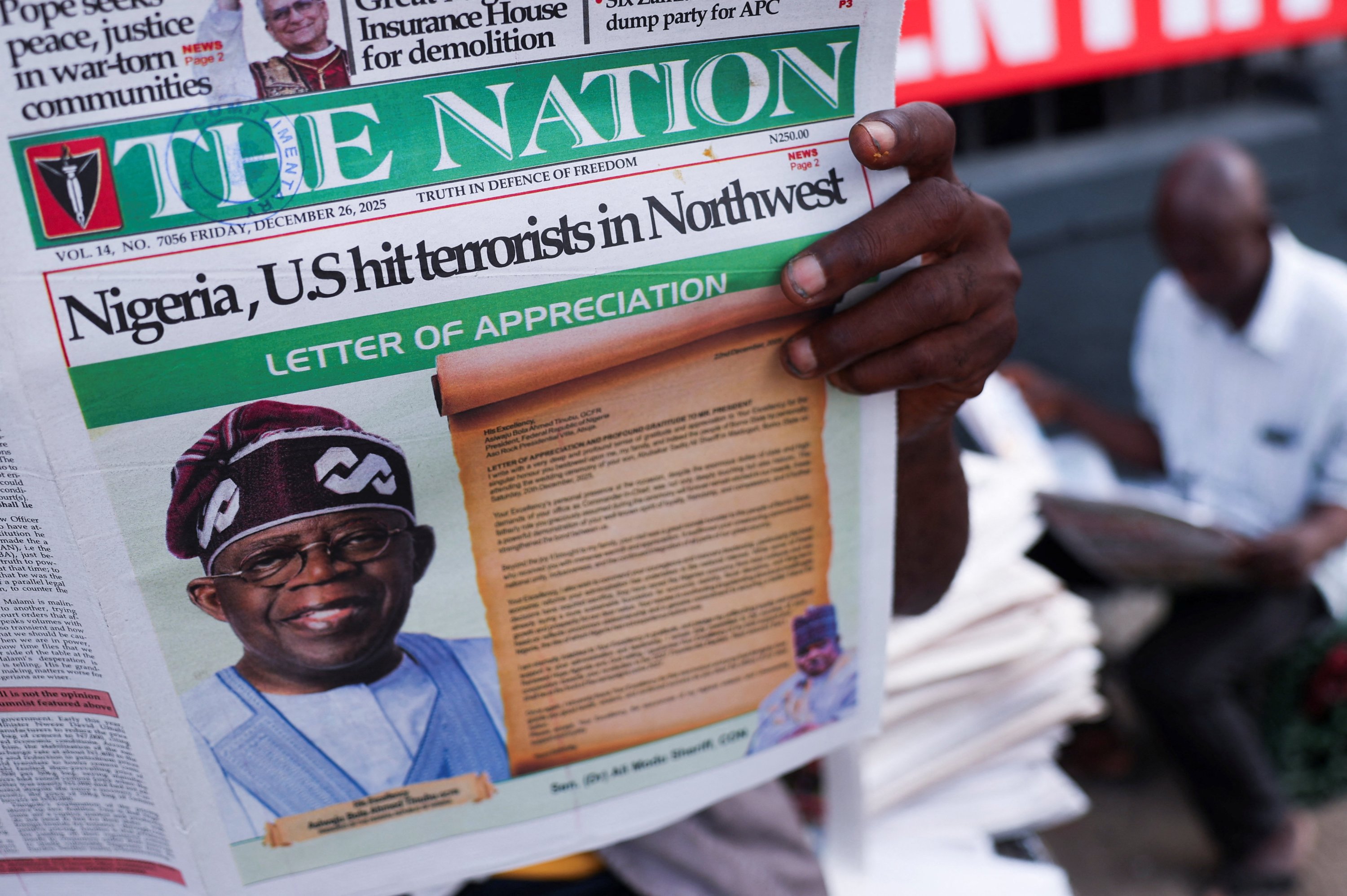
The United States carried out airstrikes against Daesh-linked terrorists in northwestern Nigeria, President Donald Trump said Thursday, marking a sharp escalation in U.S. involvement in a security crisis that has overwhelmed Africa’s most populous nation for years.
In a Christmas evening post on social media, Trump described the operation as a “powerful and deadly” strike against fighters he said were “targeting and viciously killing, primarily, innocent Christians.”
He offered no details on casualties or damage, and U.S. officials did not publicly identify the specific terrorist group targeted.
A Defense Department official, speaking on condition of anonymity because details had not been made public, said the strikes were carried out in coordination with Nigeria and approved by its government.
Nigeria’s Ministry of Foreign Affairs confirmed the cooperation, saying it involved intelligence sharing and strategic coordination “consistent with international law, mutual respect for sovereignty and shared commitments to regional and global security.”
The strikes reportedly hit targets in Sokoto state, part of Nigeria’s volatile northwest, where armed groups have expanded rapidly in recent years.
The Associated Press (AP) could not independently verify the impact of the operation.
Trump’s announcement followed weeks of public criticism of Nigeria’s government, which he has accused of failing to protect Christians.
Last month, he ordered the Pentagon to prepare options for possible military action in Nigeria.
The State Department has since announced visa restrictions for Nigerians and their family members implicated in killings of Christians, and the U.S. has designated Nigeria a “country of particular concern” under the International Religious Freedom Act.
Nigerian officials have pushed back against Trump’s framing, saying extremist violence has affected people of all faiths.
While Christians are predominant in the south and Muslims form a majority in the north, attacks across the country often target both communities.
“Terrorist violence in any form, whether directed at Christians, Muslims or other communities, remains an affront to Nigeria’s values and to international peace and security,” the Ministry of Foreign Affairs said.
Nigeria, home to about 220 million people, is battling a web of security threats that extend well beyond ideological extremism.
They include insurgencies, banditry, kidnappings, farmer-herder clashes driven by dwindling resources, communal rivalries, ethnic violence and secessionist movements.
Among the most dangerous groups are at least two affiliated with Daesh.
One is the Daesh West Africa Province, an offshoot of Boko Haram operating mainly in the northeast.
The other is a lesser-known faction in the northwest, known locally as Lakurawa and internationally as the Daesh Sahel Province.
Although U.S. and Nigerian officials did not specify which group was targeted, security analysts said the strikes likely hit Lakurawa fighters, who have grown increasingly lethal over the past year in border states such as Sokoto and Kebbi.
“Lakurawa is a group that is actually controlling territories in Nigeria, in Sokoto state and in other states like Kebbi,” said Malik Samuel, a Nigerian security researcher with Good Governance Africa. He said the group’s rise reflects the near absence of the state and security forces in rural hot spots.
According to Nigerian military officials, Lakurawa has roots in neighboring Niger and became more active in Nigeria’s border communities after a 2023 military coup in Niger strained cross-border cooperation.
Analysts say the group first appeared in northwest Nigeria around 2017, after being invited by some traditional leaders to help defend communities against bandits.
“They overstayed their welcome,” said James Barnett, an Africa researcher at the Hudson Institute.
He said the terrorists clashed with local leaders.
“Communities now openly say that Lakurawa are more oppressive and dangerous than the bandits they claimed to protect them from,” Samuel said.
The group has been linked to killings, kidnappings, rape and armed robbery, and controls swaths of territory connected by vast forests that allow fighters to move quickly by motorcycle.
Some attacks attributed locally to Lakurawa may also involve the Daesh Sahel Province, which researchers say has quietly expanded from Niger into northwestern Nigeria.
Nigeria’s security challenges, analysts say, are rooted as much in governance failures as in military capacity.
Conflict zones often coincide with extreme poverty, hunger and unemployment, creating fertile ground for recruitment by armed groups.
Former defense chief Christopher Musa has said military action accounts for only about 30% of what is needed to address the crisis, with the remaining 70% dependent on effective governance.
“The absence of the state in remote communities is making it easy for non-state actors to present themselves as the best alternative government,” Samuel said.
Nigeria’s military has intensified airstrikes and recruitment in states such as Sokoto, but analysts say operations are often sporadic and difficult to sustain. terrorists frequently relocate, hide among civilians or use hostages – including schoolchildren – as human shields, complicating aerial campaigns.
Against that backdrop, Thursday’s U.S. strikes were seen by analysts as a significant boost for Nigeria’s overstretched forces, even as Washington’s broader military footprint in Africa has shrunk in recent years.
Defense Secretary Pete Hegseth underscored the administration’s stance in a post on X late Thursday, writing that the president had been clear: “The killing of innocent Christians in Nigeria (and elsewhere) must end.” He added that U.S. forces are “always ready,” and concluded with a holiday sign-off: “Merry Christmas!”
Trump, meanwhile, said U.S. defense officials had carried out “numerous perfect strikes” and vowed that the United States “will not allow terrorism to prosper.”