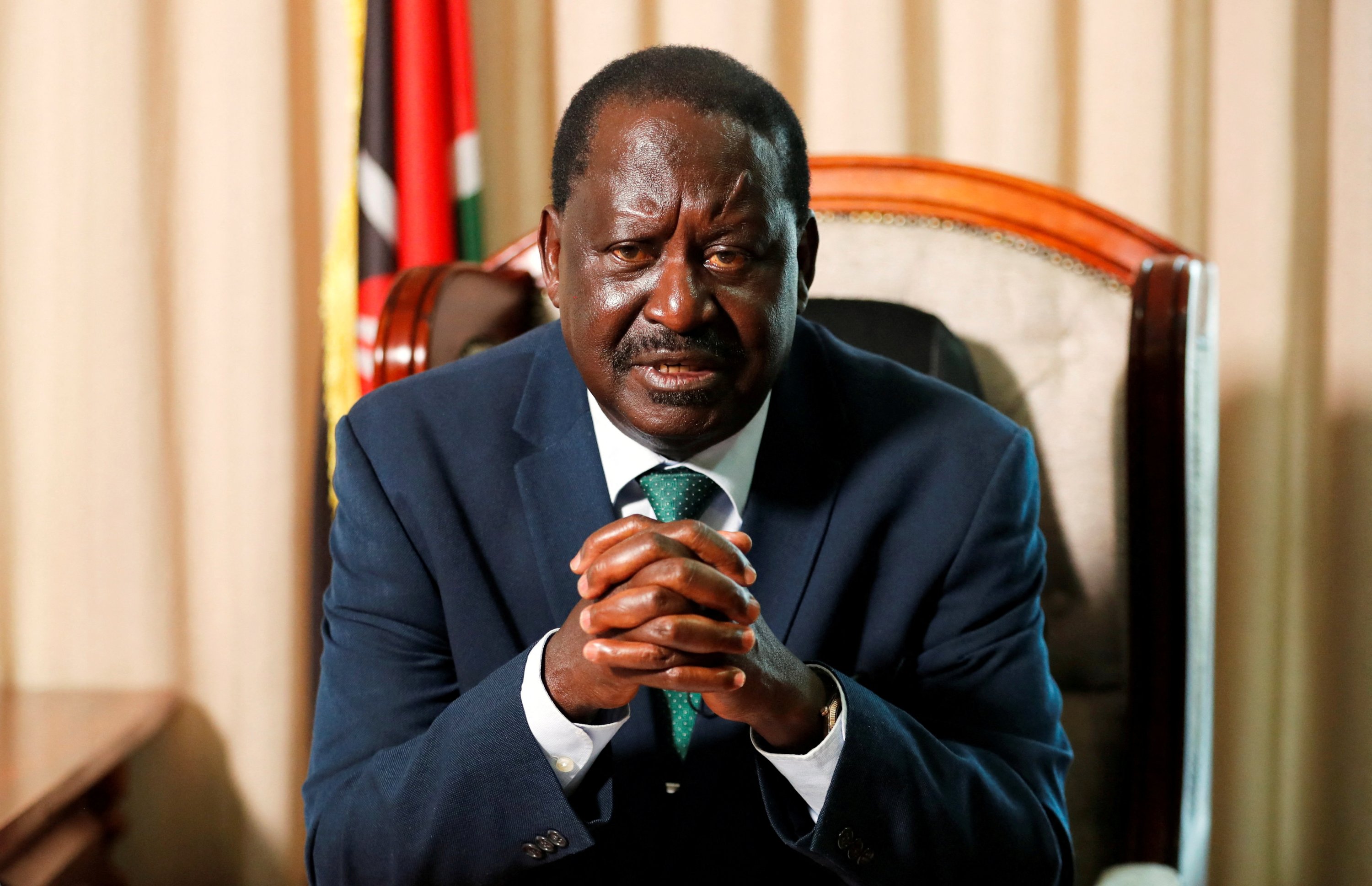
Kenya's longtime opposition leader, Raila Odinga, a prominent figure in national politics for over 30 years, has died at the age of 80, party officials and Indian media confirmed Wednesday.
Odinga had been receiving treatment in a hospital in India for several days.
Known affectionately by supporters as "Baba" (Father), his death prompted spontaneous gatherings in his home region in western Kenya and his former Nairobi constituency, with people waving green branches, a traditional symbol of mourning and respect.
Commentators on Kenyan television said his death marked the end of an era.
Odinga, leader of the center-left Orange Democratic Movement (ODM), ran unsuccessfully for the presidency five times, often blaming electoral fraud for his loss and was a staunch advocate for multiparty democracy in Kenya.
Born into the Luo ethnic group, Odinga studied in what was then East Germany and graduated with a degree in mechanical engineering from a university in Magdeburg.
After his return to Kenya in 1970, Odinga lectured at the University of Nairobi and established a company that manufactured liquid petroleum gas cylinders.
Odinga campaigned against the dictatorial regime of President Daniel arap Moi and was arrested several times in the 1980s.
On one occasion, he was held six years without trial and, he said, tortured because of his involvement in a plot to overthrow the president.
After losing a presidential election to Moi in 1997, Odinga allied with the president and served as energy minister from 2001 to 2002. He also served as public works minister under Moi's successor, Mwai Kibaki, from 2003 to 2005.
In 2007, when Odinga lost a presidential election to Kibaki, allegations of rigging unleashed a wave of ethnically based violence. About 1,200 people were killed and hundreds of thousands were displaced.
The U.N. brokered an agreement to form a coalition government and Odinga served as Kibaki's prime minister from 2008 to 2013, overseeing the adoption of a new constitution.
He lost elections two more times – in 2013 and 2017 – to Uhuru Kenyatta and then in 2022 to the current president, William Ruto.