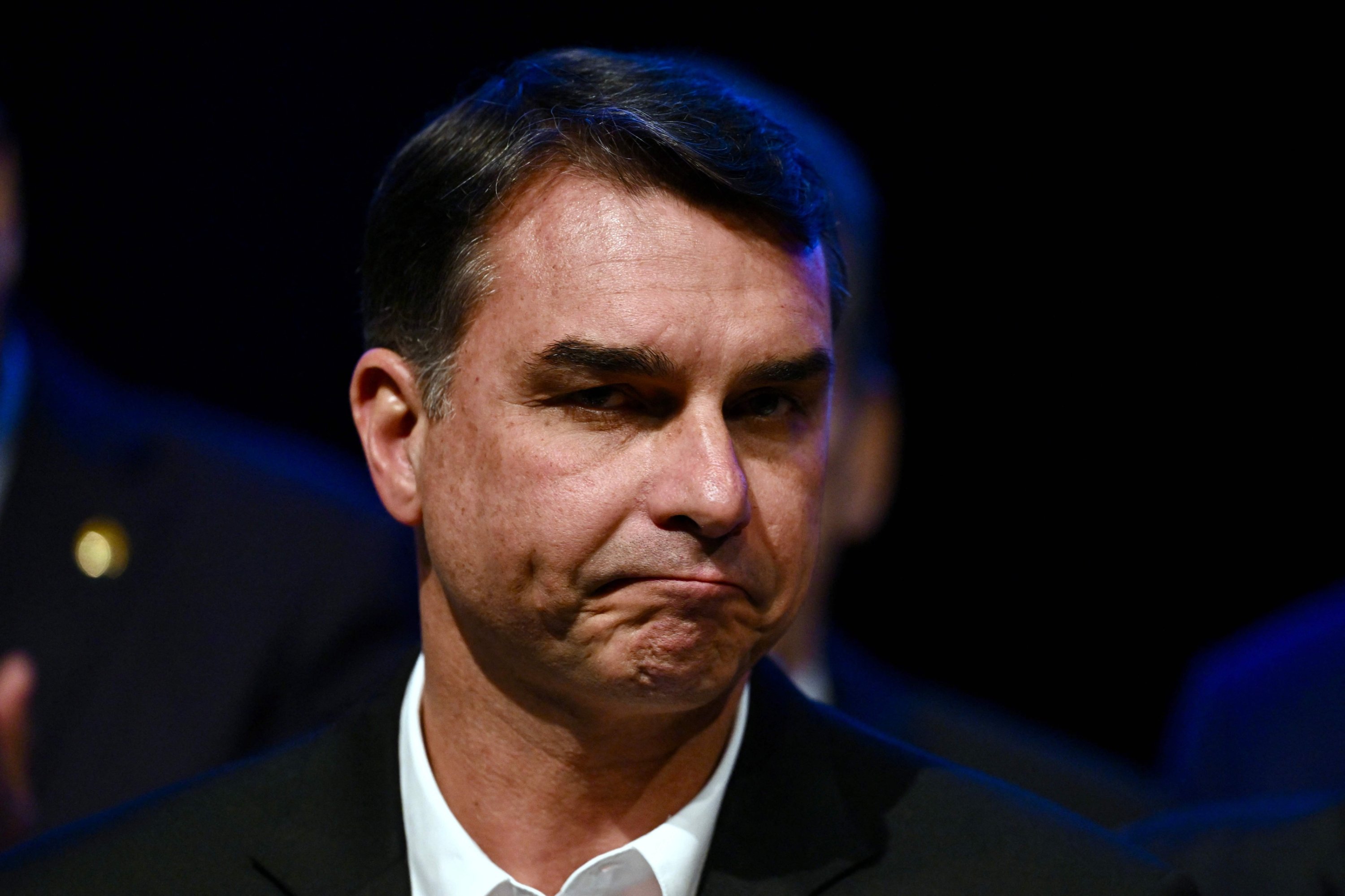
Brazilian presidential candidate Flavio Bolsonaro said Monday that a Supreme Court justice had prohibited him from traveling abroad, a day after his election defeat and refusal to acknowledge the result.
"I was served with an order to hand over my passports and I am also banned from leaving the country," the right-wing senator said, denouncing "a clear attempt to intimidate me."
The right-wing senator received 48.2% of the vote compared to 51.8% for incumbent Luiz Inacio Lula da Silva.
Bolsonaro, the son of jailed ex-leader Jair Bolsonaro, denounced "a clear attempt to intimidate me."
The senator is under investigation for alleged corruption and money laundering during the financing of a biopic about his father. He denies any wrongdoing.
The 45-year-old said the decision to seize his passport stems from a statement made by his brother, U.S.-based former lawmaker Eduardo Bolsonaro, that Flavio would have to leave Brazil if he lost the election.
"I never said that," the defeated candidate insisted in the Instagram video.
Bolsonaro reiterated that he would seek to annul the election, arguing that an extension of voting hours on Sunday favored Lula, despite having also requested the measure.
He also promised to lead the resistance to Lula's government, however.
"To withstand the chaos, I'm going to organize the opposition," Bolsonaro said.
At a news conference Sunday, Bolsonaro said he planned to request an annulment of the election following a chaotic extension of voting at the request of both candidates. However, it's unclear what legal avenue he would have to do that.
Early signs from Brazil's institutions and from leaders across the region, including conservative presidents who oppose Lula, suggest the results will be respected nationally and internationally.
Even with the vote extension, Lula's win was decisive. The soon-to-be 81-year-old incumbent won more than 64 million votes compared to just under 60 million for Bolsonaro, a margin of nearly 4%.
President of Brazil's electoral authority, Kassio Nunes, who was appointed to the Supreme Court by ex-president Jair Bolsonaro, was among those who recognized Lula's victory Sunday.
"This is a really uphill battle for Flavio Bolsonaro. Important Brazilian power brokers are closing ranks behind Lula, sometimes begrudgingly," said Brian Winter, Brazil analyst and editor-in-chief of Americas Quarterly.
"I sense that Brazilian power brokers that matter don't really want to go down the path of a truly contested election," he said.
The key to Lula's win was the additional 14.1 million voters who showed up for the second-round election, including those who voted for other candidates in the first round. Analysts say three-quarters of those votes went to Lula, handing him the victory. And notably, the first round set a record for the number of Brazilians who decided not to vote, while the second round had the least number of abstentions ever.