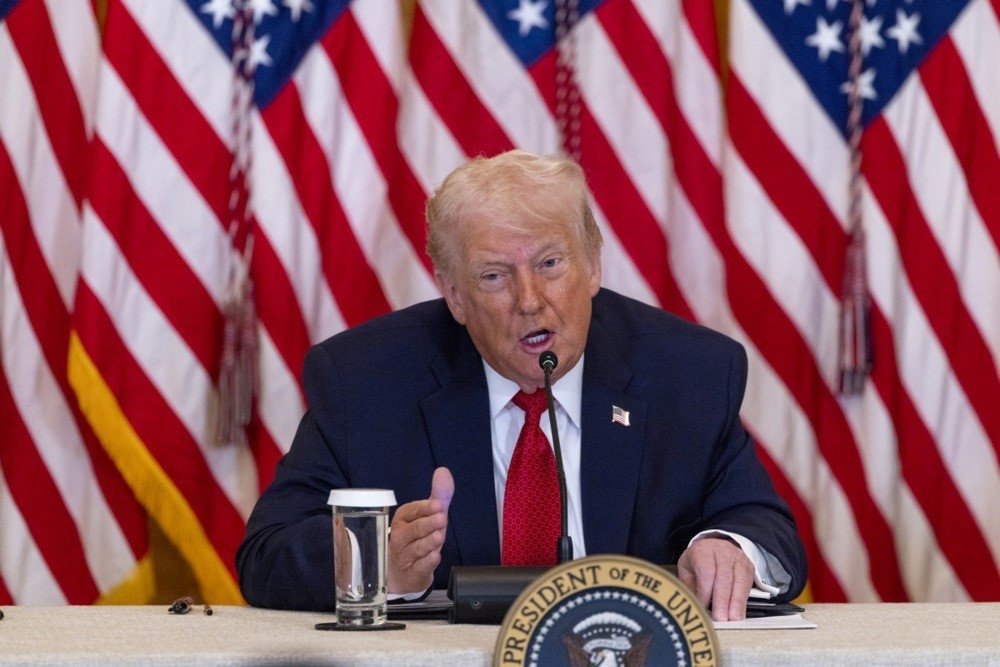
President Donald Trump on Tuesday marks his first year back in the White House after a shock-and-awe policy blitz that has expanded presidential power and reshaped America’s place in the world.
As he moves into his second year, Trump appears increasingly unbound, pressing an agenda that has deepened political and social divisions at home.
In recent weeks, he has ordered an intensified federal crackdown on illegal immigration in Minnesota that culminated in the fatal shooting of an unarmed woman by a federal agent, authorized a bold military operation in Venezuela aimed at capturing President Nicolas Maduro, revived his long-mooted proposal to take over Greenland, threatened military action against Iran, and brushed aside concerns over a criminal investigation involving Federal Reserve Chair Jerome Powell.
“I don’t care,” Trump told Reuters in an Oval Office interview last week when asked about the potential economic fallout from the probe into Powell. Speaking to The New York Times on Jan. 7, Trump said the only check on him as commander in chief when launching military strikes abroad was “my own morality.”
Taken together, Trump’s comments underscore a view of the presidency in which he is constrained chiefly by his own judgment rather than by institutional limits.
Anna Kelly, a White House spokeswoman, said Trump’s first instinct is diplomacy and that he makes decisions thoughtfully. But she added that he keeps all options on the table and decided to send U.S. military forces into Venezuela to capture Maduro and to bomb three Iranian nuclear facilities last year “after both failed to negotiate in a serious way.”
When Trump returned triumphantly to the White House on Jan. 20, 2025, for a second term, he vowed to remake the economy, the federal bureaucracy, immigration policy and much of U.S. cultural life. He has delivered on much of that agenda, becoming one of the most powerful presidents in modern U.S. history.
Like all U.S. presidents who cannot seek another term, Trump faces the almost inevitable waning of power in his second year. He remains a deeply unpopular figure, with a growing number of Americans unhappy with his handling of the economy and concerned about his priorities. But opinions remain sharply polarized, and he still enjoys substantial support among his core supporters.
Trump’s approval rating stands at 41%, according to a Reuters/Ipsos poll conducted last week, with 58% of U.S. adults disapproving of his job performance. The figure is low by historical standards but not the lowest of Trump’s second term.
“Trump’s total disregard for the rule of law or basic checks and balances has made Americans less safe across the board,” said Democratic strategist Alex Floyd, adding that voters could punish Republicans for what he described as “lawless behavior.”
In his interview with Reuters, Trump acknowledged Republicans were in danger of losing control of Congress in the November elections, noting that history does not favor the president’s party in midterms.
Earlier, he told a gathering of Republican lawmakers to fight to retain control or risk a newly empowered Democratic majority in the House impeaching him for a third time.
Asked by Reuters about voters’ concerns over high prices, the top issue ahead of the elections, Trump repeated his claim that the economy was the “strongest” in history, despite data showing stubbornly high inflation.
In recent weeks, Trump has tried to address cost-of-living concerns in speeches and other actions but has complicated that effort by simultaneously calling affordability a Democratic “hoax.”
In his first year back in the White House, Trump has cut the size of the federal civilian workforce, dismantled and closed government agencies, slashed humanitarian aid to foreign countries, ordered sweeping immigration raids and deportations, and deployed National Guard troops to Democratic-run cities.
He has also triggered trade wars by imposing tariffs on goods from most countries, passed a massive tax-and-spending-cut bill, prosecuted political enemies, restricted access to some vaccines, and attacked universities, law firms and media outlets.
Despite promising to end Russia’s war in Ukraine on his first day in office, Trump has made little progress toward a peace deal while asserting he has ended eight wars, a claim widely disputed given ongoing conflicts in several of those regions.
All modern presidents have sought to expand executive power, but Trump has done so at a pace rarely seen, historians and analysts say.
He has relied on executive orders and emergency declarations to shift decision-making away from Congress and toward the White House.
The conservative majority on the U.S. Supreme Court has largely sided with him, and the Republican-controlled Congress has done little to resist.
Unlike his first term, Trump now exercises total control over a Cabinet packed with loyalists.
Timothy Naftali, a presidential historian, said Trump has wielded power with fewer constraints in his second term than any president since Franklin D. Roosevelt.
In the early years of his 1933-45 presidency, Roosevelt enjoyed large congressional majorities that passed much of his domestic agenda with little resistance, strong public backing for his response to the Great Depression, and a fractured Republican opposition.
Analysts and party strategists say Trump’s difficulty convincing voters that he understands their struggles with high living costs could prompt some Republican lawmakers to distance themselves to protect their seats in November.
Aides say Trump will frequently travel this year to promote his economic agenda and try to persuade voters he has a plan to rein in prices, even though he is not on the ballot.
But his recent economic speeches have often been meandering and unfocused, and he has continued to devote much of his attention to foreign affairs, a lack of message discipline that alarms some Republican strategists and candidates.