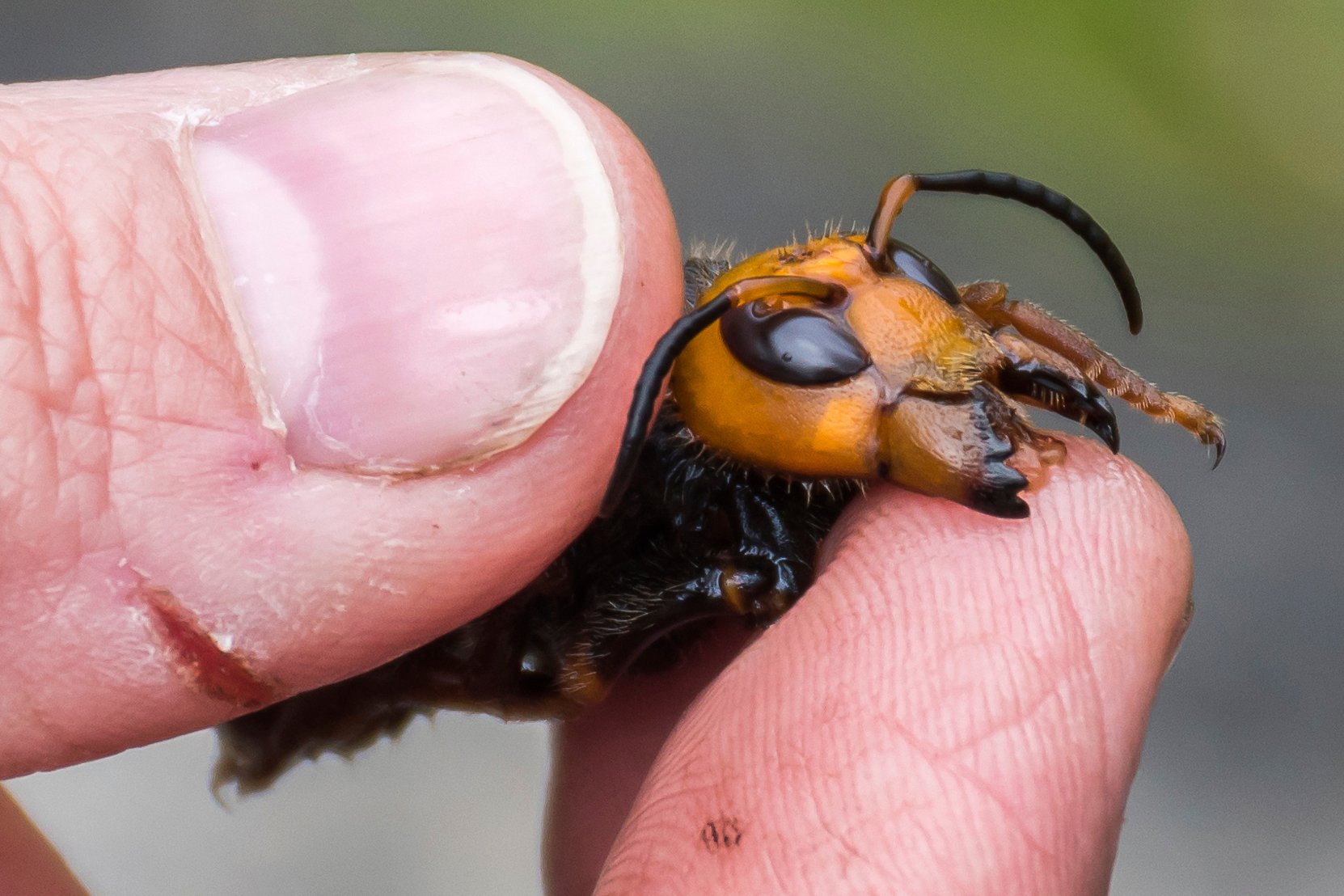
Insect experts say people should calm down about the big bug with the nickname "murder hornet" – unless you are a beekeeper or a honeybee.
The Asian giant hornets found in Washington state that grabbed headlines this week aren’t big killers of humans, although it does happen on rare occasions. But the world's largest hornets do decapitate entire hives of honeybees, and that crucial food pollinator is already in big trouble.
Numerous bug experts told The Associated Press that what they call hornet "hype" reminds them of the 1970s public scare when Africanized honeybees, nicknamed "killer bees,” started moving north from South America. While these more aggressive bees did make it up to Texas and the Southwest, they didn’t live up to the horror-movie moniker. However, they also do kill people in rare situations.
This time it’s hornets with the homicidal nickname, which bug experts want to ditch.
"They are not ‘murder hornets.’ They are just hornets,” said Washington Agriculture Department entomologist Chris Looney, who is working on the state's search for these large hornets.
The facts are, experts said, two dead hornets were found in Washington last December, a lone Canadian live nest was found and wiped out last September and no live hornets have yet been seen this year.
Looney has a message for Americans: These hornets are not coming to get you. "The number of people who are stung and have to seek medical attention is incredibly small," he said in an interview.
While its nickname exaggerates the human health threat, experts said this hornet is especially big – two inches long – so it does carry more and stronger toxins.
"It’s a really nasty sting for humans,” said the University of Georgia bee expert, Keith Delaplane. "It’s like the Africanized bee ... A dozen (stings) you are OK; 100 not so much.”
University of Illinois entomologist May Berenbaum said of the worry: "People are afraid of the wrong thing. The scariest insect out there are mosquitoes. People don’t think twice about them. If anyone’s a murder insect, it would be a mosquito.”
Mosquitoes are responsible for millions of yearly deaths worldwide from malaria, dengue fever and other diseases, according to the World Health Organization. Asian giant hornets at most kill a few dozen people a year and some experts said it's probably far less.
Hornet, wasp and bee stings kill on average 62 people a year in the U.S., according to the Centers for Disease Control and Prevention.
In Japan, Korea and China, "people have co-existed with this hornet for thousands of years,” said Doug Yanega, senior scientist at the University of California Riverside Entomology Research Museum.
Yet bug experts across the country are getting worried calls from people who wrongly think they saw the Asian hornet.
"This is 99% media hype and frankly I’m getting tired of it,” said the University of Delaware entomologist, Doug Tallamy. "Murder hornet? Please.”
Retired University of Montana bee expert Jerry Bromenshenk said in an email, "One nest, one individual hornet, hopefully, does not make an invasion ... Do we want this hornet – surely not. But the media hype is turbocharged.”
For bees and the people who rely on them for a living, this could be yet another massive problem, but it is not one yet.
The number of U.S. honeybees has been dropping for years, with the winter of 2018-19 one of the worst on record. That’s because of problems such as mites, diseases, pesticides and loss of food.
The new hornets would be different. If they get into a hive, they tear the heads off worker bees and the hive pretty much dies. Asian honeybees have defenses – they start buzzing, raising the temperature and cook the invading hornet to death – but honeybees in America don’t.
The worry for beekeeping in Washington is based on a worst-case scenario that officials have to take seriously, Looney said.
Yet even for bees, the invasive hornets are far down on the list of real threats, not as big a worry as the parasitic "zombie fly” because more of those have been seen in several states, Berenbaum said.
For people, the hornets are scary because the world is already frightened by the coronavirus and our innate fight-or-flight mechanisms are activated, putting people on edge, said risk expert David Ropeik, author of "How Risky Is It, Really?”
"This year is unbelievable in a horrible, horrible way. Why shouldn’t there be murder hornets?” Berenbaum said.