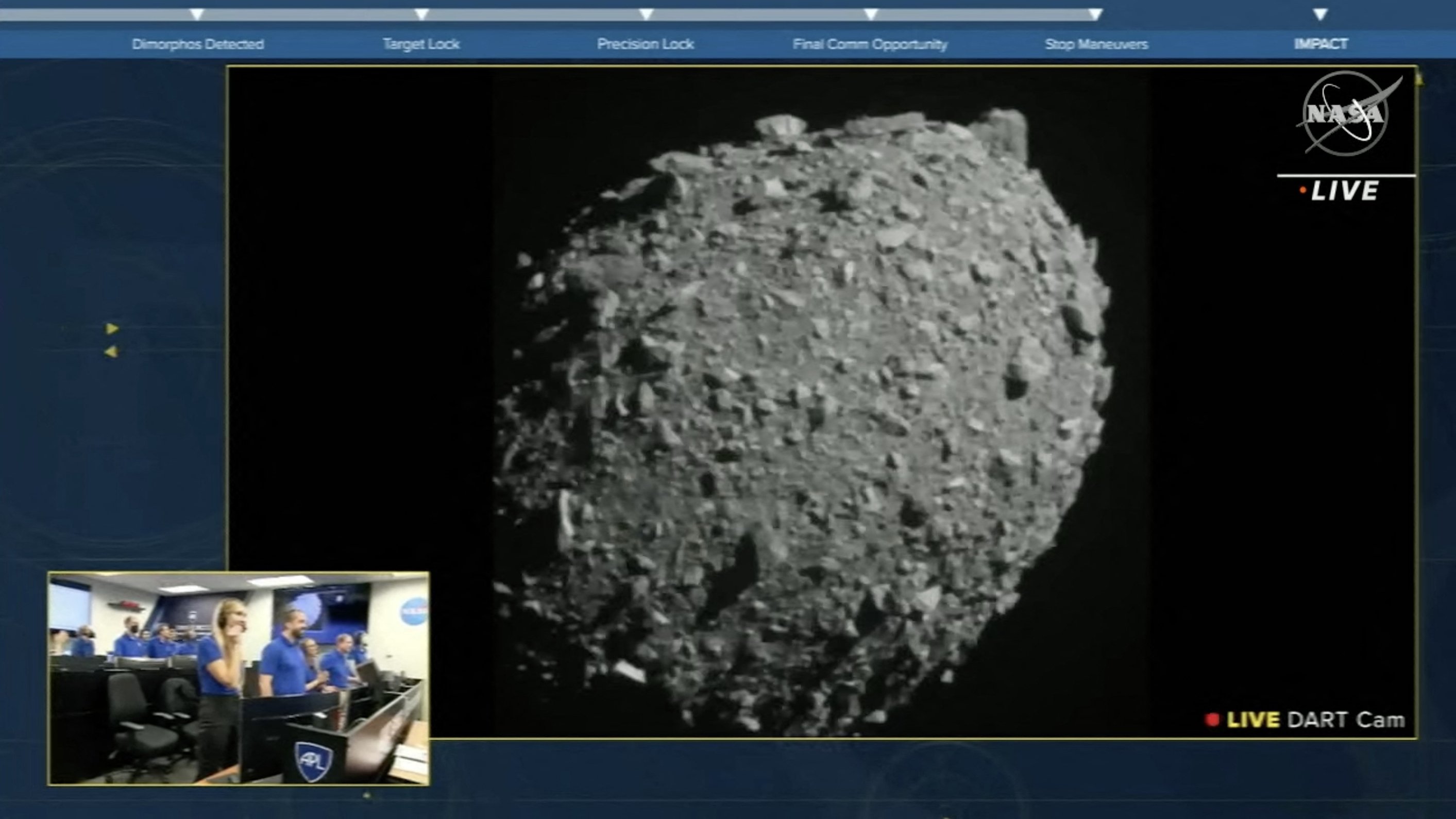
In a first-ever planetary defense test, NASA hit the bullseye Monday as it struck an asteroid 11.27 million kilometers (7 million miles) away in order to deflect its orbit.
The historic test adds to humanity's ability to prevent a celestial object from devastating life on Earth.
The Double Asteroid Redirection Test (DART) impactor hit its target, the space rock Dimorphos, at 7:14 p.m. Eastern Time (11:14 p.m. GMT), 10 months after blasting off from California on its pioneering mission.
"We're embarking on a new era, an era in which we potentially have the capability to protect ourselves from something like a dangerous hazardous asteroid impact," said Lori Glaze, director of NASA's planetary science division.
Dimorphos – a 160-meter (530 feett) asteroid roughly comparable in size to an Egyptian pyramid – orbits a half-mile-long big brother called Didymos. Never seen before, the "moonlet" appeared as a speck of light around an hour before the collision.
Its egg-like shape and craggy, boulder-dotted surface finally came into clear view in the last few minutes, as DART raced toward it at roughly 23,500 kph (14,500 mph).
NASA scientists and engineers erupted in applause as the screen froze on a final image, indicating that signal had been lost and impact had taken place.
To be sure, the pair of asteroids pose no threat to our planet as they loop the Sun every two of our years.
But NASA has deemed the experiment important to carry out before an actual need is discovered.
By striking Dimorphos head-on, NASA hopes to push it into a smaller orbit, shaving 10 minutes off the time it takes to encircle Didymos, which is currently 11 hours and 55 minutes.
Ground telescopes – which can't see the asteroid system directly but can detect a shift in patterns of light coming from it – should provide a definitive orbital period in the coming days and weeks.
The proof-of-concept has made a reality of what has before only been attempted in science fiction – notably in films such as "Armageddon" and "Don't Look Up."
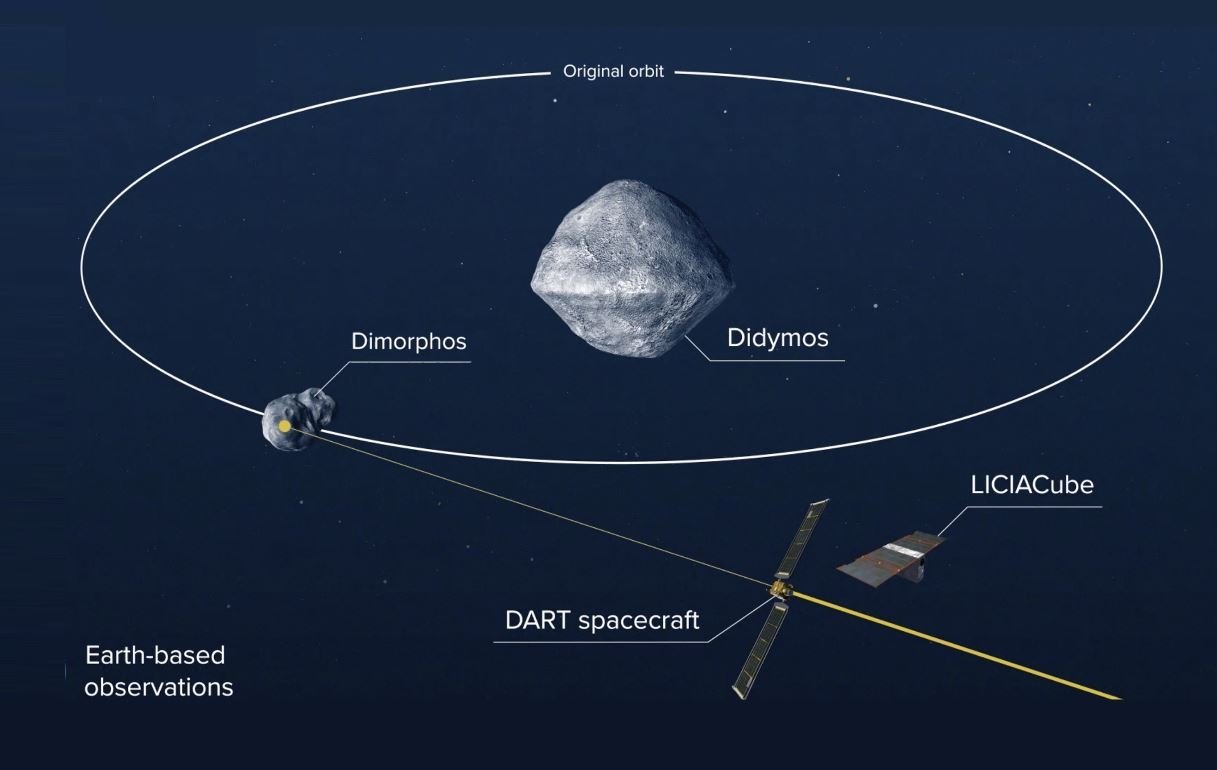
Minutes after impact, a toaster-sized satellite called LICIACube, which already separated from DART a few weeks ago, was expected to make a close pass of the site to capture images of the collision and the ejecta – the pulverized rock thrown off by the strike.
LICIACube's pictures will be sent back in the next weeks and months.
Also watching the event: an array of telescopes, both on Earth and in space – including the recently operational James Webb – which might be able to see a brightening cloud of dust.
The mission has set the global astronomy community abuzz, with more than three dozen ground telescopes participating, including optical, radio and radar.
"There's a lot of them, and it's incredibly exciting to have lost count," said DART mission planetary astronomer Christina Thomas.
Finally, a full picture of what the system looks like will be revealed when a European Space Agency mission four years down the line called Hera arrives to survey Dimorphos' surface and measure its mass, which scientists can currently only guess at.
Very few of the billions of asteroids and comets in our solar system are considered potentially hazardous to our planet, and none are expected in the next hundred years or so.
But wait long enough, and it will happen.
We know that from the geological record – for example, the 9.65-kilometer wide (6 miles) Chicxulub asteroid struck Earth 66 million years ago, plunging the world into a long winter that led to the mass extinction of the dinosaurs along with 75% of all species.
An asteroid the size of Dimorphos, by contrast, would only cause a regional impact, such as devastating a city, albeit with greater force than any nuclear bomb in history.
How much momentum DART imparts on Dimorphos will depend on whether the asteroid is solid rock, or more like a "rubbish pile" of boulders bound by mutual gravity – a property that's not yet known.
If it had missed, NASA would have another shot in two years' time, with the spaceship containing just enough fuel for another pass.
But its success marks the first step toward a world capable of defending itself from a future existential threat.
"I think Earthlings can sleep better, definitely I will," said DART mission systems engineer Elena Adams.