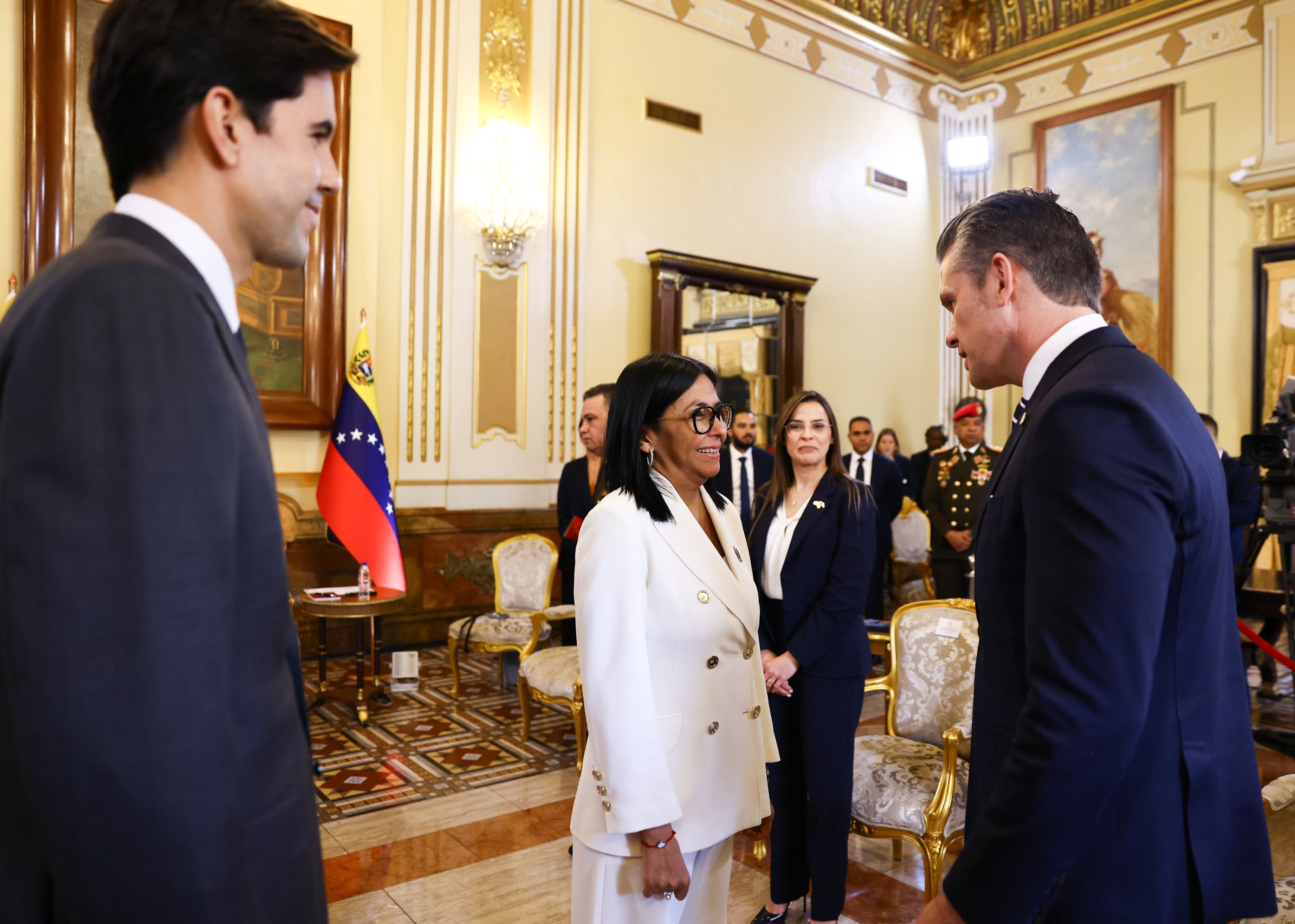
U.S. announced a military cooperation agreement with Venezuela Wednesday when Defense Secretary Pete Hegseth made a surprise visit to the country, his first since a U.S. special forces operations deposed President Nicolas Maduro in January.
Hegseth announced the agreement alongside Venezuelan acting President Delcy Rodriguez, who welcomed him to the presidential palace.
He said it covered joint training, intelligence sharing and other aspects of U.S.-Venezuelan military cooperation. Rodriguez said the arrangement would help confront "common threats" and strengthen training for Venezuela's armed forces.
Hegseth added that the partnership would herald a significant increase in joint action against drug trafficking groups.
"To the narco-terrorists who have used this as a safe haven, your time is up. We will hunt you down. We will find you. And we will kill you," Hegseth said from the U.S. embassy.
Washington already holds growing influence in Venezuela, particularly in the oil sector. Since Maduro's removal, U.S. officials have moved quickly to shape the country's future, focusing on energy policy and investment.
That role expanded sharply in August under a deal granting producer North American Blue Energy Partners, or NABEP, long-term access to 17 oilfields that contain about a fifth of the country's oil reserves through a partnership with the U.S. government. The United States secured a 35% stake in NABEP's parent, a guaranteed share of output and first refusal rights on the remainder.
Alejandro Betancourt, the Venezuelan businessman who controls NABEP and was central to the agreement, told reporters he discussed the progress of oil cooperation with Hegseth, adding that NABEP plans to produce more than 250,000 barrels per day (bpd) of oil by year end as it prepares to have 10 well clusters in service. That would be an increase from the 224,000 bpd it produced in mid-October, according to company figures.
Hegseth's trip to Venezuela came two weeks after voter anger over the Iran war helped drive an election defeat for U.S. President Donald Trump's Republican Party in Congress.
The unpopular, nearly nine-month-old conflict has driven up gasoline prices in the U.S. and around the world, as Iran fires at tankers passing through the Strait of Hormuz off its coast.
Hegseth, who has defended the Iran war as courageous, said the oil deal with Venezuela "makes the Strait of Hormuz a nonfactor for the Western Hemisphere."
Hegseth's Caracas stop came at the start of a trip to Latin America. Later Wednesday, he flew to Colombia to deliver military equipment and discuss security cooperation with Bogota.
Colombia's defense minister said Hegseth was due to hand over a Lockheed Martin Hercules C-130 aircraft and discuss U.S. support as Colombia battles drug trafficking groups and other illegal armed actors.
In August, Hegseth suggested the possibility of joint strikes on Colombian armed groups. The New York Times, however, reported Wednesday that Colombia's new right-wing President Abelardo De La Espriella rejected that plan because of a lack of votes in Congress.
A U.S. official, speaking to Reuters on condition of anonymity, confirmed concerns in Bogota about support in Congress. But the official did not say De La Espriella had rejected the plan outright.
Colombia's defense and foreign ministries referred questions to the president's office, which did not immediately reply to a request for comment.
Speaking alongside Hegseth, Colombian Foreign Minister Omar Bula said any decision by the executive branch in such circumstances would require congressional approval, adding that the government was confident it would secure lawmakers' backing.
"We cannot afford to waste time in the fight against crime," he said.
Bula also said De La Espriella had been clear about Colombia's sovereign position and that Hegseth understood the country's democratic institutions and internal decision-making processes.
Later Wednesday, De La Espriella denied The New York Times report, saying he had not rejected any proposal from U.S. President Donald Trump's administration and that Colombia's cooperation with the United States focused on strengthening its security forces rather than seeking foreign troops. He added that any deployment of foreign forces would require congressional approval.
The comments come as the Colombian Congress debates a tax reform bill that De La Espriella's government has struggled to advance, prompting the administration to soften the proposal to help secure its passage.
U.S. President Donald Trump's Latin America policy has expanded dramatically beyond its early focus on the Panama Canal. U.S. military strikes on suspected drug boats have killed more than 200 people since they began last year.
As he addressed a gathering at the embassy, Hegseth invoked a revamped Monroe Doctrine, the 19th-century policy asserting U.S. primacy across the Americas that critics associate with decades of U.S. intervention.
He called it the "Donroe Doctrine" – a play on U.S. President Donald Trump's name.
"That is the Donroe Doctrine. Venezuela has gone from our most aggressive regional threat to a compliant security partner on its way to rebuilding its military alongside the United States," Hegseth said.